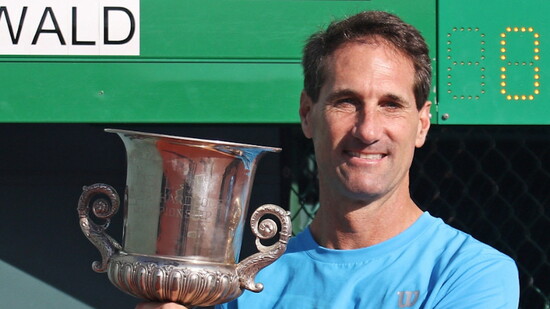
Youth sports in Fairfield County can be intense. There’s a ton of pressure on athletes to succeed, and their parents don’t always have the tools to help them process the mental load of that pressure. That’s where Jeff Greenwald steps in.
Jeff is a Staples graduate (class of 1984) who was a tennis star as a Wrecker—he won the FCIAC and Class LL championships individually, and as a team, plus a state title— and beyond, winning the U.S. 35-and-over national singles and doubles titles. He also was the world number one men’s 35 player with the International Tennis Federation. He knows firsthand what athletes struggle with mentally, which is why he went on to get a master’s degree in clinical psychology, focusing on sports psychology. “I was a hot-head as a kid,” Jeff tells Westport Lifestyle. “I was perfectionistic and angry.” While he was studying, he realized, “I started playing better. So much better than when I was on the pro tour.” The difference, he says, was a cognitive-behavioral approach—understanding the connections between thoughts, feelings, and behavior. “The primary problem people have is they’re uncertain about the future,” he explains. “So they worry about it, but they’re not focusing on what they have control over.” In his sports psychology practice, Jeff says, “I teach a mastery mindset: how do you focus on the things you care about, your values, and what you do have control over?”
Last year, hoping to bring his approach to more people, he published a book titled The Mental Edge for Young Athletes. The book is geared towards those participating in sport, but there’s much to be learned for the parents of these young athletes, too. (There’s a parent’s guide in the back of the book, in fact.) “Expectations have gone up. The expectations to achieve earlier have gone up,” he says. “And it’s hard to see your kids lose! The pressure cooker has gotten so much more intense. But it’s all about perspective. When your kid strikes out twice, and they’re upset, that’s an opportunity. They need to learn how to lose. We all need to.” He says that “normalizing their stress and the pressure” will help you connect with them, and them to understand themselves.
It goes without saying that Jeff’s mentality and mindset techniques aren’t just useful during competition. “The principles apply everywhere,” he says. “We all get anxious, but we can improve that by normalizing what our kids are feeling, validating it, empathizing, and being curious about what’s going on.” Mindfulness exercises like deep breathing can be hugely helpful, too. “These tools don’t have to stay in some little box,” explains Jeff. “The best thing you can do is remind your kids they can use them.”
The Mental Edge for Young Athletes is available on Amazon. To learn more about Jeff, visit mentaledgeforsports.com
“I teach a mastery mindset: how do you focus on what you do have control over?”