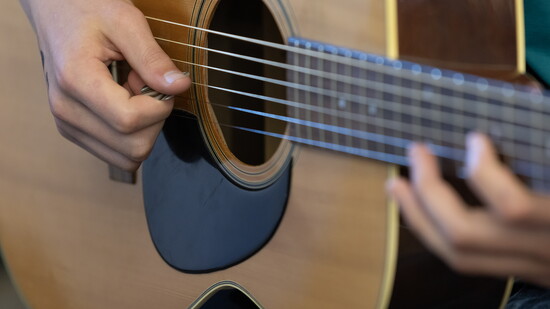
There’s a lot of science that shows the benefits of music lessons for kids. From increased brain function and cognitive development, to enhanced motor skills and pattern recognition, music can be an accelerant for a variety of nuts-and-bolts life skills.
You can read the studies and learn a lot, for sure. You can hear it straight from the people themselves who do this work day in and day out, who have made a life out of teaching music to kids, and you’ll probably learn plenty more; you might be surprised at the horizons music education can open up.
Ceci “Juni” Monroe and Matthew Nord—friends, bandmates, and fellow music educators—see music as a means of accessing all kinds of knowledge, well beyond the relatively simple act of placing notes in a sequence.
“Being that I work with youth of all ages and preschools a lot, I love how many things you can teach through music. It's just this great conduit,” says Matthew, owner of Nord Studios and Tangled Tones Music Studio, teaching artist and father of four. “You could teach about culture. You could teach about geography, math. You could teach about any subject through music.”
“I would say my program at Sussex is almost entirely integrated with other subjects,” says Ceci, who is the K-8 music teacher at Sussex School as well as having her own private studio. “I could teach fractions through rhythm. I could teach spelling or magic ‘e’ words and vowel sounds based on note reading. I could teach relationships between units of measurement, either through frequency and hertz, or through relationships between different chords in a key.
“The framework that I see for education, in general, is not siloed,” she says.
And if music can be a pathway to tangible skills, it can be an even greater medium for bringing kids to an understanding of deeper and often more ambiguous—but by no means less integral—life skills.
Music has all sorts of other lessons baked into the learning of it, lessons that might not seem so obvious on the surface of notes and scales.
“I think [learning music] is about learning oneself,” says Matthew. “For a lot of my students, I'm there realizing what their block is, a creative block or a confidence block or something that is keeping them from doing what they wanna do. It’s having somebody not feel like ‘I'm not good at this.’ Because I felt that so much growing up, and it's what kept me out of this for so long.
“I hope to teach anybody to be their own best teacher,” he continues. “A lot of that is just listening to intuition, listening to your heart.”
“It's an opportunity to explore, as Matthew said, freedom, flexibility, self-expression and play, as much as it is to be able to explore structure, solidity, and repetition and iteration,” Ceci says. “I think that's one of the biggest lessons that we all are constantly having to learn: the balance of flexibility and structure, whether it's relationally, whether it's inside ourselves, with other people, with the world. Music is inherently collaborative. There's so much connection and belonging that can be unlocked in just the simple act of active participation or active listening.”