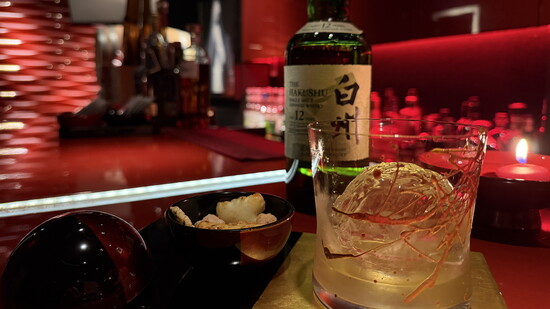
There was a time when Japanese whisky lived quietly—tucked behind the bar, known mostly to insiders, collectors, and those who had spent time in Tokyo.
That time has passed.
Today, Japanese whisky isn’t just popular—it’s permanent.
“It’s not a fad,” says Ed Kashiba of Takai by Kashiba in Bellevue. “It’s just… part of life now. Any place of note—it’s on the shelf. It’s earned its place.”
From approachable highballs to rare expressions like Yamazaki, Hakushu, and Hibiki, the category has evolved into something far more than a trend.
It has become a language.
Where It Began
The story of Japanese whisky begins with curiosity—and conviction.
Two pioneers traveled to Scotland to study the craft, then returned to Japan with something more than knowledge. They brought back a standard—one that would be interpreted through a distinctly Japanese lens.
What followed was both partnership and divergence. One path became Suntory, anchored near Kyoto at Yamazaki—where soft, pure water and a humid climate shape the spirit. The other became Nikka, founded in Hokkaido, where colder air and coastal influence create a different expression altogether.
“Japanese whisky was born as a partnership and grew up as a rivalry,” says Hill Harper. “But that tension wasn’t divisive—it was generative. It created a standard of excellence that continues to define the category today.”
That rivalry didn’t divide the category—it refined it.
It established identity. It elevated standards. And over time, it transformed Japan from a student of whisky into a global benchmark.
Precision, Craft, and the Japanese Way
At the core of Japanese whisky is something deeper than flavor.
It’s philosophy.
“What distinguishes Japanese whisky is its devotion to precision,” Harper says. “There’s an almost reverential attention to detail—from the source of the water to the way the spirit is aged and ultimately presented. It reflects a broader cultural commitment to doing things well, not just efficiently.”
Water matters. Climate matters. Even the wood matters—especially Mizunara oak, known for its unique character.
“But beyond the technical,” Harper adds, “there’s an intentionality—a sense that the experience has been considered from beginning to end. You don’t just taste it. You feel the care behind it.”
The result isn’t just smoothness.
It’s harmony.
A Finder’s Perspective
Spend enough time in Tokyo, and you begin to see it.
Not as a category—but as a quiet thread woven into the city.
In Tokyo, these whiskies reveal themselves quietly—placed with intention, never announced.
Unassuming, yet unmistakable to those who know.
No spotlight. No ceremony. Just presence.
That’s the beauty of it.
You don’t chase Japanese whisky in Tokyo.
You find it.
And when you do, it doesn’t feel like a drink.
It feels like a quiet invitation.
Scarcity, Status, and the Collector’s Mindset
In certain circles, the conversation deepens.
Someone mentions a bottle—Hibiki 30, Yamazaki 18—and attention sharpens.
“There’s a whole group of people who are just deeply into it,” Kashiba says with a smile. “It’s almost like Pokémon cards for adults—‘You’ve got that? I need to come in.’”
Scarcity plays its role. So does global demand.
Much of Japan’s production flows abroad, leaving the U.S. market competing for allocations.
And when a rare bottle appears?
It becomes a moment.
Whisky as Ritual, Memory, and Community
At its best, Japanese whisky isn’t about consumption.
It’s about connection.
“It’s celebratory,” Kashiba explains. “You’re with family, or friends, or you just closed a deal. You have a pour—and it brings you back. It’s a nostalgia thing.”
It turns a simple pour into something shared.
Something remembered.
Something you return to.
At the Table
Traditionally, Japanese cuisine leans toward sake, beer, or wine.
But whisky is finding its place—not as a replacement, but as a complement.
“Whisky can be a starter or a finisher,” Kashiba says. “Not necessarily with every course—but at the right moment, it’s perfect.”
At Takai by Kashiba, that moment comes at the end.
Hojicha ice cream and Yamazaki 12.
Warm. Toasted. Smooth.
“Nothing pairs better,” Kashiba says.
It’s the kind of pairing you don’t forget.
An Invitation
What’s happening with Japanese whisky right now isn’t just about what’s in the glass.
It’s about how we gather.
How we slow down.
How we choose to experience something—together.
Maybe it’s a night at Asa, where the setting invites conversation and discovery.
Maybe it’s a seat at Takai by Kashiba, where precision meets hospitality in a way that feels both elevated and deeply human.
Maybe it’s walking into a shop, asking a question, and leaving with a bottle that opens a new door.
Or maybe… it’s something more.
A trip to Japan.
A deeper curiosity.
A story that begins with a pour—and leads somewhere unexpected.
Because that’s the thing about Japanese whisky.
It doesn’t just stay in the glass.
It stays with you.
“And I think that’s why it resonates right now,” Harper says. “People are looking for experiences that feel intentional—something with meaning, something that invites you to slow down and be present. Japanese whisky, at its best, offers exactly that.”
Hojicha ice cream and Yamazaki 12—it’s the perfect finish. Warm, smooth, memorable. Another way Japanese whisky comes alive. Ed Kashiba
Japanese whisky captures the spirit of the moment—where precision, patience, and purpose come together. It’s more than what’s in the glass; it’s an experience that invites you to slow down and be present. Hill Harper