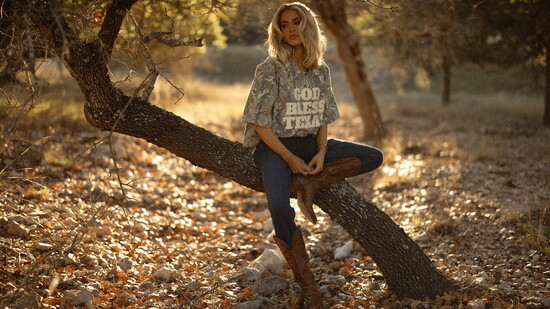
Triple E doesn't fit neatly into one category. It is a working ranch in the Texas Hill Country, the foundation of Triple E Mercantile, and increasingly, a framework for thinking about contemporary American life.
For Allie Eklund, those distinctions were never particularly important. The ranch wasn't conceived as an identity or a business. It was simply where she grew up. As she began sharing that life publicly, she noticed people responding less to the setting itself than to the values it quietly carried.
"I grew up thinking ranch life was normal," she says. "People weren't just interested in the land or the animals. They were drawn to what it represented."
That response altered the trajectory of Triple E. What began as family property expanded into a larger creative project rooted in craftsmanship, hospitality, and stewardship, ideas that have long existed on the ranch but increasingly resonate beyond it.
Rather than preserving an imagined version of the American West, Eklund is interested in the one that already exists. "It's important that it isn't treated like a costume or a moment in history," she says. "There are families, ranchers, entrepreneurs and communities living these values every day."
At a moment when provenance carries as much weight as the object itself, Triple E Mercantile reflects a broader shift in how value is assigned. The emphasis isn't on novelty but on origin, process, and permanence.
"Knowing who made something, understanding its story and trusting the people behind it creates a level of value that simply can't be manufactured."
Growing up in the Hill Country also shaped Eklund's understanding of tradition. She speaks about it less as something to preserve than something that remains relevant through continual use.
"The Hill Country taught me that tradition and innovation don't have to compete with each other," she says. "You can honor where you came from while still evolving."
That philosophy extends to the way Triple E is being built. Ranching, she says, teaches stewardship, a perspective measured over generations rather than seasons.
"You're constantly thinking beyond yourself, about the land, the animals and what you're leaving behind. We focus less on ourselves and more on creating something that feels meaningful, intentional and built to last."
The long-term ambition reflects that same pace. Eklund describes Triple E as an ecosystem that will continue expanding through hospitality, education, agriculture, retail, and shared experiences, all connected by the same underlying principles.
"It's never been just about products," she says. "The goal has always been to build spaces where people can come together."
Television and social media introduced audiences to Eklund. Triple E offers a more complete portrait, one where entrepreneurship, family history, and place converge into a single practice.
"Social media and television capture moments of my life. Triple E reflects the values that have shaped it."
Heritage, in Eklund's view, is not fixed. It gains relevance through participation.
"I believe heritage is something we continue to experience through the choices we make. The best traditions evolve."
Asked what she hopes Triple E represents a decade from now, Eklund describes atmosphere, rather than expansion. "I hope it becomes a place where people feel inspired, peaceful and connected. Connected to Texas, connected to each other and connected to something bigger than themselves."