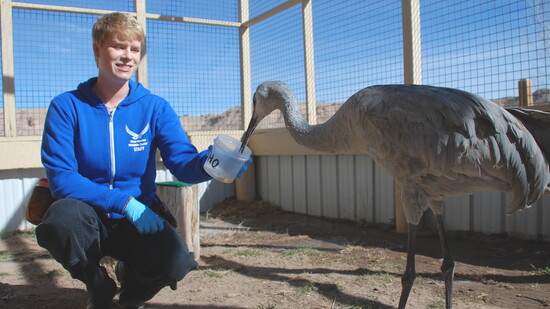
Through close-up encounters with Ambassador Animals, one nonprofit is turning environmental education into a lasting investment in the state’s natural heritage.
An hour north of Santa Fe, on a stretch of repurposed rodeo grounds in Española, Bubo the great horned owl fixes her gaze on a group of visiting students. In an instant, wildlife shifts from concept to connection. At the New Mexico Wildlife Center, that moment reminds students that this landscape — and its wildlife — belongs to them, too.
“We can’t ask a child to fix climate change,” says Anna Tobin, the Center’s Ambassador Animal Program Director and Education Director. “But we can give them something actionable.” The goal, she explains, is for everyone to leave with a sense of wonder—and a clear understanding of what they can realistically do to help. Tobin, who holds a Master of Science in Environmental Education and is one of only 117 Certified Professional Bird Trainers worldwide, has worked in wildlife conservation for over a decade. Her philosophy is simple: awe first, agency second.
Every education program—whether on the Española campus, in a state park, or at a school across New Mexico—is built around what she calls the “3C” model: conservation context, conservation status, and conservation call to action. Students don’t just meet animals; they leave understanding the threats wildlife face and tangible ways they can help—from resisting the urge to handle injured wildlife and instead calling the Center, to promoting pesticide-free yards and driving carefully to reduce wildlife collisions.
The Power of Ambassador Animals
At the heart of those programs are more than 30 wild, non-releasable Ambassador Animals who help tell the stories of their species. “You never know what is going to be that spark animal, or that spark moment,” Tobin says. She’s seen visitors return years later—even crossing state lines—still remembering falcon facts and the animal that changed how they see the world. A gray fox arrived as a mistaken “chihuahua puppy,” kept illegally by a resident before being turned over to the Center. Today, Juniper teaches a different lesson: wild animals don’t belong in living rooms.
Phoenix, an aplomado falcon, represents something even larger. His species has been extirpated from New Mexico since the late 1930s—meaning it no longer exists here, though it survives elsewhere. “If I just say, ‘Aplomado Falcons are extinct here,’ people ask, ‘What’s an Aplomado Falcon?’” Tobin explains. “But when you bring Phoenix out and tell his story, people connect.” Non-releasable doesn’t automatically mean ambassador, though; animals must be suited for public interaction and high-quality life in human care. “Welfare of the animals has to come first,” Tobin says.
It’s a philosophy reflected across the organization. Executive Director Matthew Miller leads what Tobin describes as a “small but mighty” team of 14, including a full-time veterinarian—a distinction few wildlife rescue centers can claim—and a fully staffed hospital department. Tobin’s team includes Education Coordinator Beth Thompson and animal care specialists Amanda and Sidney, whose expertise spans species-specific training and care.
A New Campus for Conservation
Celebrating its 40th anniversary, the New Mexico Wildlife Center is preparing for its most ambitious investment yet: a multi-phase Capital Campaign to build a purpose-designed wildlife hospital and education campus. Estimated at $15–20 million over the next decade, the project would create the first purpose-built wildlife hospital in New Mexico, along with expanded ambassador habitats, classrooms, and a raptor flight arena. “This is a rocket that’s about to take off,” Tobin says. The campaign comes at a pivotal moment. As federal conservation budgets shrink, the Center has stepped into new roles, collaborating on the State Wildlife Action Plan and preparing to welcome two black-footed ferrets—one of North America’s most remarkable comeback species—as the first ambassadors of their kind in New Mexico. But bricks and mortar are only part of the story. “You can do all the research and rehabilitation in the world,” Tobin says, “but if you’re not teaching people how to live with wildlife correctly, it would all be for naught.”
In Española, investment isn’t defined by dollars raised or buildings planned. It’s found in a child’s first encounter with a fox, a falcon representing the story of a lost grassland, a moment that may ignite a lifetime of advocacy. And in a state that ranks among the most biodiverse in the country, that may be the most valuable return of all.
The New Mexico Wildlife Center is at 19 Wheat Street, Española, NM. Their website is www.newmexicowildlifecenter.org.
You can do all the research and rehabilitation in the world, but if you’re not teaching people how to live with wildlife correctly, it would all be for naught.