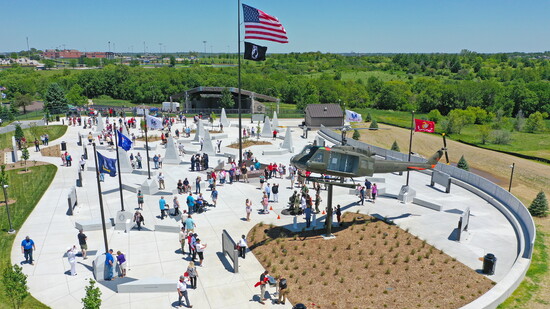
The City of Papillion has taken many steps to ensure its military community is honored. Through monuments, memorials and more, it has become part of the Purple Heart Trail.
Though not a continuous route, the Purple Heart Trail is a symbolic system of roads, highways, bridges and communities honoring service members who were wounded or killed as a result of enemy action.
For Papillion’s Mike Neuzil, receiving the Purple Heart during the Vietnam War felt almost unceremonious at the time.
“Some general came to me and said, ‘Here’s your Purple Heart,’” he says with a slight chuckle. “That’s about it, because they were so common.”
Common, however, does not mean the sacrifice was small. Neuzil remembers American units around him losing men regularly, with companies often operating with fewer than 100 men. He himself received two Purple Hearts after being wounded twice during his six months in Vietnam.
Decades later, another Papillion veteran would receive the same medal quite differently.
“Receiving that award, it made everything real,” Iraq veteran Mike Simmons says.
Separated by generations and different wars, the two men now share another connection: Papillion is a Purple Heart City.
The city received the designation on Veterans Day, Nov. 11, 2023, and became part of the Purple Heart Trail, a national network established by the Military Order of the Purple Heart in 1992.
In and around Papillion, that remembrance is visible at Veterans Park, Omaha National Cemetery, the Nebraska Vietnam Veterans Memorial and Honor and Remember’s Nebraska Memorial Forest at Prairie Queen Recreation Area.
“Papillion is a strong military community, and it’s important to us that we show our appreciation to our service members who have been wounded or lost in combat,” Mayor David Black says. “Their sacrifice in protecting our nation is what allows our community to live at peace and enjoy a high quality of life. We want to ensure they are not forgotten.”
Originally from the Chicago area, Neuzil was attending college and newly married as the Vietnam War intensified. He knew being drafted was possible.
“If I get drafted, I get drafted,” he recalls saying.
He entered the Army, completed infantry training and was sent to Vietnam. As an infantryman, life meant moving through rice paddies and jungle, sleeping in the field and remaining constantly alert.
“One of two things would happen: I’d get killed or I’d get wounded,” Neuzil says.
Neuzil earned two Purple Hearts. One came after he was wounded while his unit moved along a narrow trail. Neuzil was near the front when something caught his attention—perhaps a reflection or maybe the moon cresting a nearby hill. As he paused, another soldier moved past him and stepped on a booby trap.
The explosion threw Neuzil and his equipment to the ground. The other soldier did not survive. Neuzil was wounded, and an infection from the injury eventually took him out of the field.
His other Purple Heart came after he was shot in the arm during fighting near Hue. Neither experience left him with hatred for the soldiers on the other side.
“You didn’t hate those guys, you felt sorry for them,” Neuzil says. “But yet it was war.”
After returning home, Neuzil went back to school, earned a master’s degree in forestry and eventually moved to Papillion around 1972, working as a civilian at nearby Offutt Air Force Base before eventually joining the Papillion Parks Department. His homecoming, however, came during an era when Vietnam veterans did not always receive gratitude for their service.
Through it all, Neuzil says his own feeling remained one of pride.
“You are still proud,” he says. “You got to serve your country.”
That makes the recognition he sees today meaningful in more ways than one.
While Neuzil was serving in Vietnam, he and his wife lost their daughter, Mary Margaret. Years later, he was able to have her moved to Omaha National Cemetery, one of the places now connecting the Papillion area to the Purple Heart Trail.
“I think it’s wonderful,” Neuzil says of the memorials and the people who visit them. “The more we could do for the guys who were there and the guys we lost—that’s who you want to honor, not us.”
Simmons’ story begins decades later.
A 2007 Papillion-La Vista High School graduate, Simmons entered the Army Reserve in 2008 and deployed to Iraq the following year. His unit worked with Iraqi police stations and conducted patrols and other missions.
On Feb. 14, 2010, Simmons was returning from a mission when his convoy was struck by an improvised explosive device.
“Shortly after, that’s all I remember,” Simmons says.
He remained in Iraq for about two weeks before being medically evacuated, eventually receiving treatment in Germany and at Fort Riley, Kansas. The blast left him with a traumatic brain injury and other lasting injuries, many of which were not immediately visible.
When Simmons learned he would receive the Purple Heart, he initially questioned whether he should.
“I didn’t think I needed it,” he says. “So when they said I was going to get the Purple Heart, I said, ‘For what?’”
Receiving it changed his perspective.
“It just means that now I am a part of a small group of military veterans that we have our own niche now,” Simmons says. “Not a lot of veterans have a Purple Heart.”
Simmons has worked for the City of Papillion Parks Department since 2013. He also serves as vice president of the Veterans Resource Network, helping connect veterans with assistance, and speaks to students about his military experience.
When he visits schools, Simmons carries a small bag of items from his deployment. Among them is a G.I. Joe figure he found at Fort Dix, New Jersey, shortly before leaving for deployment. Students can hold the objects and ask questions, turning a distant war into something tangible.
For Simmons, Papillion’s Purple Heart City status is another visible form of that recognition.
“To be a Purple Heart City, it’s pretty phenomenal, and it’s pretty special,” he says.
For Neuzil, public recognition comes after a war and homecoming that often left veterans feeling overlooked. For Simmons, the designation recognizes a comparatively small community whose wounds are not always visible.
Their wars were different. Their wounds were different. Their experiences returning home were different. Along Papillion’s place on the Purple Heart Trail, their stories now share the same purpose: remembrance.
“Papillion is a strong military community, and it’s important to us that we show our appreciation to our service members who have been wounded or lost in combat" - Mayor David Black