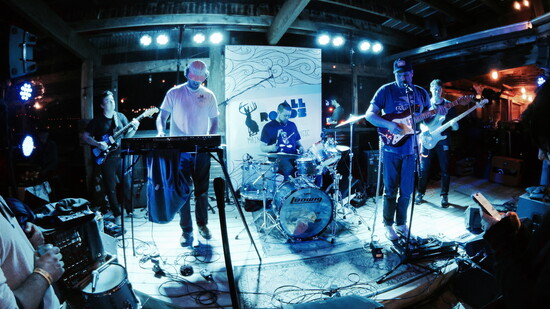
In 2015, when Josh Gass and his co-founder Meg Shorette launched what would become the All Roads Music Festival, there wasn’t a master plan for an 11-year run, an expansion into Portland, or a brand recognized across Maine’s music community. There was simply an opportunity and a belief that local music deserved a bigger stage.
“Meg and I started the festival in 2015,” Gass recalls. At the time, the pair had been working on another Bangor-area event that was winding down when a group in Belfast approached them. The community had grown attached to a spring festival called Free Range, and when it ended, there was a void. “They asked us if we’d be interested in bringing something to replace that festival,” he says. All Roads was born that May in Belfast, modeled loosely on the footprint of its predecessor but reimagined with a sharper focus. “We sort of turned it into a festival that really highlighted local music and really made it about featuring some of the best artists working in the state at any given time,” Gass says. The first year featured roughly 15 acts in an intimate, exploratory experience that required a leap of faith. “People didn’t really know what to expect,” he says. The tone was set quickly that this would be a festival built around artists, not just headliners. Over the next decade, it grew to more than 30 performers across multiple venues and days in Belfast, with this year marking a significant expansion into Portland.
While the footprint has grown, the mission hasn’t drifted far from its roots. If anything, it has been clarified. For Gass, investing in a music scene isn’t primarily about money, it’s about creating space. He remembers the first year vividly, especially a makeshift artist lounge next to Belfast’s Colonial Theatre. “Artists are coming in and hanging out, and every time there’s a new artist arriving, everybody in the lounge is so excited to see them,” he says.
What they stumbled upon was something intangible but powerful: connection. “So many of these musicians know each other,” he explains. “But what they don’t have is shared time to be in the same space at the same time—not only just sharing a bill, but literally having an opportunity to hang out and watch each other perform.” That shared time became one of the festival’s greatest returns on investment. Artists began to see All Roads not just as a gig, but as a gathering. “It ended up becoming one of the most driving forces behind the success of the festival,” Gass says. And when artists are energized, audiences benefit. “Because the artists are having such a great time… their performances are great,” he says. “The audiences win too.”
The curation of the festival is constant and deliberate. Throughout the year, the team pays attention to who is performing, who is touring, and who is quietly building momentum. Artists can reach out directly, but Gass offers simple advice: “The best thing that you can be doing right now is just performing and doing your thing, because we are actively looking for that.” Importantly, filling a 500-capacity room isn’t the metric. “We are just looking for artists that turn our heads that are out there doing work and showing themselves off,” he says.
Over the years, that approach has allowed artists to grow within the festival itself, starting on smaller stages and graduating to headlining slots. Gass points to the rock band Rigometrics, which moved from an opening-party set to headlining within a few years. “We are so happy to be a part of supporting them as they are on their journey,” he says. That kind of longitudinal support reflects a deeper investment philosophy to create platforms that evolve alongside the artists who use them.
The decision to expand into Portland was a natural next step. While Belfast has served as a travel-in showcase, Portland is undeniably the heart of Maine’s music scene. “It’s where the vast majority of the artists that we deal with are based,” Gass notes. Still, growth comes with careful guardrails. The Portland edition may include larger national acts, but the internal mandate to keep local representation strong remains clear. “It was extremely important to us that we… made sure that we gave opportunities for some of these local artists to be on main stages next to nationally touring artists,” Gass says..
Risk, of course, is inherent in any festival. “Festivals are always a risk because you don’t fully know what you’re going to end up with on the other end of it,” Gass says. “You’re telling everybody to come to this big party basically like, trust us, it’s going to be a great time.” The initial financial investment was small, but the personal leap was significant. “It was a big risk for us to say, ‘Hey, let’s try this out and see what happens,’” he says.
What happened was a community responding. Maine’s longstanding “buy local” ethos extends naturally into the arts, and All Roads tapped into that. Gass recalls a moment from the first year that crystallized the festival’s spirit: an older woman in her late seventies or eighties lining up to see a hip-hop set. She tapped his festival badge and told him it would be her first rap performance ever. “Only in the right kind of community can you find that,” he says. That willingness to try something new, to trust the curators, and to support neighbors is perhaps Maine’s greatest cultural asset.
Beyond the festival itself, Gass points to organizations like the Maine Music Alliance, which advocates for independent venues and artists, particularly in the wake of pandemic-era challenges. He also highlights emerging initiatives such as LEAF, a One Longfellow Square-supported program offering workshops and professional development for young artists. Support, he emphasizes, must be ongoing and organized. “We need to continue to look at different ways for artists and venues… to come together and connect,” he says.
When asked what feels like the most meaningful return on his own investment over the past decade, Gass doesn’t cite ticket numbers or growth metrics. Instead, he describes fans who mark the festival on their calendars every year, who travel to attend, who recount favorite performances from years past. “Seeing that excitement on either an audience member or artist's face… it makes me feel like, okay, we’re doing something that I can feel proud of at the end of the day,” he says.
In an issue devoted to investment, All Roads offers a reminder that not every return fits neatly on a balance sheet. Sometimes the yield is cultural—a stronger creative network, a risk taken on a new sound, a shared weekend that reminds a community who it is. What began as a small spring experiment in Belfast has grown into something more enduring: a festival that doesn’t just showcase Maine’s music scene, but actively invests in keeping it alive.
“Seeing that excitement on an audience member or artist's face… it makes me feel like we’re doing something I can feel proud of.”
Save the Date: All Roads 2026
All Roads Music Festival expands in 2026 with two distinct Maine experiences. The inaugural Portland edition takes place May 15–16, bringing nationally touring headliners and a strong lineup of local artists to multiple venues across the Arts District. The beloved Belfast festival shifts to a fall showcase, happening October 16–17, and will continue its tradition of spotlighting predominantly Maine-based musicians in an intimate, travel-in weekend format.
Both festivals maintain All Roads’ artist-forward approach, placing emerging local acts alongside established performers and encouraging discovery across genres. Lineups, ticket details, and artist submissions can be found at allroadsmusicfest.com.