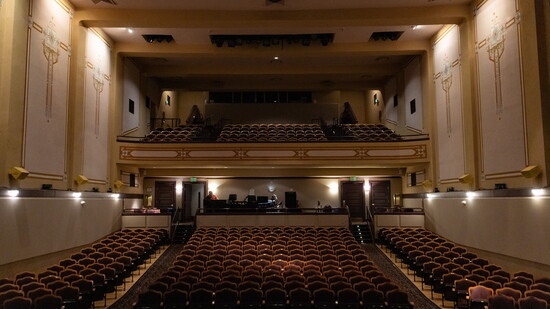
“Places, people!”
A stage manager, poised with authority, instructs performers and crew to get settled in their opening positions right before a theater show begins.
It’s a beloved phrase that’s likely been called out time and time again over the years at the City of Loveland’s Rialto Theater, a legacy business and staple of the arts and entertainment culture in downtown Loveland.
“Cultural institutions are often a point of pride for people who live in that community,” says Joe Patti, the Rialto Theater’s manager. “Having the museum, having the public art, having the theater is the type of thing that draws employers to communities like Loveland because there is that quality of life.”
“The theater is actually part of the City of Loveland’s cultural services,” he continues. “So, there is obviously a focus on serving the citizens.”
Intentional about its programming, the Rialto Theater staff aims to provide a wide range of experiences that appeal to different audiences. For instance, the theater hosts a mix of themed events in conjunction with the Loveland Museum, including Day of the Dead programming, a manga exhibit, and a Hawaiian artist, to name a few.
Aside from hosting various performances and workshops, the Rialto Theater serves as a resource to the community through rentals. The theater is rented out for shows, celebrations of life and other community events, concerts, showcases, movie screenings, and more.
With a history that spans more than a century in Loveland, the Rialto Theater actually opened its doors as a silent movie theater on May 26, 1920. For its opening day, the theater featured the silent film “Riders of the Dawn” based on Zane Grey’s “The Desert of Wheat” novel and the comedy “Dew Drop Inn” as second billing. Designed by architect Robert K. Fuller and built by Bank of Loveland president William C. Vorreiter, construction for the Rialto Theater started in 1919.
When it first opened, the theater could seat 1,014 people. The Rialto Theater also boasted a large enough seating area and stage to accommodate traveling vaudeville shows and meeting spaces for graduations and recitals.
In 1935, Gibraltar Enterprises, Inc. obtained ownership of the Rialto, shifting from silent films to movies with audible dialogue. Additionally, the theater underwent its first renovation, swapping out wooden benches for 700 upholstered chairs and installing a cooling system and new chandeliers. Gibraltar hired Ted Thompson as the theater manager around this time.
In 1977, the theater hosted its last screening as a movie theater, airing Disney’s “The Rescuers.” The Rialto was then converted into a retail mall and eventually shuttered. In 1987, Loveland’s Downtown Authority Development purchased the building, and the restoration process began in 1989 with the help of volunteers. In between this, the Rialto Theater was placed on the National Register of Historic Places in 1988, the same year the downtown authority handed theater operations over to the City of Loveland.
Today, the Rialto Theater can seat around 450 people and has additional ADA-compliant seating. It’s furnished with state-of-the-art light and sound equipment and modern dressing rooms for performers and backed by a team of over 100 volunteers.
While the Rialto Theater has undergone a few makeovers over the years, its ultimate mission has remained the same from when it first opened: to offer programming that connects with the community.
“The first thought is, is this something that will stimulate and connect with the community, serve the needs of the community, offer a good time with family and friends, or create a moment of silence and reflection, or provide learning and education?” Joe reflects. “That is the driving motivation.”
The City of Loveland is not only investing in its local residents and artists through theater programming, but it’s also investing in upgrading the Rialto Theater as well.
Due to construction in downtown Loveland, the freestanding marquee had to be taken down. However, staff are working on setting up a digital marquee in early to late fall of this year if possible, according to Joe. Down the line, they are also considering upgrading the technology in the reception area to install more theatrical lighting on a grid that can be used more frequently and easily for performances.
Progress has already been made in upgrading the Rialto Theater this year. In February, a replica of the original neon Rialto sign was hung up on the back side of the theater’s building, just in time for Loveland’s Sweetheart Festival.
Looking ahead this year, the movie series and summer concerts at the Rialto Theater will be announced around April. Meanwhile, the 2026-2027 performance series will be announced around the end of June or in early July.
“Really, the focus is trying to have an accessible experience for everybody from the community, so people have the opportunity hopefully to participate in activities,” Joe shares, noting that arts and culture create a relatability of shared experiences and a sense of belonging among community members.
“Cultural institutions are often a point of pride for people who live in that community.”
“The focus is trying to have an accessible experience for everybody from the community, so people have the opportunity hopefully to participate in activities.”