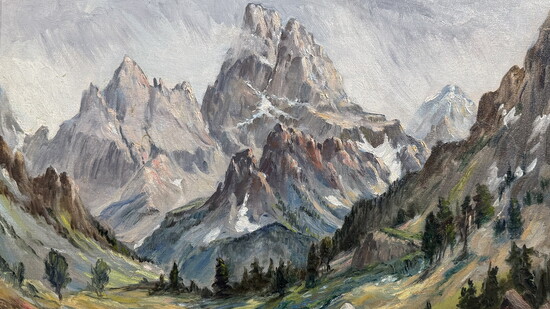
My husband Richard and I, driving eastward on I-84, quip that we are on the road to bliss—an afternoon or evening of friendship, conversation and a hearty meal, and a dramatic view of the Snake River. Depending on the time of day, the first thing one might notice about approaching Bliss, ID, is either the wind or the canyon. Once you are inside the gates of Teater’s Knoll, the gardens speak to the cultivation of its current owner. But the wind, the canyon? They, like the sturgeon below the Snake River, reflect the now-mythic character of Archie Boyd Teater, a scrappy kid living in Hagerman Valley in the first decades of the 20th century, a rough teenager who saved his money from hunting vermin to take himself to art school, another hard boiled Idaho man solid in his desire to be an artist.
Today, many visit the Archie Teater Studio, also known as Teater’s Knoll, to examine Frank Lloyd Wright’s only project in Idaho. The jutting prow, the angularity of the framed windows, the proportion of the space to the surrounding bluffs—these aspects speak of Wright’s designs, elements that call to and accentuate natural shapes in situ. But the vision of this architectural commission in Idaho is due to Patricia Teater and funds from prolific sales of Archie’s paintings.
Teater, born in Boise in 1901, studied under burgeoning artists of the Pacific Northwest and lived well in the creative spaces created by regionalists—groups of artists across the Unites States painting their everyday surroundings, not as traditional scenes but as intimate portraits of the environs consumers often overlooked, ignored, or passed by quickly on the way to something more beautiful, pleasing, and safe. Teater appeared to believe that where you are is important and worthy of being the subject of art. His impasto of the post-Impressionists, thick and whipped up to peaks, reflect the familiar textures of the uniquely sharp-edged Sawtooths.
Painting in a time of genuine identity creation in the United States as artists broke away from European storytelling, Teater relayed his self-taught and learned styles into commercial success. Even as a teenager, he painted outside and left canvases beside his tent to be purchased on an honor system. As he became more established in Jackson Hole, visitors and those who had second homes in the area bought Teater’s paintings as souvenirs of their time in the West’s mystical mountaineering majesty. They decorated their dens with scenes Idahoans might recognize—Slavey’s or the Stockman’s Club in Ketchum or the mining camps of Stanley. These sales afforded the Teaters the ability to commission Frank Lloyd Wright to design and build a structure on the rim of the canyon above Snake River.
“I love the winding Snake, have painted it from the headwaters till it joins the Columbia. The old Oregon Trail has been by stamping ground—the towering Tetons in the summer and the lava breaks in Idaho in the winter,” stated the painter in 1946.
Originally meant to be a working artist’s studio, it is now a home due to Henry Whiting, a prominent scholar of Wright and his architecture. I once asked Henry how he felt being a steward of such a place, imagining the responsibility to be daunting. However, wisely, Henry inhabits the space as a complement. On tours, he is always mindful to imbue the Oakley stones with the character of their mason, Kent Hale, and the hewn furniture inside with that of Paul Bates, celebrating the artistry of local craftsmen. Teater’s Knoll provides a dwelling where artists are celebrated.
Art historians sometimes prefer to think of the artist on their own—their style, technique, contexts within history. But artists are more often known through their collectors and patrons, those who choose to live with and sustain the life of their favorite artists. Yes, the estates of Rockefeller and Harriman now hold Teater’s works, but more significantly Idaho and Wyoming locals preserve and cherish his paintings, retain memories of his life, and pass down their collections to others.
For some, Teater’s work can be an acquired taste. His depictions of people can be described as feral. His compositions can be both crowded and flat, giving his surfaces an outsider artist feel. But they are also humorous and fantastic, montages and vignettes privileging jarring colors and unnatural light more than accurate representations of people and scale. If you ever have the chance to view his more full catalogue of work, you will find there a mystery, a playfulness that is rarely commercially viable. Widely traveled, Teater composed his curiosity for the world, making the Guggenheim in New York City as monumental as the Tetons.
Of course, knowing Henry Whiting and Lester Taylor helps a lot. Their passion for Wright’s studio space and both the beauty and peculiarities of Teater’s paintings is contagious.
Celebrating this patronage and preservation of Teater’s work, Randy Van Dyck will host an exhibition of works to benefit the Hagerman Valley Historical Society. “We want to honor Teater’s work and introduce him to a new audience who may not be familiar with his art, his fascinating story or his iconic studio.” The exhibition, An Artist's Journey, opens July 2 at Boise Capitol Contemporary Gallery, 452 S. Capitol Blvd.; Lester Taylor, Harvard-trained scholar of Archie B. Teater will present on July 17, from 5 to 9; RSVP required.
Those interested in exploring Teater’s work further can view select pieces at vandyckframe.com in Boise or tour the preservationidaho.org/teaters-knoll-home-tour overlooking the Snake River canyon.