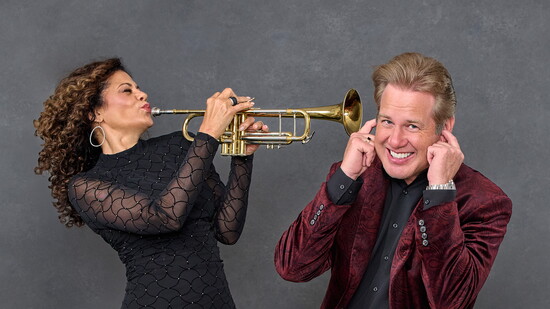
Long before he stepped onto stages or built a following, Joe Gransden was a wide-eyed ten-year-old with a trumpet in his hands and a future already quietly unfolding. Music was never background noise in his childhood it was the language of his home. His grandfather, a professional trumpet player in New York, filled rooms with a rich tone that it stopped young Joe in his tracks. Watching him practice and perform was inspiring and transformative.
“I couldn’t get enough of it,” Gransden recalls. “I practiced all day and never got tired.” He knew the trumpet wasn’t just an instrument. It was his life’s path.
His father was an accomplished jazz pianist and singer, and his mother, a dancer and choreographer, ensured that legends flowed steadily through the speakers. Frank Sinatra, Nat King Cole, Miles Davis, Chet Baker, Sarah Vaughan. Gransden gravitated toward the cool vulnerability of Baker, the phrasing of Sinatra, and the fearless expression of Miles. Learning those records by ear shaped not only his musicianship, but his confidence. Eventually, it gave him the courage to step onstage.
Today, after decades of performing, what keeps him returning to that stage is simple: connection. “The energy from the crowd is intoxicating,” he says. “It brings me joy and fulfillment.”
For Gransden, jazz is not a performance delivered at an audience; it’s a shared experience created with them. Onstage, whether leading a big band or playing in an intimate ensemble, he describes the music as a conversation — one built not on words but on trust. Eye contact replaces dialogue. Listening becomes as important as playing. Each musician is given space to speak, supported by the others. “It’s a democracy,” he explains. “We respect each other and the audience.”
Improvisation sits at the heart of that. Much like life, a jazz solo requires structure but allows freedom. There are rules, yes — but within them lies the liberty to say something uniquely your own. It mirrors the way Gransden approaches living: steady, grounded, but unafraid to go with the flow.
Time, too, has deepened his artistry. “As you live more,” he reflects, “joy, heartbreak, loneliness, achievements — they find their way into your music.” Technical precision gradually gives way to emotional truth.
He remembers wanting to sing the classic “This Is All I Ask,” recorded memorably by Sinatra and Tony Bennett. For years, his father gently held him back. “Not yet,” he’d say. “You’re not ready.” When Gransden turned fifty, the two revisited the song together and agreed it was time. Life experience had finally caught up to the lyrics.
Beyond performance, Gransden sees stewardship as part of his role. Through masterclasses, brass clinics, and his newly founded initiative The Future of Jazz, in partnership with the Atlanta Music Club, he is investing in the next generation. Passing along what was given to him feels not just meaningful, but necessary. “This music has given me the freedom to express myself in such a glorious way,” he says. “I want to pass that joy on.”
For those hearing Joe Gransden for the first time, he hopes one thing rises above the rest — that they feel his love for the music. That they sense they’ve been taken somewhere memorable. Somewhere honest. After all, when the final note fades, it’s not just about the sound. It’s about the life behind it.
Long before awards, standing ovations, and a decades-spanning career from St. Louis to Atlanta, Karla Harris was a shy fifth grader handed her first solo. She still remembers the moment.
Growing up, music poured from a well worn stack of albums in her parents’ home Nancy Wilson, Billie Holiday, Aretha Franklin, The 5th Dimension. She listened closely, absorbing not just melody but meaning. The phrasing. The ache. The joy. The stories tucked between the notes.
But it was her grade school music teacher who gently pushed her forward. Giving a timid young girl a solo could have gone either way. Instead, it changed everything. “Even though I was shy,” Harris recalls, “I felt the song somehow connect with the audience.”
That connection, that electric awareness that something invisible had passed between singer and listener was potent. It was the beginning of an artistic identity rooted not in volume or virtuosity, but in communication.
Years later, in her twenties, another pivotal lesson would reshape her understanding of what singing truly requires. A songwriter invited her to demo one of his songs her first professional studio experience. Determined to impress, Harris focused on perfection. Clean notes. Exact phrasing. Control. It wasn’t working.
The songwriter stopped her and offered a piece of advice that would stay with her forever: “You’ve got to sing the story. It’s not about sounding perfect.”
That shift from perfection to presence unlocked something deeper. Harris began to understand that jazz, and any meaningful music, demands openness. It asks the artist to bring lived experience into the room heartbreak, hope, doubt, triumph. The highs and lows of being fully human. That honesty is what listeners now recognize immediately in her performances. There is clarity in her tone, yes but more importantly, there is truth. She doesn’t simply sing lyrics; she inhabits them.
Jazz, with its delicate balance of structure and spontaneity, gives Harris the perfect vehicle for that expression. Each performance begins with a roadmap, but the beauty lies in the detours. A phrase stretches a bit longer. A dynamic softens. A musical conversation veers unexpectedly into brilliance. “There’s nothing like catching that wave of creativity, and when it happens, the audience feels it. In those moments, they aren’t observers. They’re part of the band."
Beyond performance, Harris’s devotion to jazz extends into mentorship and advocacy. As a teacher, she witnesses transformation in real time. Jazz, she believes, cultivates far more than musicianship, it builds confidence, creativity, self-awareness, and connection. Watching students discover their voices reignites her own curiosity and courage. Teaching pushes her, too, to grow and step beyond comfort.
When she was named a 2025 Jazz Hero, the recognition felt both humbling and communal. So many musicians and educators labor tirelessly to sustain the art form. For Harris, the award is less a personal accolade and more a reflection of the vibrant community beside her. Still, at the center of it all remains that original goal: connection.
If someone hears Karla Harris for the first time, she hopes they forget the noise of everyday life for a while, they feel lifted. That the music moves something inside. That they leave lighter than they arrived.
And if she could whisper advice back to that shy fifth grader? “Say yes. Do the thing that scares you. Ask. Seek mentors. We’re going to grow into this thing we love to do.” Decades later, she has done exactly that and the story is still unfolding.