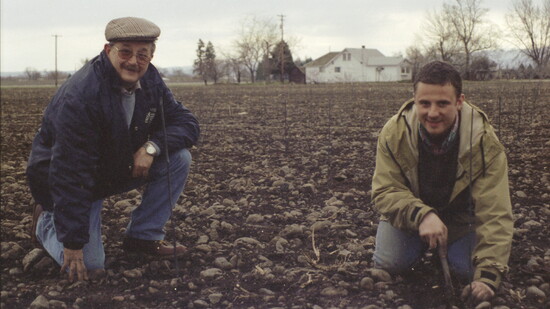
Unproven ground—an investment that started a legacy.
A wide stretch of round river stones lay exposed to the sun — a field most people would have overlooked. It was 1996, and Christophe Baron, a young vigneron originally from Champagne, was on his way to Oregon to invest in Pinot Noir and Chardonnay.
A friend, seeing the photo in a book he was carrying of the stony vineyards of Châteauneuf-du-Pape, told him there was land “like that here.”
Christophe drove out to see it.
He stepped onto the rocky ground, looked around, and said simply:
“This is it.”
That quiet moment redirected the course of his life — and, ultimately, the direction of Northwest wine.
Leaving the Expected Path
Christophe grew up in Champagne and studied in Burgundy. Becoming a vigneron was straightforward; staying in France and his family’s roots in wine since the 16th century would have been the natural path. Instead, he chose to travel, work harvests, and learn the craft, finding his own direction.
Oregon seemed like the logical place to start his own path. The varieties were familiar. The industry was established. The investment was clear.
But standing on those stones, the plan changed.
It wasn’t dramatic. It wasn’t strategic. It was immediate. Something in the land spoke to him, and he followed it.
Investing in Unproven Ground
At the time, no one believed vineyards could succeed on those rocks. Locals questioned the idea. Some referred to him as “the crazy French guy” as he began the work of planting vines in terrain that fought back.
The stones were so dense that Christophe and his crew used crowbars to wedge the young vines into place. Nothing about the work was easy.
Still, he invested — not in what the land was, but in what he believed it could become. Vines that create great wine must struggle. This place was perfect.
A Different Kind of Capital
Christophe calls himself a vigneron — a winegrower — because the focus is on the vineyard, not the cellar. Everything begins with the land.
He farmed organically from the start and moved fully into biodynamics in 2002, long before it became more widely accepted. His approach favored patience over speed, observation over intervention, and horses over tractors where possible.
High-density planting, long timelines before releasing wines, and a commitment to traditional methods required significant investment. Not all of it financial. Much of it was time, attention, and belief.
The Region That Followed
Over time, Christophe’s early vineyards developed into what would become Cayuse, No Girls, Horsepower — each an expression of the land he had first seen in 1996 — while Hors Catégorie would later become his defining vineyard in the North Fork area of the Walla Walla Valley.
As the wines gained recognition, other vignerons and wineries began investing in the same area. What once looked like unworkable ground has since become The Rocks District of Milton-Freewater AVA, now home to more than 500 planted acres.
A region that didn’t exist before now carries an identity shaped by the same stones Christophe first walked across nearly thirty years ago.
Looking Ahead
Christophe pays close attention to how new generations engage with wine. He understands that younger drinkers look for connection, story, and authenticity. During the pandemic, he introduced Double Lucky — a more accessible wine meant to meet people where they are.
Through each of his labels, he focuses on expression of place, clarity of farming, and respect for the vineyard. His investment continues to be centered on doing things at the highest level and letting the land lead.
An Investment That Started a Legacy
There’s no need to overstate what happened that day in 1996. It didn’t look like a milestone. It looked like an empty field of river stones.
But for Christophe Baron, that field was the beginning.
He stepped onto land no one believed in, recognized something familiar, and trusted it. The work that followed helped shape a new chapter of Northwest wine — patiently, steadily, and from the ground up.
Sometimes the most significant investments begin that way—not with announcements, but with a simple statement spoken on unproven ground.
“This is it.”
Tammy de Weerd is a contributing writer for Boise Lifestyle and Meridian Lifestyle. She is also the co-founder of Spoken Wines.