When you sit down with Trish Roe, founder of The Georgian Goose Interiors, she talks about homes the way some people talk about old friends—warmly with a hint of curiosity about the stories they hold.
Rooms, to her, are never just that. They're expressions of the people who live in them: their routines, their histories, and the tiny details that make their lives feel like their own.
"The best projects come out of trust," she says. "You have to know people well enough to see what they'll love before they see it themselves."
Trish built her studio on that belief. What began as helping friends design their spaces after she moved from the Northeast to Atlanta eventually evolved into a thriving boutique design firm serving families throughout the Southeast. She hadn't initially set out to become a designer; she worked in publishing and marketing. But design had always been the thread running through her life, from childhood days hunting antiques with her grandmother to the creative pull she felt every time she walked into a new space.
Her work with one longtime Collier Hills family illustrates her approach perfectly. The couple, both attorneys with two young children, had moved into a traditional home with rooms that felt underutilized or undefined. They initially asked for help with their formal sitting room. "They both worked from home, but they didn't work together," Trish recalls with a laugh. "They wanted to share a room but not a desk."
She transformed the space using a long dining table—one spouse at each end—and a seating arrangement near the fireplace. The room became both a shared office and a secondary living area. After the workday ended, it shifted into a calm retreat, somewhere to read, unwind, or enjoy a quiet moment out of the fray. "Once that room came together, it sparked everything else," she says. "They suddenly saw possibility in the whole house."
One of the most memorable spaces that followed was a small, unfinished area on the home's terrace level. The couple had always wanted a wine room, the wife was studying for her sommelier certification and dreamed of a place to store her growing collection. "I love taking a really small space and making it have a big impact," Trish says. She brought in her custom millworker to design floor-to-ceiling shelving, a temperature-controlled unit, glass doors, and a tasting corner. But the moment that sealed the room's personality came during planning.
"My millworker’s first drawing held around 300 bottles," she says. "My clients looked at me and said, 'We want to store way more.' So we expanded."
The finished room is moody, immersive, unexpected—a destination tucked inside a family home. "All of their friends come over and immediately say, 'We're hanging out in the wine room,'" Trish says. "That's when you know you've created something special."
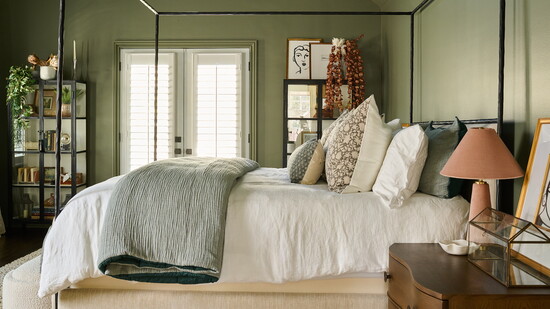
Upstairs, the primary bedroom offered an entirely different challenge. With high vaulted ceilings and vast empty walls, the room felt impersonal. Trish used one of her favorite techniques—color drenching—to transform it. "Painting the walls, trim, and ceiling the same shade added this cocoon feeling," she says. "Even a big room can feel warm and intimate." She grounded the space with a plush wool rug, layered in texture, and hung custom artwork from local artist, Lindsey Franks. The final touch was a bubbled glass chandelier so intricate that she, her assistant, and her electrician had to hang each bulb individually. "We won't forget installing that one," she says. "But it was worth every minute."
Throughout the home, Trish's process remained rooted in understanding the family, not just the architecture. She listens to how people live, what habits define their routines, and what small details reveal their personality. "People's kitchens are incredibly telling," she says. "What's left out, what they cook with, whether there are cookbooks or take-out menus—it all gives you clues." She asks about travel, favorite restaurants, and family traditions. She takes in photos, closets, and small collections. "Those details might not seem important," she says, "but they help shape a home that feels personal and alive."
Color plays a key role in her work—not as a trend, but as a feeling. "I always try to walk people into color," she says. "Some want to jump into the deep end, and some want to dip in a toe. But nobody lives in a house that's all white. It's not real life—kids, dogs, coffee, crumbs.. You need warmth and personality."
She's firm about a few design principles. Rugs should be bigger than you think. Antiques have a place in every home. Drapery panels should be hung high and touch the ground. And mixing patterns and colors isn’t something to fear.. "Whatever works for the family is what matters," she says. "Those rules are the ones that hold a room together."
Budgets, she believes, are best focused rather than stretched thin. "If a budget is tight, don't try to redo the whole house," she says. "Work on a couple of spaces and invest in pieces that will last." A high-quality arm chair or a vintage wool rug, she argues, will outlive any trendy decorator item—and grow with a family over time.
To keep clients from becoming overwhelmed, she presents two complete design options for every room—enough choice to feel empowered without falling into decision fatigue. "People get overwhelmed when there are too many options," she says. "You want them to stay excited."
Outside of client work, Trish is renovating her 100-year-old home in East Lake with her husband and two children. The walls are still open, the work ongoing. But for her, the process is part of the joy. They plan to tuck handwritten notes inside the walls for future renovators to find. "Homes should feel like they've lived," she says. "Old houses give you that before you even start. You're adding your chapter to a story that was already there."
That sense of narrative is what defines The Georgian Goose Interiors.
Trish isn't simply designing showpieces; she is imagining spaces that hold real life. Spaces where people gather, rest, host friends, raise children, and create memories they'll talk about years from now. In her hands, houses become homes that feel both deeply personal and fully alive.
“Homes should feel like they’ve lived lives—and like people truly live in them.”