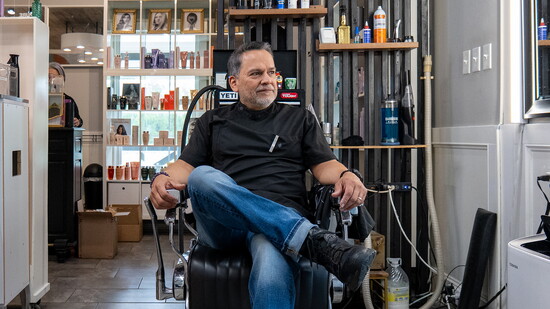
In the small but growing town of Buda, Texas, tucked between the hum of Austin commuters and the rhythm of local life, there’s a barber chair that has witnessed decades of transformation—not just in hairstyles, but in people.
For this barber, Ronnie Ojeda, now working out of Salon 112 with his wife, the chair has become more than a place of business.
It’s a front-row seat to human experience.
His story begins in 1985, when he cut hair on 6th Street in downtown Austin, with his dad.
Like many people, he built his craft through consistency, long hours, and a quiet attention to detail. Over time, that steady presence turned first-time customers into lifelong regulars.
Some of them, he notes, have been with him since those early days—returning not just for a haircut, but for something harder to define – trust, consistency, and the comfort in having something constant in their lives.
In 1999, he moved to Buda, planting roots in a town that still feels personal despite its growth– although he still commuted to his dad’s shop on 6th Street until 2006. Yes, his dad was a barber too. Ronnie’s barber chair evolved over the years—different spaces, new routines—but the essence of his work remains the same.
Today, Salon 112 is both a professional space and a shared life.
Despite decades behind the chair, he describes himself simply: an introvert, a listener. “If I need to say something, I will,” Ronnie explains—but often, he doesn’t need to. The chair does the work. There’s something about sitting down, cape draped, mirror in front, that invites people to open up. It’s a space that feels both relaxed and, as he puts it, offers his clients to put away their phones and just sit for a few minutes—just enough to let honesty and the chatter evolve.
The conversations tend to follow familiar paths—family, work, sports—but occasionally, something deeper surfaces. Over time, he’s learned to navigate those moments with care.
There are boundaries, of course, but also an understanding that sometimes people just need someone to listen. “Good stories turn into regulars,” he says, hinting at the quiet bond that forms between barber and client.
Not every story is dramatic. In fact, many are small: a high school student growing up over the years, a customer returning after a tough season, or the loss of a loved one, or the everyday humor that builds when people feel comfortable. One client, once considered “awkward,” now laughs easily about those early interactions. Growth, it seems, is part of the rhythm of the shop.
The atmosphere itself has shifted over time. Where there was once a calmer pace, the shred shop now leans towards a faster environment—still warm, still welcoming, but grounded.
“Good vibes,” he calls it. People come in, sit down, and settle into the moment.
Beyond the chair, the shop reflects the spirit of Buda itself: a small town with a strong sense of identity. Conversations often drift to what’s new in town, local businesses, or shared connections. It’s a community built not on spectacle, but on familiarity.
After nearly four decades, what keeps him coming back is simple: the people. “All different walks of life,” he says. And in that diversity, he’s found something steady—good conversations, loyal customers, and a craft that continues to matter.
If his chair could talk, it might tell hundreds of stories. But perhaps its greatest story is this: sometimes, the most meaningful connections happen in the quietest places, one haircut at a time.