As she starts the story, when Sharon Pryse and her late husband bought their house in the Kingston Pike Historic District in 1984, she would not have mentioned that it was on the Tennessee River. She couldn’t see it down the steep slope that was completely grown up. “There was a back terrace, but no access to the garden from it. The owner before us had put in a very modern swimming pool … which did not necessarily complement the house,” Pryse adds. Having moved from a subdivision to their 1922 Georgian house, designed by Knoxville architectural firm Baumann and Baumann, they would sit on the terrace, having a drink and lament “there was nothing to the backyard.”
“Everything from the pool terrace down the slope was covered up in euonymus, vines and brambles. It was not about the garden or the river view. We bought the property for the house and the beautiful molding details.” Turns out uncovering a hidden garden holds lots of surprises.
The first garden designer Pryse worked with in 1985 was Knoxville’s Bob Hendrix. When they started clearing, they found the remains of a sprinkler system that was original to the house. “It was not functioning, but we found the pipes. There was a little bog pond on the slope in addition to a pond on the main terrace. I don’t know if the bog pond has an underground pipe to it, but we never have to fill it up.” As they cleared out the euonymus, they found the basics of a walkway. “It was rudimentary, but it was the first part of that meandering walkway—where you enter through the gates—to a flat place where the bog pond is, and a little stone seating area that was all covered up. We tried to find what the original walkway looked like and later built another seating area two-thirds of the way down.”
A Georgia native and University of Tennessee alumna (who would later serve on the UT Board of Trustees), Pryse has roots in gardening going back to her grandmother’s house. “I spent time with my father’s mother, who was a big gardener. My late husband was a physician and loved gardening because it was a huge release for him.” A lot of satisfaction, she says, is gleaned from the hard work of clearing. “When you pull weeds, you can see a pile of what you’ve gotten done … as long as you look at the pile you have done and don’t look down the slope and see all that you haven’t gotten done.”
In those early days, it might have surprised Pryse that the stunning three-acre multi-terraced hillside garden on the Tennessee River she would transform over the next 40 years would be featured in such lifestyle media as HGTV’s “Garden Tour” and Southern Living. Most recently, Pryse and her garden were one of 20 featured aspirational gardens and their maximalist owners who prove “more” is better in the 2025 garden book, “Garden to the Max: Joyful, Visionary, Maximalist Design” (Teresa Woodard, Photography by Bob Stefko).
Widowed in 1998, Pryse married Joe Pryse in 2006. “When Joe and I got married, I already had a rose garden, but it was down by the river. We bought the house next door that was in serious disrepair and tore it down. We told our new garden designer that we’d like the roses closer to the house and maybe some kind of garden pavilion with a grill. ‘Give us some ideas,’ we said. Joe and I were thinking ‘casual.’”
However, Ryan Gainey, the internationally acclaimed garden designer and horticulturalist they had hired for the redesign, was not. “He presented us with this plan for a formal rose garden and a very formal pavilion that Joe calls ‘The Temple.’ It was not at all what we asked for, but it was gorgeous … and it’s what we did.”As its centerpiece, Gainey’s formal design incorporated six limestone columns from a Middle Tennessee bank that Pryse’s late husband had acquired years earlier. “Knoxville portrait artist John Kelley, known for his work interpreting Greek mythology, was involved with the original purchase of the columns. The prior owner didn’t utilize the columns, so they lay in a yard for a long time when my late husband heard about them and bought them. Of course, it took a Metler’s crane to move them. We paid more to place the columns than to purchase them,” she laughs.
“We have 120 hybrid tea roses in the double 8-feet-wide and 40-feet-long formal beds, and multiple hybrid tea and David Austin roses going down the slope. We enjoy taking our homegrown roses to lots of people, but we have to remind them that, because they are homegrown, they do have thorns. Joe’s favorite is Double Delight, and he’s convinced Lydia, one of our five grandchildren and four great grandchildren, that it’s hers too.”
There’s also a companion Itoh peony [Japanese hybrid] bed comparable in size that Gainey installed on the upper tier. “The beauty of Itoh peonies is they don’t need ants to blossom, so you can cut and bring them inside without bringing in ants.” Their two dogs, Molly, a Westie, and Pearl, a 17-year-old Cairn Doodle, love the gardens as much as their people do. “Molly likes to start at the top of the peonies bed and belly crawl all the way down the slope and then run back up and do it again, as if she’s sliding,” Pryse adds.
During planning, they also told Gainey they wanted everything to be as low maintenance as possible, which “was not a forte of his,” Pryse explains. “When he suggested planting vineyards, I asked, ‘Since when are vineyards low maintenance?’ But ours are. Ryan planted native muscadines and blackberries that don’t need tending, thanks to the birds, and thrive without maintenance.”
Gainey was the gifted visionary behind their redesigned, expansive four-tiered garden tapestry (including vegetable and herb gardens, an English knot garden and several water features) up until his death in 2016. “We worked with him so long, we still ask ourselves what would Ryan do? I don’t do as many garden chores as I used to, now that our weekends are spent in our North Carolina mountain house. But we have a wonderful crew with Megan Shankles as our garden manager.”
Active on many nonprofit boards, Pryse is also Vice-Chair of The Garden Conservancy, a national organization that celebrates America's gardens and diverse gardening traditions with lectures, webinars, garden tours and Open Days. “Open Days are fundraisers for The Garden Conservancy, but they also introduce people to private gardens they might not otherwise see. We’re not as well represented in Tennessee as in New England or California, and haven’t had Open Days in Knoxville in a couple of years. I hope to put together Open Days in 2027.”
Pryse’s advocacy for opening private gardens to public enjoyment is reflected in her experience throughout the years, entertaining and hosting personal, business, and nonprofit events for organizations such as Legacy Parks, Random Acts of Flowers and UT Gardens. “Friends, family and folks who work with us or know us have family event photos taken here. Knoxville has been good to me and my family and I’m glad to be able to give back to the community and share our garden experience. Walking through the garden and the way it smells, the way it looks, the way it makes you feel … it’s just comforting.”
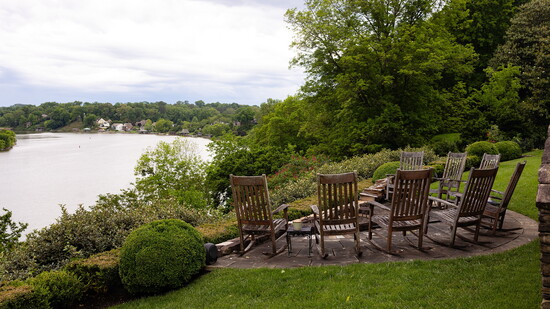
“Back in the day, we’d have people for dinner, go for a garden walk and stop on our way back at the terrace and have cheese or vichyssoise and wine before going back up. As we and our friends have aged, we aren’t taking people down to the river as much as we once did.” Pryse says she doesn’t walk down to the river every night either, but when she does, she ponders making maintenance easier. “I may not walk to the river as often, but I do walk to the rocking chair terrace underneath the rose garden. It’s a semi-circle of rockers around a fire pit overlooking the river and a favorite place to enjoy the views.”
Their historic hillside garden has brought unexpected gifts. “We don’t have any significant trees left, not by plan. They’ve all died. I’ve been told that during the Civil War, these hillsides were denuded for firewood or whatever else. The large trees that came back naturally were roughly the same age and often uprooted at the same time.” One of those surprise gifts came when one of them fell.
“Before, that really huge tree blocked the view of the bridge [James E. Buck Karnes Bridge] from the house. Now that it’s gone, we can see the bridge from the house and the rocking chair terrace. Our house faces south, and the bridge is southeast of us. When the sun sets to the west, that bridge glows orange, and it is beautiful. If the water is flat, you get that orange reflection of the bridge in the water. I never thought about the view of the bridge, but it’s really a pretty bridge with that double reflection.”
Where better in Big Orange Country to appreciate that tangerine glow in the river than from a rocking chair in the garden of a transplanted Georgian who was grafted into the Volunteer family decades ago? One more surprising garden lesson in blooming where you are planted.
“Our rocking chair terrace, with its fire pit underneath the rose garden, is a favorite place to enjoy garden views.”
“Joe and I met the renowned British garden designer and writer Rosemary Verey in England and became friends. She came and spent the weekend with us and gave us wonderful garden ideas.”