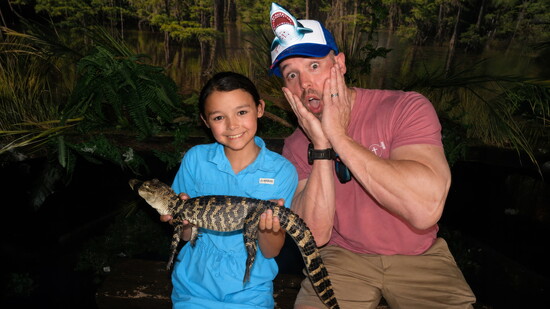
When Orry Martin hears someone say they are afraid of snakes, he does not start with a warning. He starts with an invitation.
“I can get you over that if you’re willing,” he says.
For Martin, a biology teacher at The Woodlands Christian Academy and longtime reptile educator known as the Texas Snake Hunter, the goal is to move people from fear to curiosity, sometimes by showing them that snakes can be unexpectedly cute. Around the wooded edges of Montgomery County, children grow up close to yards, trails, creeks, and lakefront places where wildlife is part of the neighborhood.
Martin’s education began outside. He grew up in rural Louisiana, in a place he describes as woods, water, and few neighbors. His mother loved animals and did wildlife rehabilitation, so possums, raccoons, squirrels, turtles, frogs, salamanders, and snakes were ordinary. Bath time, he says, sometimes meant sharing the tub with ribbon snakes, king snakes, or whatever he and his twin brother had found.
At 14, after moving to Texas, Martin caught his first Southern Copperhead. A friend handed him Alan Tennant’s A Field Guide to Texas Snakes, and something clicked. He memorized the book, then set out to find, film, and understand Texas snakes one species at a time.
That field knowledge now follows him into the classroom. Martin teaches students to ask better questions, especially when fear takes over. He says most snake fear comes from family habits, a bad encounter, cultural stories, or the mistaken idea that killing a snake proves toughness.
His counterpoint is practical. Snakes are not looking for people. They have no arms, no legs, and few ways to defend themselves. When they musk, flatten, rattle, flee, or bite, they are responding as if a much larger animal intends to eat them.
“Most snakes are not looking for trouble,” Martin says. “They are looking for a way out.”
That message matters for families. Calm observation is safer than panic. Children should learn to stop, step back, and get an adult, not chase, touch, or harm a snake. Martin does not teach casual handling, especially with venomous species. He teaches respect.
Faith is central to his work. Martin says his job title is biology teacher, but his deeper calling is helping students know God and see creation with humility. Nature, to him, is not disposable. It is entrusted.
That conviction shapes his conservation message. He wants students to understand stewardship, not just science. Development, habitat loss, and unnecessary killing have changed what can be found nearby. He worries that species he knew as a young outdoorsman may become rare for the next generation.
Fatherhood has sharpened that concern. Martin talks about his daughter, Molly, and his students as “my kids.” He wants them to inherit curiosity instead of reflexive fear.
His hope for readers is simple: see reptiles as a beautiful part of creation. For Conroe families, that starts by learning what lives nearby. Keep a field guide handy. Teach children to pause before they react. In that pause, Martin believes, there is room to see more clearly, respond more gently, and recognize the Creator’s hand in even the most misunderstood things.