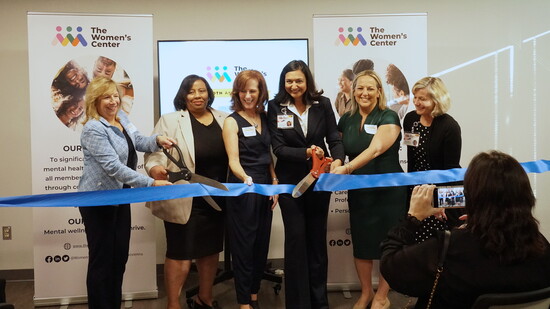
In the quiet, light-filled corridors of their newly expanded Tysons space, there is a palpable sense of what the French call solidarité. It is a word that suggests more than just support; it implies a shared standing-up, a collective holding of the breath until the crisis passes. This is the heart of The Women’s Center, an institution that has quietly anchored the Northern Virginia and D.C. community for over half a century.
To understand the Center today, one must look back to 1974. It was a time when the "glass ceiling" was not yet a phrase, but a very real, low-hanging roof. College graduates Joan Alden Parks and Peggy Lockhart Mummerling saw a specific void: women were trying to re-enter the workforce and finding no bridge to get them there. What began as the Northern Virginia Information and Counseling Center for Women was a radical act of pragmatism: a place for career training and employment support.
By 1984, the name was simplified, but the mission was deepening. Today, the Center is a 35,000-hour-a-year powerhouse, serving more than 3,300 individuals annually. And while the word "Women" remains proudly on the door (a nod to its founding mothers), the doors themselves are open to everyone, including men, children, teens, and families of every configuration.
The Architecture of Healing
What makes the Center unique isn’t just that it offers therapy; it is how it defines well-being. It is a holistic ecosystem. If you walk through their doors, you are not just a patient. You are a person whose emotional health is inextricably tied to your bank account, your legal status, and your physical safety.
"We approach support by integrating emotional, physical, economic, and social well-being into every aspect of our services," says the leadership team. This manifests in a staggering menu of resources. Beyond traditional individual and couples counseling, the Center provides:
- Economic Empowerment: Career coaching, job-search counseling, and financial education workshops.
- Legal Guidance: Divorce mediation led by certified attorneys and free consultations with family law experts.
- Crisis Advocacy: Intensive support for survivors of domestic violence and sexual assault, including court accompaniment.
- Specialized Care: Programs like "It Takes a Village" (ITAV), a pilot initiative addressing the maternal mental health crisis.
The Human Ripple Effect
Statistics provide the skeleton, but the clients provide the soul. Consider Rory, a 16-year-old who arrived at the Center feeling shattered by home conflict and school disruptions. Her journey did not happen in a vacuum. Her therapist met her where she was, quite literally. When Rory was in a juvenile facility, the therapist continued to show up, offering a steadying hand that did not try to "fix" her, but rather listened.
Today, Rory has a job, a fresh mindset for school, and a restored relationship with her younger sibling. "You can’t hold pain in forever," Rory says now. "Counseling helped me see that. It helped me feel heard."
Then there is Julia, a mother of two and a survivor of domestic violence. For years, Julia was silenced by a controlling relationship. Through the Center’s Domestic Violence and Sexual Assault services, she worked with a therapist named Sophie to rebuild her identity. It was not just about emotional processing; it was about the logistics of survival: navigating custody evaluations, setting boundaries, and regaining a voice in the legal system. Julia is not just surviving now. She is leading her family with a courage she once thought was lost.
A Community Investment
The Center’s impact is a study in the "Ripple Effect." When a woman gains economic stability or heals from trauma, her children thrive, her neighborhood stabilizes, and the local economy grows more resilient. This is particularly crucial as the D.C. metro area faces a projected loss of 40,000 federal jobs over the next several years. This 21% reduction in the workforce historically correlates with spikes in domestic violence and mental health crises.
Furthermore, Northern Virginia is more diverse than ever, with more than one in four residents speaking a language other than English at home. The Center is meeting this by expanding culturally competent services for immigrant women who often face heightened vulnerability due to a lack of legal protections.
The engine behind this work is a sophisticated blend of professional staff and a dedicated "army" of volunteers. From the Fall Gala to the year-long Annual Campaign, the community fuels the Center’s ability to offer sliding-scale fees and even free services for those in the greatest need.
Looking Toward 2030
As the Center looks to the next three to five years, the focus is on expansion and sustainability. In 2025, they launched the Resident and Supervisee Program, a brilliant double-play that helps new clinicians reach their licensure while increasing the Center’s capacity for reduced-fee counseling by 20% each year.
The message is clear: investing in the well-being of the community’s most vulnerable is not just charity. It is a regional necessity. When people like Rory and Julia find their footing, we all stand a little taller.
As one client poignantly put it: "Without The Women’s Center, I wouldn't have that anchoring in myself. I would still be lost." In the heart of McLean, that anchor remains as heavy and as hopeful as ever.