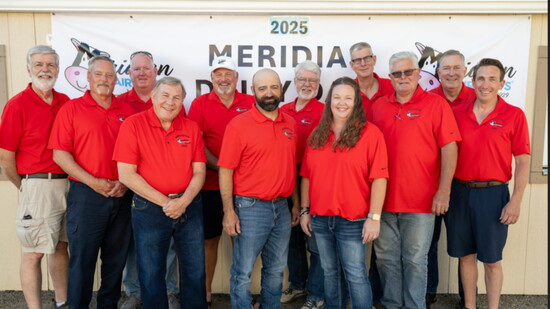
Every June, Meridian gets a reminder of its bovine and hircine heritage in the form of Dairy Days.
The celebration, spanning June 25–27, continues to connect the rural parts of the city with the rapidly expanding urban areas. It also draws in more than 30,000 visitors, highlighting what Meridian offers.
Rooted in Place
The inkling of what would become Dairy Days began June 18, 1929. That’s when the first Dairy Show celebrated the opening of the Ada County Dairymen’s cooperative creamery.
The property at 33 Broadway Avenue processed milk, crafted butter, and eventually manufactured baby formula until 1970, when local operations shut down. If that address sounds familiar, it should—Meridian City Hall now sits on the same property where the creamery once stood.
In 1948, the Meridian Dairy Show was incorporated and held its first official event the following year.
Now, Dairy Days spans downtown Meridian, with events at Storey Park and the Meridian Speedway.
As for why the racetrack hosts cows and goats each June?
“We own the Meridian Speedway,” Meridian Dairy Days and Stock Shows President Hans Bruijn said. “And that’s kind of the other question we get a lot—‘Why did they build a speedway in downtown Meridian?’ But if you look at pictures from the ’60s, there’s nothing around it. Main Street actually ended where the Speedway is. So it’s just part of the history.”
An Evolving Celebration
Bruijn has been on the board since 1987 and has watched the number of dairies in the area dwindle.
“Now there’s basically none with a Meridian address,” he said. “Dairy Days used to be kind of like a fair where all the local dairymen brought their cows and competed against each other and had a good time. Now it’s changed more to trying to educate people about the dairy industry. I think it’s important to show the history of Meridian—and still bring people together for a good time.”
That good time includes the Saturday parade. With dairy industry support, you’ll see milk and cheese sticks rather than traditional parade throws.
Steve Wilder, who’s been with Dairy Days since 2022, once served as the parade’s Grand Marshal after board nomination and selection.
“It’s not often you think of a time in your life when you’ll be sitting in a Corvette with your wife, waving at people along your own parade,” he said, noting that more than 100 entries have been featured in peak years. “There’s a ton of support for it, and it’s well attended. We shifted it from an evening parade to a morning parade, which has been a win-win. It can be fairly warm sometimes, but moving it to the morning makes it more manageable—even if it’s 100 degrees.”
The ice cream social, pancake breakfast, carnival, and performances are also popular events in the packed weekend.
Future Dairy Industry Leaders
As Bruijn mentioned, education has become one of Dairy Days’ cornerstones.
It spans multiple generations, with members of the Meridian Crazy Critters 4-H club teaching younger children about animals through the Old MacDonald’s Farm area.
“They bring in as many types of animals as they can,” Bruijn said. “Calves, chickens, lambs, maybe some pigs—just for the kids to see.”
Youth from 4-H and FFA are the stars of Friday’s dairy cattle and dairy goat shows.
“My favorite part is always the dairy cattle show because that’s my background,” Bruijn said. “To see those kids—they’ve worked hard with those animals. It’s basically the first show of the year, so we try to get a judge who explains what they can improve so they’re ready for their county fairs and the Western Idaho Fair.”
“It’s an opportunity to teach kids work ethic, patience, and respect for others and animals,” Wilder said, who served as a West Ada School District agricultural science instructor and FFA advisor in Meridian.
Some youth traditions, like the Dairy Princesses, stretch back to 1949.
Two are crowned each year—a senior and a junior princess. To earn the tiara, candidates must follow Dairy Days’ mission to build “strong leaders for our future by supporting 4-H and FFA in the Meridian area.” They must be either a dairy consumer, live or work on a dairy farm, or show livestock in FFA or 4-H. This year’s candidates will also address questions about industry challenges such as rising feed costs and how to encourage young people to see farming as a viable career.
Helping future farmers and ranchers has been a highlight for the organization.
“We give away $20,000 in scholarships each year to local or Treasure Valley students going into agricultural fields,” Bruijn said. “That’s probably what we’re most proud of. We used to not be able to do as much, but strong sponsor support has allowed us to grow that.”
Festival Future
While the dairies may have left Meridian, the Treasure Valley remains closely connected to the industry.
“The dairy industry is still the number one industry in the state,” Bruijn said. He cited the Sorrento Lactalis factory in Nampa and Meadow Gold Dairy and Darigold in Boise. “It still employs a lot of people in the Valley, even though it’s no longer inside Meridian city limits. You don’t have to go very far outside Meridian to see large dairies. The impact of the dairy industry in Idaho is still tremendous.”
And with that connection comes Dairy Days, year after year.
“You see that question a lot, especially from newcomers—‘Why do they still have Meridian Dairy Days?’” Bruijn said. “But it’s important. It shows what made Meridian.”
For more about the festival, including the parade route and events, visit dairydays.org.