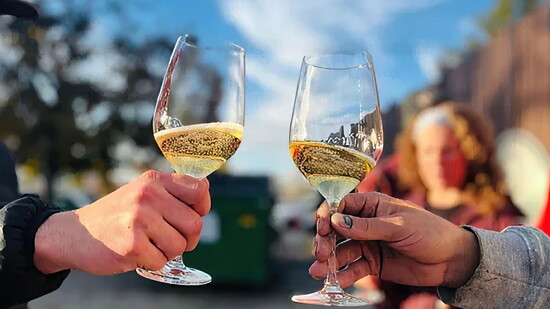
Champagne has a way of pulling people closer during the Holidays. Maybe it’s the bubbles; maybe it’s the excuse to linger a little longer. If you happen to have a favorite uncle who knows every twist and turn in Champagne’s history, it becomes something else entirely. I’d give that man hours of my time by a crackling winter fireplace, nodding along in polite awe. My price of admission? Three glasses of Champagne, minimum.
Ancient stories always open slowly — like a worn book from the back of a monastery library. Grimm’s Fairy Tales but with whiskered monks, musk in the air, and stone cellars that had been damp since long before anyone kept track. I like knowing these things; they make the wine taste different.
The Fizz They Didn’t Mean to Invent
Pierre (Dom) Pérignon was thirty years old when he took over as cellarmaster at a Benedictine abbey. Thirty — old enough to have opinions, young enough to be surprised when bottles exploded right under his nose. He wanted to craft a wine that could give Burgundy something to worry about, but he didn’t quite realize that the leftover sugar in his bottles would go to sleep during the cold months, then wake up in spring warmth like a mischievous houseguest. Pop, pop, fizz, fizz… chaos in the cellar.
And because Benedictine monks weren’t allowed to “furrow their eyebrows,” he had to pretend he was utterly serene about the whole thing. He didn’t invent Champagne on purpose, but he did refine it — blending, clarifying, gentle pressing, corks. A reluctant trailblazer, but a trailblazer nonetheless.
The Widow Who Refused to Go Quietly
Glass No. 2, and my imaginary uncle always arrives at Madame Clicquot. A young widow running a man’s business in a man’s world — winemaking in France no less — is practically a fable on its own. She had more wolves at her door than Little Red Riding Hood. But she outsmarted them, holding her ground with intelligence, invention, and a courage that still echoes through the industry. Her biography, The Widow Clicquot, might as well be an adult bedtime story.
The Three Musketeers of Champagne
Chardonnay. Pinot Noir. Pinot Meunier (say it like Mun-yay if you want to impress a crowd). Only these three can legally become Champagne.
Chardonnay gives the freshness and citrus snap. Pinot Noir quietly handles the structure and depth — the backbone of the party. Pinot Meunier adds richness and that aromatic lift you didn’t know you were waiting for. Any mix of the three can work, or a single star can carry the whole show. Your own swash and buckle will tell you which one wins.
Rare, But Somehow Everywhere
By the third glass, I’m nearly as charming and insightful as Dear Old Uncle — or at least no one is telling me otherwise. Fast forward a few centuries: more than a billion bottles are resting in Champagne right now. Another 300 million are produced each year. It sounds like scarcity, but it isn’t. The mystique doesn’t come from numbers any more than diamonds do. The glory is in the craft, the history, the patience. Prestigious bottles command a price, but there are plenty of beautiful Champagnes that don’t require a second mortgage.
Chilled… but Not Too Much
A word of advice: don’t freeze the poor thing. Overchilling blankets the aromatics and flattens the character. There are about five different recommended temperature ranges depending on style, age, and prestige — all of which assume you have a refrigerator dedicated solely to Champagne. I do not. Most of us do not.
Bubbles With Passports
Sparkling wine has gone global. You can find bubbles in nearly every wine region now, some playful, some ambitious. But even after wandering the world map, the compass tends to swing back to Champagne — not out of habit, but because it remains the benchmark for what bubbles can be.
It’s funny how these stories — half history, half folklore — settle in and warm you through the winter. Champagne has a way of doing that. So do good uncles.
If you’re curious to explore Champagne’s nuances beyond the legends and the lore, you can taste your way through the styles with a visit to Olive and Vyne. Learn more at OliveAndVyne.com
Cheers.