George Gillemot spent his life chasing the sky. A driven entrepreneur with a childhood dream of becoming an aviator, he built a career that achieved both—earning success in the cockpit and in business with the same focus and ambition that defined his character. But it was what he chose to do with that success that continues to shape northern Nevada today.
Through the Gillemot Foundation, established to carry on his vision after his death, Gillemot’s legacy lives on in classrooms and campuses across the region—funding aviation and aerospace engineering education through programs at the University of Nevada and the Washoe County School District. The goal is simple but powerful: capture students’ imaginations early with the excitement of flight, then nurture that spark into real skills, real opportunity, and the next generation of aviation and aerospace leaders.
“Flying was a dream of George’s. He put himself through college and got his own pilot’s license,” says Tom Hall, president and chairman of the board of the Gillemot Foundation, and a long-time friend of George. “He loved planes, but he also loved navigation and flight planning—all things that responded to his feeling of self-fulfillment and adventure… George thought flying was a good ally for self-improvement and economic development.”
Gillemot approached University of Nevada leadership in 2005 about funding an aviation and aerospace curriculum, but ultimately the two sides could not come to terms. Hall says the University was not prepared to accept a master gift at that time, but after Gillemot passed in 2022, Hall reintroduced the idea with UNR officials and an agreement was made. In 2023, the Foundation announced it was contributing a $36 million gift to establish the George W. Gillemot Aerospace Engineering Department.
The University hired Dr. Petros Voulgaris as the founding aerospace program director in 2020, before the Foundation’s gift. However, when the COVID-19 era hit, funding for a program vanished. The generosity of the Gillemot Foundation changed that. The first hurdle was getting a curriculum approved and new faculty members hired.
Mission accomplished! Over the past two years, UNR has put an aerospace curriculum into place for a bachelor’s program, a master’s program, and a doctoral program and has also hired four new full-time aerospace faculty members. Last fall, the first 40 freshmen started the program. Voulgaris says there are about 70 total students in the aerospace program and that enrollment numbers look good for this coming fall.
“There is a lot of interest and there are many opportunities for students thanks to the Gillemot funding. Plus, it has provisions for scholarships,” Voulgaris says. “We’ve got great faculty that can teach students about wind tunnels and robotics. They will learn about design, build and flight capability. I’m very excited that we’re in this situation. I’m hoping in a few years we can have a constant stream of 50 or more freshmen enroll in the program annually with maybe 200-250 going for their bachelor’s as well as another 30-40 graduate students.”
While the Gillemot Foundation’s commitment of resources to secondary education was sizeable, it was far from its lone investment into local aviation education. With the UNR deal done, Hall and his foundation team struck up conversations with WCSD brass. What came from those talks was a plan to add another Signature Academy to the district’s growing support of career and technical education (CTE) – this latest addition being an aviation school at the district’s Academy of Arts, Careers and Technology (AACT). The new Signature pathway also opened to students for the first time last fall.
Still, there was more. The Foundation set aside monies for a drone curriculum in all Washoe County middle schools. The after-school club program, open to all students, will begin when the new school year kicks off in mid-August. Those two programs marked another $1.4 million in Gillemot funds earmarked for aviation education.
“At AACT, one of the best things I love about the aviation program is we know some of these students will become pilots,” says Josh Hartzog, the WCSD’s director of career and technical education. “Their career and life trajectories have been altered by the career offerings at this school. They are choosing this path, and it has been amazing to see.”
“And then with the drone program… the skills they’re building—specifically coding, flight dynamics, systems thinking, and teamwork, those concepts really enforce 21st century learning skills—like our 4C’s of collaboration, communication, creativity, and critical thinking.”
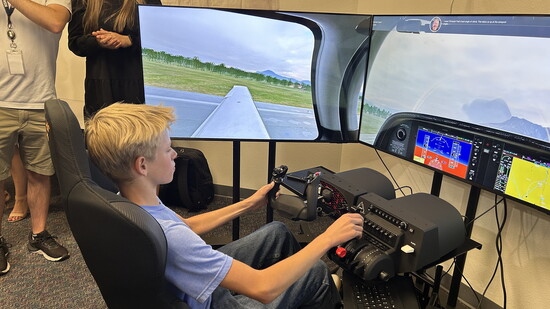
The district has gone further. At JWood Raw Elementary in South Reno, Principal Jonna AuCoin knew she wanted to reinforce aviation at her new school given the school is named after a naval aviator. Using grants, she purchased two flight simulators and now has vertically aligned kindergarten through fifth-grade programming that increases in complexity with student age.
“This is creating something for everybody,” AuCoin says. “It’s neat to see students that may struggle in other areas have success with this… I’m hoping through aviation we can get that hook to get more kids that want to be here, improve attendance, and see a passion for learning and critical thinking. I want to help these kids grow.”
That ‘hook’ is a key component for Hall, too. If there’s a way to get kids more interested and passionate about exploring aviation you can bet the Gillemot Foundation is open to promoting it. Hall says the Foundation is a cheerleader for the aviation world and George G’s dreams. The Gillemot Foundation is a key sponsor of a Fourth of July drone show to be hosted at Nevada’s Mackay Stadium. It’s also funding an aviation exhibit at The Discovery museum in downtown Reno.
In late May, The Discovery unveiled its new Above and Beyond exhibition, a 5,000-square-foot interactive experience that explores the innovation, imagination, and engineering behind humanity’s pursuit of flight. Designed to inspire visitors of all ages, the exhibition invites museumgoers to step into the role of aerospace innovators—designing and test-flying their own supersonic jets, piloting drones into the eye of a hurricane, and engaging with hands-on challenges that demonstrate the science and technology shaping aviation and aerospace exploration. Through immersive simulations, historic milestones, visionary concepts, and stories of pioneering aviators and engineers, Above and Beyond celebrates the dreamers and problem-solvers who continue to push the boundaries of what is possible.
“One way to attract kids is to make aviation interesting,” Hall says. “We’ve set aside 10,000 free tickets to let school children go to the Fleischman Planetarium. We want programs in schools that are exciting, to get kids interested. Plus, we’re giving teachers a chance to be rewarded, giving six teacher-of-the-year awards, $2,000 each. We’re covering all the bases we can possibly think of.”
“We want kids and families to come to the UNR campus for the July 4th drone show and concert. We hope to get 25,000 people. We keep punching and punching to get kids to explore. These are all great opportunities for kids to do something they haven’t done because they haven’t had exposure to them. If we get all this going, hopefully we’ll all be better off.”
“One way to attract kids is to make aviation interesting,” - Tom Hall