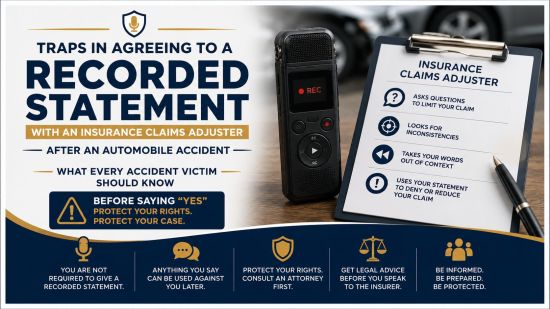
After an automobile accident, one of the first calls you may receive is from an insurance claims adjuster. The adjuster may sound friendly, professional, and helpful. During the conversation, the adjuster may ask if you would be willing to provide a recorded statement.
Many accident victims agree without hesitation.
After all, if you have done nothing wrong, why not simply tell your side of the story?
The answer is that a recorded statement can create problems that you may not anticipate, particularly in the days and weeks immediately following an accident when you do not yet know the full extent of your injuries or losses.
This guide explains some of the most common traps associated with recorded statements and why caution is important.
What Is a Recorded Statement?
A recorded statement is an interview conducted by an insurance adjuster in which your answers are recorded and preserved.
The recording may later be:
Transcribed into written form;
Reviewed by claim representatives;
Shared with defense attorneys;
Used during settlement negotiations;
Used in litigation.
Because the statement becomes part of the claim file, it may be reviewed months or even years after the accident.
Trap #1: You Don't Yet Know the Full Extent of Your Injuries
One of the biggest problems with giving a statement shortly after an accident is that many injuries do not immediately appear.
Common delayed symptoms include:
Neck pain
Back pain
Headaches
Concussion symptoms
Numbness and tingling
Shoulder pain
Psychological injuries
If you tell the adjuster: "I feel okay" or "I'm not really hurt" those statements may later be compared to your medical records when symptoms develop.
Better Approach: Be honest about what you know and do not know. If you have not yet been fully evaluated, say so.
Trap #2: Casual Statements Can Be Taken Literally
Many people speak casually during conversations.
Examples include:
"I guess I was fine."
"It wasn't that bad."
"I'm probably okay."
"I didn't see him."
Months later, those statements may be analyzed word for word. What seemed like casual conversation may be treated as an important factual admission.
Better Approach: Answer carefully and accurately. Do not guess.
Trap #3: The Adjuster Knows More About the Process Than You Do
Insurance adjusters handle claims every day.
Most accident victims do not.
The adjuster knows:
What information is important;
Which answers may affect liability;
Which answers may affect damages;
Which answers may create inconsistencies later.
This experience imbalance can place an accident victim at a disadvantage.
Better Approach: Take your time before agreeing to a recorded statement. Understand the purpose of the interview.
Trap #4: Questions May Encourage Speculation
Adjusters sometimes ask questions such as:
"How fast do you think the other vehicle was traveling?"
"Could you have avoided the collision?"
"Why didn't you see the other vehicle?"
"Do you think you were distracted?"
The problem is that you may not actually know the answer.
Speculation can create unnecessary issues later.
Better Approach: If you do not know, simply say: "I don't know." Or "I cannot accurately estimate that."
Trap #5: Statements About Fault Can Be Misunderstood
Immediately after an accident, people often replay events in their minds and second-guess themselves.
Some people say things such as:
"Maybe I should have reacted sooner."
"Perhaps I could have done something differently."
"I didn't expect that to happen."
Such comments may later be interpreted as admissions of fault.
Better Approach: Stick to facts. Describe what you observed rather than offering conclusions.
Trap #6: The Recording Never Changes
Your memory may improve.
Additional evidence may be discovered.
Witnesses may come forward.
Video footage may surface.
Medical diagnoses may evolve.
The recorded statement, however, remains exactly the same.
Any difference between the recorded statement and later evidence may be highlighted by the insurance company.
Better Approach: Recognize that a recorded statement is permanent. Answer thoughtfully and accurately.
Trap #7: Questions May Focus on Prior Injuries
An adjuster may ask about:
Prior accidents
Prior injuries
Previous medical treatment
Existing medical conditions
These questions are often asked because the insurance company may later argue that some symptoms existed before the collision.
Better Approach: Answer truthfully but carefully. Do not minimize prior conditions, and do not exaggerate them.
Trap #8: You May Accidentally Minimize Your Pain
Many people are reluctant to complain.
As a result, they frequently understate their symptoms.
Examples include:
"It's just soreness."
"I'm probably okay."
"It's nothing serious."
Those statements may later be compared against extensive medical treatment or diagnostic findings.
Better Approach: Describe symptoms accurately rather than attempting to be tough or optimistic.
Trap #9: The Adjuster May Ask Broad Questions
Questions such as: "Tell me everything that happened." can seem simple.
However, a broad question may lead people to leave out important details unintentionally.
Later, the omission may be characterized as an inconsistency.
Better Approach: Take your time, answer carefully, and do not rush through important facts.
Trap #10: You May Not Be Required to Give a Recorded Statement
Many people mistakenly believe they must agree to every request made by an insurance adjuster.
That is not always true.
The answer may depend upon:
Which insurance company is requesting the statement;
Whether it is your insurer or the other driver's insurer;
The language of your policy;
The circumstances of the claim.
Better Approach: Before agreeing to a recorded statement, understand whether it is actually required.
Common Mistakes to Avoid
Do Not:
Guess.
Estimate speeds you do not know.
Speculate about fault.
Minimize symptoms.
Exaggerate symptoms.
Assume injuries are fully known immediately after the accident.
Agree to a recording simply because you feel pressured.
Forget that the statement may be reviewed years later.
If You Decide to Give a Recorded Statement
Remember these simple rules:
Tell the Truth.
Listen carefully to each question.
Answer only the question asked.
Do not guess.
Do not speculate.
Do not volunteer unnecessary information.
Correct mistakes immediately, and be accurate rather than fast.
Final Thoughts
Most insurance adjusters are professional and courteous. However, it is important to remember that a recorded statement is not merely a casual conversation. It is a permanent record that may be used throughout the life of the claim.
The days immediately following an automobile accident are often the worst time to make definitive statements about injuries, fault, future treatment, or long-term consequences.
Before agreeing to a recorded statement, take the time to understand why it is being requested, what information is being sought, and how your answers may affect your claim in the future.
The best protection is simple: Tell the truth, do not guess, and understand that every recorded statement matters.
The Law Offices of Paul A. Samakow has been helping injured individuals since 1980 in Virginia, Maryland and Washington, D.C. Call 301-500-0000 for a free strategy session to see if you have a case and if his office can obtain full compensation for you.