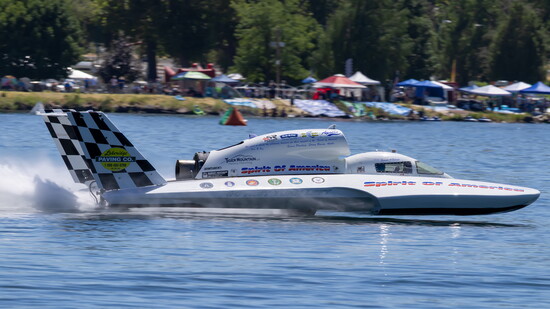
For most people in the Pacific Northwest, hydroplane racing is something they glimpse once a year during Seafair: loud boats, giant rooster tails, and crowds lining Lake Washington. But beneath that annual spectacle, there is an entire racing world built on family dynasties, engineering obsession, and boats capable of reaching nearly 200 miles per hour while skimming the surface of the water.
At the center of that world in Washington state is Go Fast Turn Left Racing, a Maple Valley-based H1 Unlimited hydroplane team that has quietly become one of the sport’s most recognizable grassroots organizations.
The team’s story begins decades ago with founder Greg O’Farrell, whose fascination with hydroplane racing started at Seattle’s Seafair when he was just 10 years old. During that event, O’Farrell got the opportunity to ride with legendary driver Bill Muncey in the famous Miss Thriftway Too hydroplane. It was a moment that would shape the rest of his life. Years later, O’Farrell began sponsoring racing teams before officially founding Go Fast Turn Left LLC in 2004 after purchasing his first unlimited hydroplane hull, the U-48.
Today, the organization has become a multi-generational family operation. Greg’s grandson, Gunnar O’Farrell, now pilots the team’s U-21 hydroplane, while Gunnar’s father Brian serves as co-owner. Gunnar’s sister Makenna manages the team, and Gunnar’s wife Marina oversees social media and public relations.
This family-centered structure is surprisingly common in hydroplane racing.
Unlike NASCAR or Formula 1, H1 Unlimited remains a niche motorsport sustained largely through regional sponsorships, passionate owners, and small but deeply committed racing communities. Many teams operate more like highly specialized family businesses than giant corporate entities.
To understand H1 racing, it helps to understand just how extreme these machines really are.
Modern unlimited hydroplanes are lightweight aircraft-inspired boats that barely touch the water at speed. Much of the hull actually rides on trapped air, reducing drag and allowing the boats to corner aggressively while maintaining incredible velocity. Drivers battle on oval-style courses, often reaching speeds close to 200 mph while pulling intense G-forces through turns.
The season itself is shorter than many mainstream racing leagues, but intensely competitive. It begins each May with spring testing in Tri-Cities, Washington, before continuing through the summer with races in Indiana, Seattle, California, and other host cities. Teams compete for the APBA National High Points Championship while also chasing the prestigious Gold Cup, widely considered the oldest active trophy in motorsports history dating back to 1904.
The 2026 H1 schedule includes stops in:
- Tri-Cities, Washington
- Madison, Indiana
- Seattle, Washington
- San Diego, California
Historically, however, hydroplane racing stretched far beyond the Pacific Northwest. Previous race sites have included Miami, Pearl Harbor, Qatar, Acapulco, Detroit, Washington D.C., and even Doha, Qatar, illustrating how globally ambitious the sport once was.
The boats themselves are engineering marvels.
Over the decades, hydroplanes evolved from older “shovel nose” designs into the modern “pickle fork” hulls seen today. A major turning point came in the 1980s when the famous Miss Budweiser team pioneered turbine-powered “T boats,” fundamentally changing the sport’s technology. Modern hulls often trace their lineage back to those designs.
Go Fast Turn Left’s current U-21 hydroplane was actually built by the team themselves at their Maple Valley shop and debuted in Tri-Cities in 2019. The hull combines aluminum, honeycomb structures, fiberglass, and carbon fiber, reflecting how hydroplane construction increasingly resembles aerospace engineering.
Running one of these boats requires far more than a driver.
A typical H1 team includes mechanics, electricians, propeller specialists, fabricators, and logistics crews. Many drivers and crew members race in smaller APBA classes outside the H1 season as well. Gunnar O’Farrell himself began racing outboard hydroplanes at just nine years old before eventually advancing into unlimited racing.
That development pipeline remains one of the sport’s biggest priorities.
Organizations like the Seattle Outboard Association now host “New Folks in Boats” programs, where beginners can drive race-ready hydroplanes under supervision. Meanwhile, the Hydroplane and Raceboat Museum (HARM) in Kent, Washington has become one of the sport’s most important cultural hubs, preserving historic boats while teaching younger generations how to build and race them.
For Go Fast Turn Left, the future of hydroplane racing likely depends on expanding beyond its traditional audience.
The team is heavily focused on growing its social media presence and attracting younger fans who may have never seen a hydroplane race before. Like many within H1, they believe the sport still holds untapped mainstream potential, especially if sponsorships return and additional race sites are revived. Teams like Go Fast Turn Left continue building, tuning, and launching some of the fastest boats on Earth, still chasing the same thrill that captivated a 10-year-old boy at Seafair decades ago.