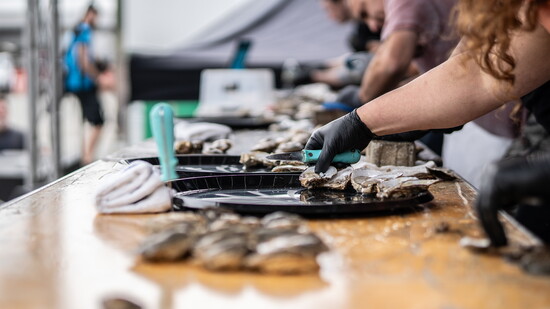
If you’ve lived in Milford long enough, August means one thing: oysters. The smell of salt water, the sound of live music drifting over Fowler Field, the lines of people stretching down toward the harbor — it’s a rhythm this city has known for more than half a century. The Annual Milford Oyster Festival, now in its 52nd year, is one of the oldest and most beloved community traditions in Connecticut. It now shares the weekend with the DMBA’s Fair on the Half Shell, offering attendees a chance to explore Milford’s offerings by day and night alike.
At the Water’s Edge
The Oyster Festival was born in 1975 as a small community celebration of Milford’s deep-rooted oyster history — a history that stretches back centuries. Oysters have been harvested in Milford’s coastal waters for generations, and Bob Gregory, one of the festival’s founding members who is still a familiar face around town, helped turn that heritage into a public gathering. What began modestly — a local event, modest in scale — grew into something that would eventually draw thousands of visitors from across Connecticut and beyond.
“We get people from all over,” says Ila Tokarz, current president of the Milford Oyster Festival, who has served on the committee for 14 years. “People come from all over the country.”
In its heyday, the festival was a full-weekend spectacle that stretched from Greens End all the way past Fowler Field. Saturday mornings kicked off with a canoe and kayak race — a tradition that signaled to the whole city that Oysterfest had arrived. There was an arts and crafts fair on the Green, a car show at Armory Square, nonprofit food groups, live music on multiple stages, and, of course, thousands of freshly shucked oysters. At its biggest — the year Bret Michaels took the stage in 2014 — the festival ran out of just about everything.
The oysters themselves are entirely locally sourced. Today the festival works exclusively with Pearl’s Shellfish Farm and Briarpatch, both based in Milford, ordering approximately 30,000 oysters each year — all harvested fresh from the waters just off our shores. They’re served raw, the way Milford’s oyster tradition demands. And after the festival, the shells don’t go to waste: a CORR recycling program collects and returns them to the water, where they help cultivate new oyster growth and close a beautiful ecological loop.
The festival is run entirely by volunteers and funded entirely by sponsors and the sale of food and beverages — no city dollars, no municipal oversight. It is, in every sense of the word, a community endeavor.
“Our mission is to invest in our community and give our city an opportunity to shine,” says Tokarz. “We really want to celebrate the history of the oyster in Milford.”
A Necessary Evolution
After the festival’s 50th anniversary, the committee made a difficult but necessary decision. Rising costs across the board — insurance, staging, security, entertainment — had become increasingly difficult to manage. The music industry had changed dramatically; the post-COVID era brought with it inflated booking fees and new contractual restrictions that made it nearly impossible to bring in marquee acts at prices a volunteer-run nonprofit could sustain. And volunteerism, the festival’s lifeblood, was declining — not just on the committee, but among the nonprofit food groups that had long been the heart of the festival’s food operations.
The decision was made to streamline: two evenings of live music at Fowler Field, oysters, food trucks, and beverages — a focused, sustainable event that could continue to thrive for years to come. The daytime activities and the arts and crafts fair on the Green would close.
For many in the community, it was a loss. Social media lit up with frustration. Some blamed the city — a common misconception the committee is eager to correct.
“This is not a city-run event,” explains Michele DiBella, second vice president of the festival committee and longtime head of publicity. “Your tax dollars do not pay for the festival. We pay for everything, even the things nobody thinks about – like re-seeding the baseball field when it’s over.”
The Fair Finds a New Home
Enter the Downtown Milford Business Association.
When it became clear that the arts and crafts fair would no longer be part of the Oyster Festival, the DMBA saw an opportunity — and a responsibility. Partnering with the Junior Member League (JML), the DMBA took on the task of carrying forward a tradition that the community had made clear it wasn’t ready to give up. The result was Fair on the Half Shell, now in its second year.
The transition was made smoother by an act of remarkable generosity: Cathy Curley, the longtime arts and crafts coordinator for the Oyster Festival, literally handed the DMBA a playbook. She walked them through it step by step — vendors, logistics, layout, everything. The institutional knowledge that had built the fair over decades didn’t disappear. It transferred.
“She ran us through everything,” says John Wezenski, DMBA vice president. “I mean, it couldn’t have been a more seamless transition.”
The vendors followed. Many of the artisans who had set up on the Green for years made the move with the fair, preserving continuity for both sellers and shoppers. This year, Fair on the Half Shell will feature more than 250 vendors, kids’ activities including bounce houses, interactive coastal-themed programming, and community performances. The DMBA is also working to expand its small-business presence — offering emerging local entrepreneurs a platform to test products and services in front of a large, engaged crowd.
“For over 50 years, that iconic fair has been a beloved tradition and a cornerstone of Milford’s summer season,” says Maritza Quintuna, DMBA PR and social media director. “The Downtown Milford Business Association is proud to carry this cherished tradition forward — breathing new life into a legacy that continues to unite families, friends, and visitors from across Connecticut.”
One Weekend, One Milford
This August, the two events will run in deliberate concert. Fair on the Half Shell will take place during the day on Saturday, August 15, on the Green in downtown Milford. As the fair winds down, attendees can make their way to Fowler Field, where the Annual Milford Oyster Festival After Dark — the festival’s new name that reflects its two-evening format — will be in full swing from 4 to 10 p.m. Friday night’s festivities run from 5 to 10 p.m.
The intentional scheduling overlap is no accident. Both organizations have worked to ensure the day flows naturally from one event to the other, eliminating the dead time that frustrated some attendees last year. The goal: a full, rich day in Milford — morning coffee and browsing on the Green, an afternoon of oysters and music at Fowler, and an evening that carries the energy all the way to 10.
“It seemed like a natural thing, another Milford nonprofit stepping in," John says. “To give the people who love this weekend the ability to keep the tradition going."
What binds both events together, ultimately, isn’t a shared organization or even a shared history. It’s something less formal and more durable: the spirit of Milford volunteerism. People who love this city, who want it to shine, who show up year after year — not for pay or recognition, but because this is their community and they want it to be great.
Bob Gregory, who helped start it all in 1975 and still drives around Milford with the license plate “Oysters 1,” would probably recognize that spirit immediately. Here we are, 52 years later. The canoe race is gone, the format has changed, and a new organization has picked up the fair — but the oysters are still coming in fresh from our waters, the music is still filling the summer air, and Milford is still showing up.
"Our mission is to invest in our community and give our city an opportunity to shine... to celebrate the history of the oyster in Milford.”
“It seemed like a natural thing, another Milford nonprofit stepping in...To give the people who love this weekend the ability to keep the tradition going."