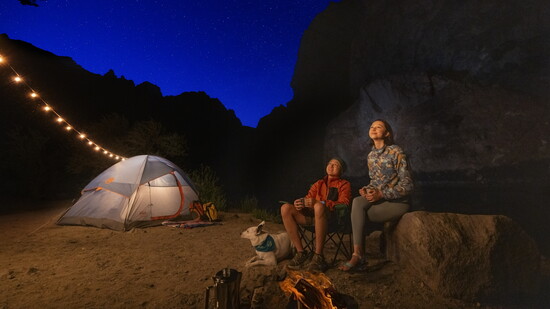
Settled outside of Beatty, Nev.—effectively the middle of nowhere—in a quirky cabin set on hundreds of private acres just miles from Death Valley National Park, I sighed deeply around 11 p.m. Through the glass doors there was a night sky unlike any I could see in Reno. The lack of light pollution meant the Milky Way was visible, as were countless stars and plenty of constellations. My son snored lightly in the cot next to the king-sized, wooden-framed bed I shared with my husband. We had spent the day driving across dusty backroads before landing at the Shady Lady Inn, an uncommon overnighter more than just on the outskirts of town.
We spent the evening stargazing. We used our phones to identify planets and bright celestials. Nearby there are viewing areas and international DarkSky Parks, but our accommodations offered views of the same brightly lit sky just outside our door. We were on a weekend-long road trip through Nevada, specifically researching the connection between astrotourism and sleep, a not-so-novel idea that has gained traction more recently suggesting experiencing dark skies away from city light pollution helps to reset sleep schedules—essentially travel for the sake of sleep.
The National Institutes of Health published a neuroscientific study that measured brain activity using near-infrared technology to uncover a link between visual stimulation from dark, low-light star fields and reduced activity in the prefrontal cortex, the area of the brain tied to stress and anxiety.
The International Astronomical Union Office of Astronomy for Development and its Astronomy for Mental Health initiative suggested stargazing provided relief from anxiety and depressive symptoms within 24 hours at a rate higher than that created by nature retreats alone.
A study published in the Journal of Environmental Psychology included a metric system for humans and their relationship to the night. The suggestion was that psychological connection to the night sky improves mental health and boosts overall happiness.
Enter Astrotourism, a sector of traditional tourism that encompasses travel to remote, dark-sky destinations. In addition to improving overall mood, there have been several correlations between celestial event viewing and improved sleep quality. It’s linked to a biological response to the environmental cadence of light and dark including natural melatonin production, circadian rhythm realignment, and inherent downshifting into a restful state instead of hovering in fight or flight.
At home we can seek natural darkness, putting down our phones and powering off lights when the night sky turns onyx. While helpful tools, they do not seem to replace the sleep response from aligning yourself with Mother Nature.
Sleeptourism, for that reason, is more effective—and more fun.
Nevada is home to a certified DarkSky International park, Great Basin National Park in Baker (in the southeast corner of the state) and a globally recognized Dark Sky Sanctuary (one of ten worldwide) called Massacre Rim, a few hours north of Reno.
Closer yet, a one-hour drive to Fort Churchill State Historic Park offers open desert skies with minimal light pollution. The Tonopah Stargazing Park just shy of four hours south of Reno provides stargazing programs that blend education with nigh sky exploration. If you find yourself in Beatty, take a short drive north to escape any small town lights in the Rhyolite/Goldwell area (where the Rhyolite Ghost Town and Goldwell Open Air Museum are navigable by day).
Just outside of Nevada, Death Valley National Park is a Gold Tier International Dark Sky Park.
Regardless of where you search out your Milky Way viewing station, the benefits remain the same. A deep connection to nature, alignment with the natural world, and an escape from the modern spaces 99% of Americans call home can at the very least promote a proper night’s sleep and at best cure insomnia and mental health disorders, if even temporarily.
There are undoubtedly additional benefits provided by the rural expanses of Nevada’s less-explored corners and the connection between positive mood and sleep by simply interacting with nature. I am also aware there can be a sense of contentment that comes with quality time. Those pockets of unreliable cell service and remote towns with little to do but connect with those around you—or yourself—all add to the advantages.
So, in that silly little bed and breakfast in Beatty, I found calm. Family curled up, heater on, and an intense inky dark sky beyond the sliding glass door. No traffic sounds or streetlights burglarizing my peace, only a chorus of inconsistent squawks from the resident peacocks that perched on our roof, enjoying the night sky on their own as I drifted off in a contented and restful sleep.
In addition to improving overall mood, there have been several correlations between celestial event viewing and improved sleep quality.
Those pockets of unreliable cell service and remote towns with little to do but connect with those around you—or yourself—all add to the advantages.