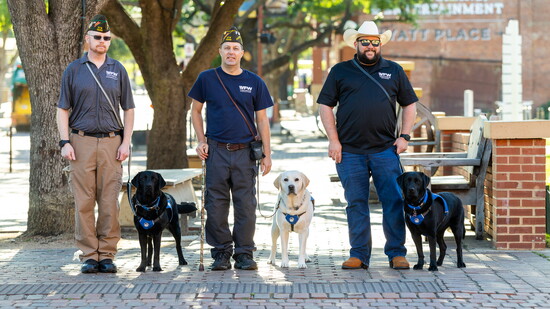
With a better sense of smell, hearing and night vision than humans, dogs have been helping the military for centuries. The first working dogs date back to the Dutch in the first World War. They pulled military equipment and guarded camps. Early mechanical inventions–like vehicles and telephones–changed dogs’ duties in WWII and beyond. But dogs are still many a military man’s best friend.
Working dogs provide an early warning system when threats arise, they retrieve bodies, open doors, and when the battle is over, they provide emotional support and companionship to veterans, especially ones with Post Traumatic Stress Disorder.
“Three years ago, I got Guppy,” says Steven Cook, a retired veteran who served in the U.S. Army’s 7th Infantry Regiment from 1989-1992 in Panama and in the Gulf War. “She just absolutely saved my life.”
Studies show that positive interactions with dogs increase levels of oxytocin, the feel-good hormone, in both humans and dogs. Because dogs rely on their handlers for their basic needs, taking care of pets provides a positive feedback loop, promoting responsibility and offering a sense of purpose.
Cook first learned about the United States Veteran Service Dogs program in 2018 when he went to a graduation at the Texas VFA convention in Houston. “I left crying,” he says. “You could literally see the change on the veteran’s faces when they got their dog.”
Soon after, he received Guppy. “When I came to pick her up, I went to a mall in New Orleans. Guppy broke the leash in a crowded mall and came to me. She picked me.”
With Guppy by his side, Cook became a vice president of US Veterans Service Dogs, helped them open a satellite office in Kyle and raised more than $60,000 for the program. This will be his fourth year hosting a fall telethon.
“The more veterans lives we can change and impact, the better,” he says.
By the end of 2027, US Veteran Service Dogs will have placed 100 dogs and are working on qualifying for free insurance.
As it stands now, a veteran service dog must come from an organization accredited by Assistance Dogs International (ADI) or the International Guide Dog Federation to get Veterans Affairs insurance. Once approved, the VA covers veterinary care, necessary equipment, and prescribed medications for service dogs.
The dogs US Veteran Service Dogs places are mostly labrador and golden retrievers. They are bred in Louisiana, where they receive a year of training and get a full health check. A dog for a veteran with almost complete hearing loss took a little longer to train, Cook says, adding that all the dogs have great instincts.
“Guppy was the one who picked up on my diabetes,” he says. “She started licking my hands profusely. I was with the CEO Cody Bellanger and his wife. He asked what is your blood sugar? She is telling you your blood sugar is low.”
When Cook first started talking to people to raise funds for the program, he couldn’t point to many studies about the benefits of service dogs for PTSD. Then he asked his wife.
“Honey, you are the data, she said. Do you realize you have not taken meds since you got Guppy? You do not sit in your room in the dark. You don’t go to the ranch and spend hours by yourself. You are the data.”
To learn more about United States Veteran Service Dogs go to https://usvsd.org/about-us/