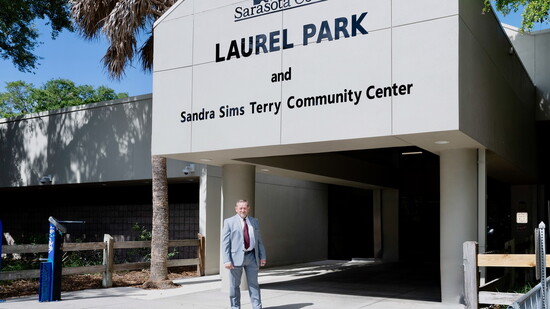
With a career in public service, Peter M. Casamento, M.A., has long been driven to make a difference. After retiring as a law enforcement captain and teaching at John Jay College of Criminal Justice, he recognized that many challenges begin long before a crisis. That insight shaped his path. Today, he focuses on proactive, community-centered work that stabilizes lives and strengthens families—earning recognition as Venice City Lifestyle’s 2026 Remarkable Man.
Q. What brought you to the Laurel Civic Association, and what were your first priorities when you arrived?
A. I was drawn by the opportunity to build something meaningful in a community that needed it. Laurel Civic had a strong foundation and history, but also real potential for greater impact. Early on, it was clear the biggest need was structure—both organizationally and programmatically. By introducing clear expectations, accountability, and measurable goals, especially in youth programs, we shifted from simply providing services to delivering consistent, outcomes-driven results that can truly change lives in South Sarasota County.
Q. How does your focus on structure shape your programs—and help young people build confidence?
A. Structure is everything. Young people thrive when expectations are clear and consistent, so we build our programs around discipline, routine, and strong support—academically, behaviorally, and through mentorship. It’s not complicated, but it does require consistency. Confidence follows success, and success comes from that structure. As students begin to achieve—improving grades, strengthening skills—they start to see themselves differently. With daily encouragement from teachers and mentors, that belief grows, and it can change everything.
Q. How do you approach supporting the whole child and family beyond academics?
A. If a child is hungry, worried about home, or lacks stability, academics alone won’t be enough. We focus on the full picture—providing meals, transportation, and family support—so those barriers are removed. Only then can real progress happen.
Q. Many people describe your work as transformative—what do you consider your most meaningful accomplishments so far?
A. The most meaningful accomplishment is the measurable change in the lives of the people we serve. Seeing students go from struggling to achieving above-average grades, and families move from instability to sustainability—that’s what matters. Those outcomes are real, and they last.
Q. You’re planning a Center for Community Empowerment, but plans have shifted—what’s happening now, and what gap are you working to fill?
A. The vision hasn't changed, the need has. Our Afterschool Academic Program is growing fast, enrollment is up 56 percent in just one year, and we currently have 175 students enrolled, and we're at the point where we don't have enough space. We now have a waiting list for elementary students, and when we can't accommodate them, we're turning children away. That's not acceptable to us.
Originally, we planned to build a new facility, but as that process continues, we're also exploring more immediate solutions to our space challenges. One avenue we're pursuing is our current leased space. We're also in discussions with other community partners and stakeholders to explore additional opportunities to help our program reach more children. Those conversations have been productive.
Our priority is simple. We need space now. The program is established, it's producing great results, and we are exploring opportunities to expand into areas of greatest need, including North Port. But none of that is possible without the capacity to serve more students.
The gap we're filling hasn't changed. There is still no dedicated facility in South Sarasota County that brings together academic support, youth development, Kids Cafe, and essential services to consistently improve outcomes for our children and families. We are excited about these challenges because every day we see the tremendous impact this program has on the children and families we serve, and that drives us to keep growing and finding solutions.
Q. As you look to expand the program—whether in your current space or a future location—what will that growth make possible that you simply can’t do now??
A. Additional space would allow us to add dedicated STEM classrooms—two rooms focused on science, technology, engineering, and math—along with art studios, sensory spaces, and areas for dance and music. The sensory rooms are especially important, offering a calming environment for students who need support with focus and regulation. We would also expand Kid’s Café, because if a child is hungry, they are not focused. It’s that simple. The STEP program would have room to grow, and we could offer more arts and enrichment opportunities—something we simply can’t do at scale now.
Q. Looking ahead, what impact do you hope this expanded facility will have on children, families, and the broader community?
A. The long-term goal is to break generational poverty, and we do that through a two-generation approach, working with both the child and the family at the same time. We start as early as possible.
Our program serves students from kindergarten through 12th grade, with a strong focus on K-8th grade—that’s where the foundation is built. We want children to believe in themselves early and understand there is nothing they cannot achieve. They may need support, and that’s exactly why we are here.
If we can guide students to graduate high school with A’s and B’s and beyond, then they have real options. They can choose their path—college, a trade, public service, or the military. The key is that they are choosing their future, not being limited by their circumstances.
For families, the impact is stability. When you look at ALICE families—Asset Limited, Income Constrained, Employed—you see households one setback away from crisis. Our role is to keep families stable, keep them in their homes, and prevent homelessness by providing food, resources, and support.
For the community, the impact is long-term and measurable: fewer families in crisis, more young people succeeding, and a stronger, more stable community overall.
Q. Your programs seem to create not just services, but a sense of family—why is that piece so critical to the work you do?
A. Because people need more than services, they need connection. When individuals feel supported and valued, they engage more deeply and stay committed to the process. That sense of family builds trust, and trust is what allows real change to happen.
Q. Your work relies on a strong network—who are the people and partnerships helping drive your mission, and how do they shape its success?
A. No organization can do this work alone. Our staff and board are at the core, providing daily commitment, leadership, and accountability. Beyond that, partnerships are essential—they bring resources, credibility, and shared purpose, allowing our impact to grow. Support from community partners like Plantation Golf & Country Club, and so many other companies, organizations and foundations in the community, plays a meaningful role in advancing our mission.
I’m also deeply involved in service through the Laurel Nokomis Lions Club, where I serve as president, as well as Rotary and Sertoma, and we collaborate with organizations like the Red Cross and COAD. When a community invests in a shared mission, the impact multiplies—and that collaboration is what makes lasting, meaningful change possible.
Q. What grounds you in your life and work?
A. My faith is at the center of everything—it shapes how I lead and serve. I believe that to whom much is given, much is required, and it’s a privilege to use my gifts to help others. As an ordained permanent deacon at Our Lady of Lourdes since 2003, that calling to serve guides me every day.