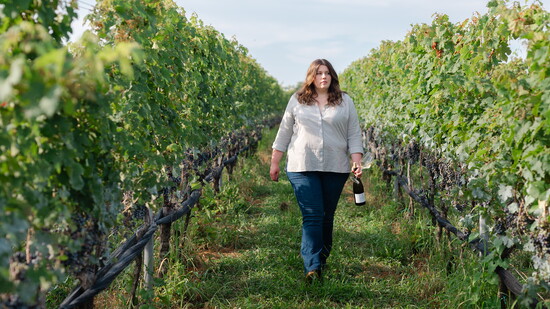
At Early Mountain Vineyards, winemaker Maya Hood White approaches her work with a steady sense of purpose, shaped by both technical training and a deep respect for the land. Her path into wine began with curiosity and quickly evolved into something more intentional.
“It was happenstance! I was working for an engineering firm, and I didn’t love it. But I was always really interested in wine,” Hood White said. “I’m originally from Southern California, and I thought: That’s something I’d like to learn more about.”
That interest led her from classes and tastings to harvest work and, eventually, graduate studies at UC Davis. Today, that scientific foundation remains an asset, though her approach is intentionally restrained. “Our approach in the cellar is surprisingly hands-off but with a lot of data,” Hood White said. “We have a lab on-site so we can do a lot of checks and balances.”
She joined Early Mountain in 2014 and has grown alongside the vineyard, first working in the field and later leading the winemaking program, including planting the Quaker Run vines in 2015. That long view continues to shape how she thinks about each bottle. “Having really seen the evolution and then seeing what they produce in the cellar has been such a special thing,” she said.
In Virginia, where conditions can shift quickly and dramatically, that perspective is essential. “So many dynamics -- it keeps you on your toes,” Hood White said. Rather than forcing consistency, she focuses on pairing the right grape with the right site and allowing each to express itself naturally.
That philosophy shines through in the varieties she’s most excited about. “I love Petit Manseng, I love Tannat,” she said with a nod to how well both grapes adapt to Virginia’s climate. But she also noted that the way the vineyard handles the grapes, from picking times and length of leaf contact to malolactic fermentation and more, is at the heart of what makes Early Mountain’s wine what it is.
For Hood White, the work is as much about stewardship as it is craft. “Wine is a luxury. We have a responsibility to take care of the land, and we take a hyperlocal approach,” she said. It’s a mindset that carries through every stage of the process, from vineyard decisions to the final glass.