Legend has it, Bertha Honoré Palmer was reading the newspaper on a cold, windy Chicago Sunday in 1910, when she came across an ad for Sarasota citrus groves placed by extensive landowner and real estate developer Joseph Lord. Drawn in by the warm climate and natural beauty unique to southern Florida, Palmer came to Sarasota that same year with her brother and sons. She then purchased the land that would make up her Osprey Point Estate—30 acres of which is now Marie Selby Botanical Gardens’ Historic Spanish Point—from the Webb family, who owned most of Osprey. In the eight years between her arrival in 1910 to her death in 1918, she would influence the economic, agricultural, and social future of Sarasota and beyond.
When Palmer’s husband, Potter Palmer, passed away in 1902, it was rare for widows to inherit their husbands’ wealth. “It usually bypassed the wives; the wives were not thought of as being intellectual enough to know how to spend money,” explained John McCarthy, Vice President for Regional History at Marie Selby Botanical Gardens. “It was a unique situation where, in her husband’s will, he made it clear [that] she’s getting the money.” Potter, a highly successful figure in Chicago business and real estate, knew Palmer’s capabilities equaled his own. “Somebody recently described her [as] a Chicago socialite; that’s kind of an insulting term for someone who multiplied her husband’s fortune several times before she died,” McCarthy said. Palmer would come to own 90,000 acres in Sarasota alone, and the land she acquired at what is now Marie Selby Gardens Historic Spanish Point campus would become an enduring source of intrigue and enjoyment.
“When she came to Sarasota, she was probably one of the most famous women in the world,” said McCarthy. At this point, Palmer was not only known for her real estate holdings in Chicago, but for being significantly involved in the World’s Fairs in Chicago and Paris. Elected President of the Board of Lady Managers and tasked with constructing the exhibition building for women’s accomplishments at the 1893 Chicago World’s Fair, Palmer hired a staff of female architects, muralists, and artists. Using her connections to French aristocracy and close ties to Europe, she effectively “convinced people all around the world to send their accomplishments to America to be put on display,” said McCarthy. In 1900, against the objections of Congress, President McKinley appointed Palmer as a United States ambassador for the Paris World’s Fair. “As I understand it, that’s the first time a woman was ever appointed as an ambassador to represent the United States,” said McCarthy.
In Sarasota, Palmer continued to assert herself in and attract people to her community. Upon her arrival, she participated in the male-dominated Board of Trade, a predecessor to the Chamber of Commerce, and announced her development plans. “Back in those days, it was more unusual for a woman to be involved in real estate … for a woman to be an entrepreneur … for a woman to be a large-scale developer, but that’s what she was doing,” explained McCarthy. Palmer even developed a demonstration farm on the property adjacent to Historic Spanish Point to showcase the rich agricultural opportunities Sarasota offered potential buyers. Palmer’s influence on the area was so great that her presence was often touted on brochures produced by the Board of Trade, and picturesque images of her Osprey Point Estate frequently graced Sarasota postcards. McCarthy noted that while John Ringling also arrived in Sarasota in 1910, “there weren’t any articles in the newspaper about it.”
Although Ringling did not bring the circus to Sarasota until the late 1920s, he is often credited with introducing it to the arts. As early as 1915, however, Palmer began organizing art lectures at the women’s clubhouse she helped establish downtown. “In Chicago, she basically introduced the United States to Impressionist art,” said McCarthy. Palmer, along with her friends, routinely traveled to Europe and purchased the art of Claude Monet, Edgar Degas, and Mary Cassatt. “She had Monets hanging on her wall here at Historic Spanish Point,” said McCarthy. Palmer’s European connections continued to inspire her home and garden at Osprey Point Estate. King Edward VII, who was close friends with Palmer, felt that his gardens should have a more “deliberate but casual” design than those of his predecessors, and Palmer appeared to follow suit.
She had a remarkable appreciation for the natural contours of her gardens. At a time when most landowners were selling their property’s ancient shell mounds—built by Native Americans thousands of years prior—to be made into roadway material, Palmer understood the importance of preservation. At that time, it was believed the shell mounds were only hundreds of years old. It wasn’t until the 1950s that radiocarbon dating was used to determine they were in fact constructed as long as 4,500 years ago.
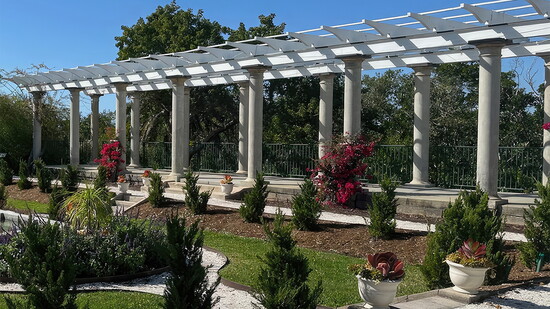
Historic Spanish Point, adopted by Marie Selby Botanical Gardens in 2020 (Selby.org/hsp/Visit-Historic-Spanish-Point/), likewise preserves and shares Palmer’s sprawling gardens today. When asked what Palmer would be most proud of if she could see the grounds now, McCarthy did not hesitate: “The Sunken Garden and Pergola; that it’s here and looks just like when she built it, that thousands of people come here every day to enjoy it. That would make her smile.”