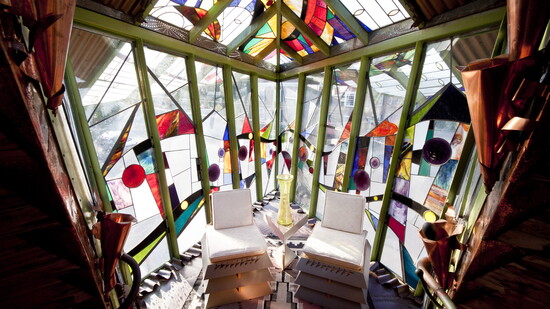
Tucked into a residential block in East Hyde Park, Wahopi—often called “the mushroom house”—stands apart from its surroundings. Designed and built beginning in 1992 by architect Terry Brown, the structure was originally known as The Studio. Brown’s early design work is known as Wahopi, a Native American word loosely translated as “nest.”
Wahopi was conceived as an immersive expression of organic architecture—a philosophy rooted in the belief that buildings should echo the forms, materials and rhythms of the natural world. The movement traces back to Louis Sullivan and Frank Lloyd Wright, whose work emphasized harmony between structure and environment.
According to Rick Wolf, one of the local craftsmen who helped build Wahopi, “[The house] reflects those principles through its undulating cedar shakes, lack of orthogonal [traditional right-angled] shapes...including the windows...and constant use of found or recycled materials.”
All of these trademarks are an approach that elevates what might otherwise be discarded into something intentional and expressive.
Locally Sourced
A defining principle of organic architecture is the use of materials drawn from the area.
“In Cincinnati, that means wood—oak, pine or cedar—and tile, due to our clay and river,” says Wolf.
Across the metro, other examples of organic architecture include the stonework of Burnet Woods Open Shelter Pavilion and Bellevue Hill Park Pavilion, the brick-and-stone Eden Park Board Administration Building and the rustic materials of Mount Airy Forest’s Oak Ridge and Maple Ridge Lodges.
At Wahopi, the private residence in East Hyde Park, cedar, tile and recycled materials bring the philosophy home.
The Art of Preservation
As an architecture student, Wolf worked inside Wahopi layering hand-cut cedar shingles to create rippling interior walls and embellishing windows and doorways with hammered copper remnants. He was later invited to take on something entirely new: mosaicking three studio ceilings using leftover Italian glass tiles from a client’s bathroom remodel.
“I had never installed tile,” Wolf says, “but was excited by the project.”
After completing the ceilings, Wolf submitted a kitchen floor concept inspired by a Louis Sullivan stencil. He spent weeks installing the floor himself—and in the process discovered tile as an expressive medium.
Today, he runs Wolf Custom Tile and Design and maintains Wahopi’s tilework. Preservation, he notes, is very different from renovation. Organic buildings age, shift and sometimes leak. When that happens, the goal is restoration, not reinvention.
“We try to put it back exactly the way it was made,” he shares.
The landmark home, a collaborative effort of local craftsmen working under the vision of Terry Brown, is a celebration of the organic architecture movement that blossomed in our community.
Wahopi was conceived as an immersive expression of organic architecture.