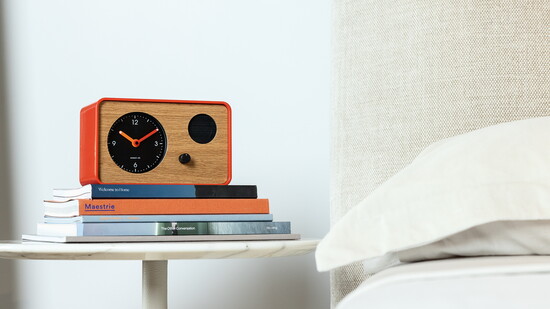
Five years ago, as Jamie Kripke was preparing to leave the advertising world behind, he continued a routine of having to hustle and get up to catch flights for work. In the midst of the grind, Jamie and his wife made a simple and sensible decision: no more phones as alarm clocks and minimising screens before bed.
What seemed like a small lifestyle change quickly exposed a problem. He searched endlessly for a clock that felt intentional, something well-designed and calming, different from the typical jarring bright lights and sharp tones most of us have unfortunately grown accustomed to. Nothing on the market resonated, so Jamie did what creatives often do when the solution doesn’t exist: he got to work designing.
He shared the idea casually with friends, kicking it around without any clear plan. At the same time, he was doing artwork for a certain friend who happened to have experience in manufacturing. That coincidence proved pivotal.
“Sometimes you bump into the right person,” Jamie says.
After countless prototypes and workshops, the idea evolved into a real product. The team, eventually joined by another of Jamie’s constituents, decided to launch on Kickstarter and Indiegogo. But this wasn’t a casual experiment. They went in wholeheartedly on production, obsessively preparing every detail. “It was very intentionally orchestrated,” Jamie explains.
They sent prototypes to journalists, executed major marketing pushes, and leaned hard into the momentum. The campaign was a success, raising a total of $1.1 million when all funding efforts were considered. More than 4,000 people received the product, and the buzz was only just starting—quite impressive.
With momentum building, the company scaled up with additional collaborators. Like many young businesses, the overhead outpaced the moment, and Jamie responded by wisely tightening the operation and returning the company to a leaner model. Reminiscing on the experience, he noted feeling, “[he] had to get through the process.” By doing so, he gained an entirely new skillset and got to focus on the ethos of the company.
What followed was a crash course in entrepreneurship. Jamie taught himself how to run ads, build email campaigns, and operate the business end-to-end. The reset worked. By stripping the company down to its essentials, he created something efficient and sustainable, allowing the company to sell through its first 10,000 units directly from the factory.
“I’m always wrestling with the balance of art and commerce.” A sentiment Jamie shares. That came as no surprise, given the eclectic artist I’ve come to understand him as.
That tension is especially evident in OneClock’s approach to sound. Rather than relying on traditional alarm tones, the company built its identity around music and neuroscience. They had a sonic strategist, Eli Mishkin, compile and analyze current research on sleeping, waking, and how the brain and body respond to sound. From that science, the team created a set of guidelines and leaned on Jon Natchez, Grammy award-winning member of The War On Drugs, to compose exclusive waking music for the clock.
The result is deeply intentional and deliberately limited. The music made for OneClock can only be heard through the device itself and complements the minimalist design seamlessly.
It’s a philosophy rooted in restraint: fewer notifications, fewer distractions, and a more human relationship with technology. “Solving the riddle of art and commerce” is an unending problem Jamie is constantly tussling with. In the case of OneClock, he’s made wonderful progress.
In an oversaturated world, OneClock represents a return to simplicity without sacrificing sleekness or modern design. It’s a quiet reclamation of stillness in an always-on culture, and a reminder that sometimes the most meaningful innovation starts with stepping away.
To learn more, visit OneClock.co.
OneClock is an analog timepiece with science-backed sounds that gently lift you out of sleep in a peaceful, natural way.
A big return to simplicity in an oversaturated world.