Walla Walla has been written about.
The wines reflect the range found in the land itself—different soils, elevations, and varietals that resist settling into one style. My husband and I have been visiting and tasting here for nearly three decades, first discovering it while at Washington State University. We keep coming back.
Experiencing Walla Walla feels different than reading about it.
The town carries its history quietly. Streets lined with older homes, neighborhoods that feel settled and intact. Irrigation ditches move through front yards and disappear beneath sidewalks and roads. Whitman College sits calmly within it, while the Marcus Whitman Hotel anchors downtown, familiar to anyone who has spent time here. Over the years, downtown has become as much a destination for food as wine.
It shows up in how long people stay at a table. How a tasting becomes a conversation that moves beyond the wine itself. One stop turns into another, and eventually the question shifts. Not what Walla Walla is known for, but what it is about the place that continues to draw people back.
You begin to notice it out in the vineyards.
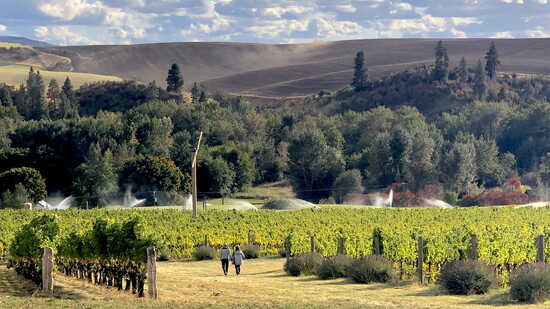
The landscape doesn’t reveal itself all at once. It unfolds slowly as you drive or bike through it—open stretches, subtle elevation changes, steady wind, grain fields giving way to vineyards. Some sites feel exposed, others tucked into folds of the land.
And once you begin to see those differences, you hear people describe them in ways that make you pause.
Chris Figgins of Leonetti Cellar and Figgins Estate put it simply: “You’re not just tasting the wine… you’re tasting the site.”
Devyani Gupta, winemaker at Valdemar Estates, describes Walla Walla less as a single landscape than a series of distinct environments, each shaping the wine differently. In The Rocks District, the soil shifts to deep cobblestones—an ancient riverbed that holds heat and gives it back to the vines. Elsewhere, wind becomes the defining force, shaping growth and concentrating fruit. Higher in the Blue Mountains, cooler temperatures and heavier clay soils slow things down, creating a different structure and expression.
Those differences carry through to the glass.
Warm days give way to cooler nights. Wind keeps the vines in check. Elevation brings lift and freshness. The balance feels less manufactured than naturally occurring.
Every vineyard is worked with intention: where to plant, what to plant, how blocks are divided, when fruit is picked. Even within the same vineyard, sections are treated differently and understood over time.
For Gilles Nicault, winemaker at Long Shadows Vintners, part of the appeal has always been the freedom to work without rigid expectations. In older wine regions, traditions are often fixed. Here, there’s still room to respond to what the land offers. Cabernet and Syrah can come together. Fruit from different parts of the Columbia Valley can be blended with purpose rather than convention.
Jean-François Pellet of Pepper Bridge Winery and Amavi Cellars describes it as a region still evolving. Even after decades of working the land, there are still things to learn. The soils, shaped by ancient floods, vary more than they first appear. The climate offers consistency, but not predictability.
What stands out as much as the wine is the exchange between the people making it.
Winemakers here taste together. Compare notes. Talk openly about what worked and what didn’t. It’s not unusual for several wineries to source fruit from the same vineyard and later sit down to compare how each interpretation turned out.
There’s a phrase that comes up more than once, first from Chris Figgins and later from Marcus Rafanelli of Woodward Canyon Winery:
“We push the people ahead of us and pull the people behind us.”
It doesn’t feel rehearsed. It shows up in conversations, in shared information, and in the willingness to see someone else succeed.
Early on, there were only a handful of wineries here. People were learning through trial and error—what could grow, what could survive winter, what could stand alongside wines from more established regions. Collaboration began out of necessity, but much of it remains.
Devyani Gupta arrived in Walla Walla from a very different direction, originally coming to Whitman College with interests unrelated to wine. What she found was not only a landscape surrounded by vineyards, but one layered with possibility. There’s history here, but also room for new perspectives.
Scale matters too. Walla Walla remains relatively small, and many wines never reach broader markets in large quantities. Attention stays close to the vineyard, the vintage, and the decisions shaping each bottle. There’s less distance between the people making the wine and the people drinking it.
Visitors come expecting good wine and usually find it. What tends to linger is harder to define.
Maybe it’s the pace. Maybe it’s the way conversations stretch longer than expected. Maybe it’s the feeling that the region still hasn’t fully settled into a final version of itself.
By the time you leave, Walla Walla resists being neatly summed up.
Not because it’s trying to be mysterious, but because the experience is cumulative. The land, the wine, the people, and the history all seem to build on one another slowly over time.
And perhaps that’s what continues to hold people’s attention long after they leave.
Tammy de Weerd is a contributing writer for Boise Lifestyle and Meridian Lifestyle and co-founder of Spoken Wines.
Walla Walla feels less like a finished destination and more like an evolving landscape, where vineyards, shared experience, and long-standing relationships continue influencing both the wines themselves and the people drawn back there repeatedly.