Those who are drawn to downtown Parkville come for the historic charm of this community, as well as locally owned shops and restaurants.
But most visitors and some residents never experience a quiet, but historically significant side of this little river community. This requires a visit to a short street in a residential area just west of downtown.
The address is 1137 West Street.
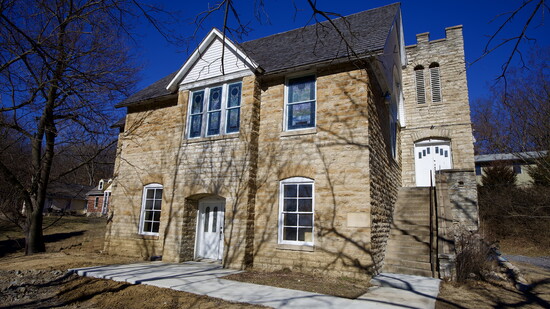
Rising on a grassy hillside is the Washington Chapel C.M.E. Church. The history here is as old as Parkville itself.
This is where the Douglass sisters were raised — Cora, Pearl and Lucille. They have fond memories of their grandmother preparing church suppers on the old South Bend Malleable stove that still anchors the fellowship hall and not so fond memories of a firm pinch from their mother if the sisters were not paying attention in church. They sang in the youth choir, attended junior church, Sunday school and church again.
“This is home,” Cora, 77, and Pearl, 83, said, almost simultaneously. “This is my safe space,” added Cora, who holds a doctorate in Christian counseling.
Some records indicate that “colored Methodists” were meeting in a hotel located adjacent to the old Parkville Train Depot as early as 1835.
The town of Parkville was founded in 1838, a year after the Platte Purchase became a part of Missouri. Later, Park College donated land on what was then Parkville’s west side for a school and a church for Black residents.
Benjamin Banneker School, just down the street from Washington Chapel, was built in 1885. The chapel’s cornerstone was laid in 1907. Both buildings include limestone quarried and hand-hewn by Parkville’s Black residents and students at Park College.
“Former slaves had great skills in masonry and construction,” says Cora. “That these buildings are still standing is testament to that.”
Both buildings were placed on the National Register of Historic Places in 1992 thanks to efforts from their mother, Lucille Sears Douglass, who passed away in 2003.
Over the years, Washington Chapel has been maintained to the best of the small congregation’s abilities. But in October 2022, services inside were suspended until major architectural and accessibility issues were addressed.
The Douglass sisters and others are quick to recognize Saint James C.M.E Church in Leavenworth and Rev. Nicky Wright for welcoming members of their congregation during the renovation. The Parkville Presbyterian Church has also provided invaluable support.
But the bell tower was crumbling, the attic had no insulation, the single bathroom was not up to code, and many other issues were identified by retired architect and volunteer project manager Mike Scarborough. While fundraisers and volunteers began the work, the entire cost is estimated at more than $600,000, an overwhelming amount for a small congregation.
Then, Barbara Luetke moved to the area. A native of Wisconsin who came to Platte County via Seattle, Barbara is a retired university professor with experience in grant research and writing.
Working with Pearl Douglass Spencer, Barbara prepared a grant through the National Trust for Historic Preservation’s African American Cultural Heritage Action Fund. They were awarded $160,000.
That, along with an estimated $200,000 worth of in-kind donations and volunteer work, has allowed for the completion of three handicapped accessible restrooms, new carpeting and a new HVAC.
The sanctuary is located on the second floor, so the biggest outstanding expense is adding an elevator to allow worshippers access who cannot manage the stairway.
About 30 volunteers showed up on Martin Luther King, Jr. Day this year to clean and polish pews, move piles of debris and other tasks. Among them was Joyce Schrimsher and her 11-year-old grandson, Henry, and his best friend, Riley Gosch, 11.
“Having them here on this day, doing this work, puts the knowledge of slavery this close into perspective,” said Joyce Schrimsher.
Many of the volunteers that day were with the White Alloe chapter of the Daughters of the American Revolution. Most had never been in the church before and expressed excitement at the prospect of returning for a worship service.
“If people are going to try to erase history, then we’re going to do what we can to save it,” says Kat Henry, a frequent volunteer and member of Do Something Missouri. “We can’t do everything, but we can always do something.”
Another group that has been a Thursday presence for at least two years is Friends of Sacred Structures, a Kansas City non-profit dedicated to the preservation and renovation of religious spaces. FOSSKC has also awarded the church nearly $6,000 in grants.
“The people who originally built this church, they were good,” says Max Sherman, who coordinated the skilled labor volunteers from FOSSKC. “It’s been such a joy to see this congregation get their church back.”
Services are expected to return to the chapel any day now. The restoration will continue for as long as it takes.
Follow progress and learn how to donate on the Facebook group for Washington Chapel Restoration.
“This is home,” Cora, 77, and Pearl, 83, said, almost simultaneously. “This is my safe space."
“Former slaves had great skills in masonry and construction,” says Cora. “That these buildings are still standing is testament to that.”