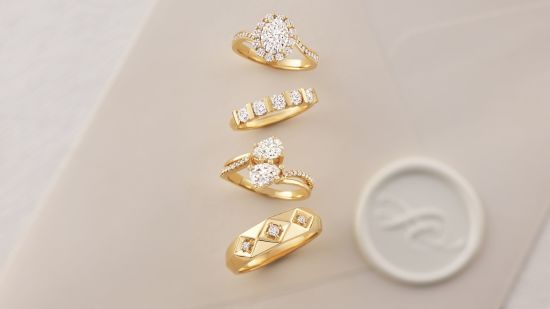
You love your engagement ring. Then you try a wedding band beside it and notice something you had not considered: a gap.
Does that mean you chose the wrong engagement ring? Not necessarily. Does it mean you need a completely new setting? Not automatically.
How closely two rings sit together depends on their shapes and dimensions. The structure beneath your engagement ring’s center stone may occupy the space a straight wedding band would need. The wedding band’s height and profile matter, too.
At Christopher Fine Diamonds in Chandler, we encourage couples to compare wedding rings and bands with their actual engagement ring rather than choosing from photographs alone. The goal is to find a pairing you enjoy wearing—not simply two rings that look coordinated in separate pictures.
What Does “Sitting Flush” Actually Mean?
When someone asks for a wedding band that sits flush, they usually mean they want the two rings to rest closely beside one another without a noticeable gap.
That preference is worth mentioning early. It is different from wanting matching diamond shapes, identical band widths, or the same metal color.
You might love two rings that coordinate beautifully but leave some space between them. You might prefer a band that follows the engagement ring’s outline closely. Neither look is automatically the right one for everyone.
Before comparing options, ask yourself: Is closing the gap important to me, or do I simply want the two rings to look good together?
Why a Straight Band May Not Fit Closely
Look at your engagement ring from the side rather than only from above.
The center stone has a supporting structure beneath and around it. Depending on the design, that structure may extend beyond the engagement ring’s band and prevent a straight wedding band from moving closer.
This is why choosing a wedding band based only on your diamond’s shape can be misleading. Two oval engagement rings, for example, may have very different settings underneath their center stones.
During your visit, ask us to show you exactly where the rings meet. Understanding what creates the gap makes it easier to compare solutions.
Do not try to force the rings together. A close-looking pairing should still be evaluated for appropriate clearance and how the pieces interact.
Start by Comparing Three Directions
Before deciding that custom design is necessary, explore a few different approaches.
A Straight Band With Intentional Space
Try a straight band and look at the complete pairing on your hand.
Do you like the separation? Does the wedding band have enough presence on its own? Does the overall combination feel balanced?
A visible gap is not automatically a design flaw. It may simply be part of how those two styles sit together. We would still want to evaluate the pairing, but you do not have to eliminate every bit of visible space to create a look you love.
A Curved or Contoured Band
A curved band changes direction around the engagement ring’s center setting instead of continuing straight across.
Some curves are subtle. Others follow a more pronounced outline. The important question is whether that particular shape works with your particular engagement ring.
Try more than one profile. A band that looks beautiful beside one setting may not create the same result beside another.
A Custom Band Designed Around Your Ring
When an existing style does not give you the fit or appearance you want, a custom wedding band gives us another direction to explore.
We can consider your engagement ring’s dimensions alongside your preferred band width, metal, diamond details, and overall look.
At Christopher Fine Diamonds, our in-person CAD Jewelry Design Experience provides a way to review the proposed design before it is made. We can discuss the contour and proportions together rather than asking you to imagine the finished pairing from a verbal description.
Custom does not have to mean elaborate. It can mean creating a simple band with a shape chosen specifically for your ring.
Try the Wedding Band by Itself, Too
During your appointment, take off the engagement ring and look at the wedding band alone.
Do you still love it? Does its shape feel intentional on its own? Would you be happy wearing it that way?
Tell us whether you expect to wear the two rings together every day or sometimes prefer only the wedding band. That preference can influence which options you want to compare.
Also pay attention to the complete set’s comfort. Bend your fingers, relax your hand, and notice the combined width. Ask us to check sizing with both rings in place rather than assuming a familiar size will feel exactly the same in every combination.
The wedding band deserves consideration as its own piece of jewelry, even when you are choosing it to complement another ring.
A Coordinated Set Does Not Have to Match Exactly
Closing the gap is only one part of the design conversation.
You can also compare matching and contrasting metal colors, different diamond arrangements, or a plain band beside a more detailed engagement ring.
Try a quieter option that lets the engagement ring remain the focus. Then try a band with more presence. Notice which combination feels most like your style rather than assuming the wedding band must repeat every detail of the engagement ring.
The same applies to your partner’s ring. You can choose a shared detail without needing identical designs.
Should You Change Your Engagement Ring?
We would begin by exploring bands that work with the ring you already love.
Changing the engagement ring’s setting may be worth discussing in some situations, but it should not be treated as an automatic solution to a gap. An evaluation comes first, followed by a conversation about feasibility, appearance, cost, and timing.
Tell us which details of your engagement ring you want to preserve. Perhaps its low profile is something you particularly enjoy. Perhaps the original setting has sentimental importance.
Those priorities should guide the next step—not get lost in the effort to make two rings sit closer together.
Bring Your Engagement Ring to the Appointment
Your actual ring is the most useful starting point for this conversation. Inspiration photographs can help explain your preferences, but they cannot show us every detail of its construction or how different bands will feel beside it.
Bring any other rings you plan to wear in the same stack, too. Share your wedding date, a comfortable budget, and whether a close-fitting set is essential or simply something you are curious about.
We can compare existing styles, discuss custom possibilities, and explain the next steps for the option you prefer. For an order or custom project, confirm the anticipated completion date before moving forward.
Find Your Wedding Band in Chandler
At Christopher Fine Diamonds, we help couples from Chandler, Gilbert, Mesa, and the surrounding East Valley explore wedding bands with the complete pairing in mind.
You do not need to arrive knowing whether you want a straight band, a curved design, or something custom. Bring your engagement ring and let us help you compare.
Schedule your wedding-band consultation at our Chandler showroom. We will start with the ring you love and explore what belongs beside it.