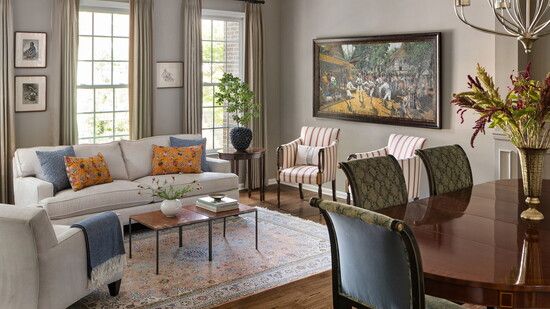
The ultimate modern indulgence is the ability to truly exhale, recharge, and be completely yourself within your own walls. We sat down with Jennifer Fordham, owner and designer at Pembrook Interiors, known for creating homes that feel utterly personal, serene, and deeply rooted, to explore how interior design becomes the blueprint for well-being.
Defining a Restorative Sanctuary
Fordham defines a restorative sanctuary not just as a beautiful room, but as "an environment that allows you to exhale and be yourself, to recharge." She argues that true sophistication is entirely personal.
"In a world where things are mass-produced, the ultimate expression of luxury is the opposite: a home so thoughtfully composed around your life, your collections, and your concept of beauty that it feels like an authentic expression of you. True sophistication isn't about fancy and new, it's about what's thoughtful, lasting, and personal."
Fordham's philosophy is centered on creating a “frictionless” day, designing out the stress and distraction of the external world. "We're designing for the 5 p.m. version of you who's depleted, not just the 10 a.m. version who has energy to spare," she explains. This means every detail, from storage to the placement of furniture, is designed to eliminate cognitive load. Protection from chaos requires intentional curation where every object earns its place through beauty, utility, and meaning.
Beyond the visible aesthetics, the intangible elements like scale, rhythm, and proportion, are critical. When a room "feels off," the problem usually lies in three foundational elements: architectural detailing, lighting, and window treatments. Getting this right creates visual coherence paired with functional clarity, essential for refuge.
The Heart of the Sanctuary
The selection of materials is a holistic exercise, balancing performance and psychological impact. Natural materials like wood, stone, and linen, are paramount, and the key to emotional grounding is texture. "Varied textures, a wool mohair headboard, linen velvet drapery, or a chunky cashmere throw, signal domesticity and permission to relax," Fordham says. "We layer textures intentionally to create what we call 'tactile richness' without visual chaos." This attention ensures your home registers as a place of substance and comfort.
Sound mitigation is a profound, yet often overlooked, component of sanctuary. "Sound is one of the most overlooked elements in residential design, yet it profoundly impacts whether a space feels like sanctuary." Solutions like acoustically lined window treatments, grass cloth wall coverings, and substantial wool rugs are employed to absorb noise while adding visual interest.
Fordham also stresses the importance of Biophilic Integration, noting, "The most fundamental way to connect with nature isn't through objects we bring in, but through intentional design that honors the environment surrounding the home." This includes designing spaces to capture natural views, or echoing garden elements through textiles or wall coverings.
For lighting, Fordham designs layered, dimmable systems that support the body's natural circadian rhythms. "Natural light is non-negotiable for wellness, but it's not just about quantity, it's about quality and timing," she notes. Artificial light is tailored: bright for morning energy, warm and dimmed for evening wind-down.
Tech Detox Zones offer a dedicated area for recharging away from devices. "The goal isn't banning technology; it's creating spaces so perfect for their intended purpose that tech naturally stays in its lane." Ultimately, great design begins with great questions. Fordham asks, "What makes you feel restored? What does recovery look like for you?" This discovery process ensures spaces, whether a perfect reading nook or a movement studio, are designed for actual use, not aspirational use.
The Enduring Sanctuary
When designing for longevity, the focus must be on human constants; your need for light, privacy, comfort, and smooth daily routines, rather than passing trends. This means investing in quality bones, thoughtful flow, and quality materials. "Quality design and furnishings last 15-20 years or more," Fordham says.
Looking ahead, Fordham sees the future of luxury in comprehensive, holistic wellness integration: "The transformative principle isn't just eliminating toxins; it's proactively designing for wellbeing at every level."
For readers who want to feel the immediate effects of a restorative home, Fordham offers this simple, powerful action: "Edit one surface in your most-used room. Remove everything. Then put back only what's beautiful, functional, or meaningful. Your home should feel special because everything in it deserves to be there."
Varied textures, a wool mohair headboard, linen velvet drapery, or a chunky cashmere throw, signal domesticity and permission to relax.
The most fundamental way to connect with nature isn't through objects we bring in, but through intentional design that honors the environment surrounding the home.