One of the first things you’ll notice when you walk into Khan Medical Clinic is the artwork. While pictures of Longhorns and Texas-themed décor are not unusual choices for a Texas establishment, the Western style throughout Dr. Nusrat Khan’s office is more than a cultural byproduct of the location; it’s a reflection of the physician himself.
“I pretty much like everything Western, but I love Longhorns,” he says. From the time he was young, Dr. Khan has always held a special admiration for the “Old West,” including cowboys, Longhorns, and John Wayne.
The best example of his enjoyment of Western themes is found in the logo of his clinic. “I actually made that logo,” he says, pointing out a framed piece in the hallway of the clinic. “I drew it myself. It was me and a nurse who worked together to make that logo… I was sitting in this museum, the Sid Richardson Museum. That day, they were laying out these cards and saying, ‘Draw something.’ I had just opened up the clinic, so I drew a logo: Longhorns, hat, stethoscope… I sent it to my manager, and she sent it to her daughter. She put the ‘K’ in there… So, that’s the story of the logo.”
While the Western influence has been strong in Dr. Khan’s life, it’s far from the only thing that shaped his journey. Medicine has been a deeply fascinating subject to Dr. Khan since he was very young. “I was always interested in medicine. I think it’s one of those weird things. My mother said I was very young when I started showing an interest… Other kids were thinking of toy trucks and of being firefighters, and I was thinking of stethoscopes… It was a first love kind of thing.”
Unlike some childhood loves, Dr. Khan’s interest in medicine endured. He graduated from medical school at East Carolina University, making him the first physician in his family. He then trained at the Cleveland Clinic Foundation and pursued postgraduate studies at Harvard, focusing on patient safety and medical quality. He has also earned an MBA in healthcare management from Texas Tech while continuing to provide care for patients in and beyond Parker County for the last 17 years.
Dr. Khan met his wife while he was at Davidson College in North Carolina. The couple spent a few years in Chicago before settling in Texas, where they chose to raise their (now grown) children. “I’m very lucky that I found a place in Parker County because it’s the mix of Texas and small-town charm… So, I’ve been adopted by Parker County. People here are very nice, and they’re very accepting.”
After serving 3 years in corporate medicine, Dr. Khan returned to private practice. Khan Medical Clinic, located in Willow Park, began welcoming patients in 2024 and plays a vital role in the health and wellness of the residents in Weatherford and the surrounding areas. “As long as you serve (the community) well, they’ll accept you. I’ve found a home and a heart of acceptance in Parker County.”
However, his community engagement stretches beyond the county lines. Dr. Khan is a member of the faculty at TCU School of Medicine, UNT Health Science Center Fort Worth, and UNT Arlington, where he helps future healthcare workers prepare to treat patients.
Dr. Khan also considers himself a lifelong learner and devotes time outside of work to medical research. “In order to serve my patients, I need to know the art and science of medicine… Because I believe in the mind, body, and soul connection for medicine, I tend to be more holistic in my approach. So, while I read medicine, I also read a lot about supplements, diet, exercise, gut health, and doing certain things along with medication that may improve the mind, body, and soul connection. I’ll read about alternative medicine; I’ll read about functional medicine. I’ll read about supplements and herbs that help us live better, or basic foundational habits, such as yoga, exercise, or a healthy diet, and how they kind of blend together.”
When he isn’t treating patients or dedicating time to research, Dr. Khan enjoys the outdoors. “My wife and I like to hike,” he says. “It’s nice to do that. And Fort Worth is a really nice place for that, and even further south.”
A Clinic with a Mission
Around Parker County, Dr. Khan and his team are known for their hard work and dedication to their patients, a mission they take to heart. “Within patient care, one has to have a mission… And that mission then guides how you deliver care… It’s such an emotionally encompassing thing to do, to listen to other people when they’re sick and vulnerable… It takes an emotional toll. So, unless you are guided by some mission, there’s a risk of burnout.”
At Khan Medical Clinic, the mission is clear. “To serve with a purpose; to truly care about and help people.”
For patients with chronic conditions, “You have to have a purpose to improve quality of life,” Dr. Khan says. “You talk to the family members, you talk to the patient, you tell them the good, bad, and ugly about drugs. And you always feel like even that little bit of good that you might do—which can be something other than writing a prescription—is going to lead to a better quality of life. So, my feeling is that if I can just do even a little bit, that helps them psychologically, mentally, physically… That’s really sort of my spiritual mission.”
That’s another reason Dr. Khan encourages his patients to communicate frequently with his clinic. “Prevention is the best cure… We encourage our patients to come at least every 3 to 4 months, depending on their age… (Patients) should consider coming in for routine evaluations, checks on their labs, and general health issues. That's important. And that really helps us provide better care.
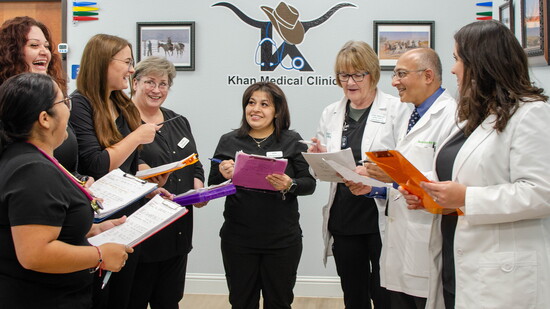
Dr. Khan believes, “You cannot deliver comprehensive health care unless you have techniques you utilize to elevate the care of the patients, and a very dedicated team. One of the things we do daily is run a quick check-in team meeting. We call it a Huddle. We check all the local hospitals to make sure that if any of our patients have gone to the ER or come out of the hospitals, we call them and check on them, and we see them soon. Some of our really sick patients even get a Friday afternoon phone call from us to check on their healthcare needs before the weekend.
“This is not something new. We have run huddles for over 10 years in my clinic. However, you cannot do any of this without a truly dedicated and caring staff. I am so fortunate to have found the team I currently work with. The nurse practitioners here, Denise Austin, Cindy Bernard, and Christina Bazan, are what any health care team would be proud to call colleagues. Our current staff is a blessing to me and this clinic. Our mission of exceptional care would not be possible without these unsung heroes.
“But we do that day in, day out… Every day—even nights and weekends—we're on call. I have taken calls for 365 days for the last 17 years. And if I'm not the one who's on the first call, I'm the one on the second call… That’s what keeps them coming back here… It’s the relationship you build with people. It’s serving the community.”
The Search for Answers
Sometimes, patients have searched everywhere for answers and still come up with no solutions: “This happens more commonly than we think,” Dr. Khan says. “Western medicine doesn't always have all the answers. Just because you wear a white coat or have the power to prescribe, you don't have all the answers… Now you're forced to think outside the box.”
Dr. Khan says that looking at a patient’s overall lifestyle is crucial to figuring out the root of the problem. “It really becomes a more holistic way of looking at the patient. I've had my set of challenges… some we still continue to work on as a team.” In a complex case, Dr. Khan says it’s important to consider all avenues. The answer to a patient’s concern may lie in a combination of medicine, diet, and exercise. Others may find solutions in a mixture of traditional and alternative forms of care. “We, as healthcare providers, have to be open to the idea that… we may not have all the answers, but just because the labs are negative doesn't mean your patient doesn't have a problem and isn’t suffering… The worst thing we can do—and I've seen this happen in healthcare, very unfortunately—the worst thing we can do is label somebody's problem as in their head… Don’t dismiss human beings.
“It goes back to the mission of practice: try to do some good somewhere all the time, even if you can't cure it… I tell my team this, and whoever cares to listen, ‘You create a ripple effect. And the ripples continue to benefit other people.’”
The Power of Preventative Care
From regular checkups and lab work to routine vaccinations and screenings, Dr. Khan’s approach is straightforward: informed patients make informed choices. Putting the facts into a patient's hands helps them control their own health journey.
When results come in, Dr. Khan sits down with his patient to review the data. “I actually try to have a larger monitor in the exam room so we can see the results together. If I'm going through their CT scan, x-ray, or their labs, I can actually have them look at it with me… Just because I say, ‘I think you should start a cholesterol medicine,’ doesn't mean they should. They may have information, data, or history that says otherwise… They’re literally the captain of the ship. They know what's best for them and their body, but you need to provide the information. And, based on their desires and your opinion, you reach a process of shared decision-making.”
Mind, Body, and Soul
Holistic primary care, according to Dr. Khan, is all about finding a balance between medical treatment, preventative screenings, and healthy lifestyle habits. This can be especially beneficial if patients are dealing with chronic conditions. “I think that really goes back to the mind, body, and soul connection... If they don't sleep well, don't eat well, and are not rested in the daytime, they really are going to suffer from a mind-body-soul disconnect.”
As for prioritizing mental health and dealing with the stress of everyday life, Dr. Khan says, “We live in an information overload state. We live in a sensory overload state. We live in a state where we barely have time to prep a meal and eat a meal peacefully. We have little freedom from the constant influx of information. A very small example of that is that you're never really free from information on your phone. And you're never really free from people being able to access your attention… I think we all have stress, regardless of what we do, who we are.
“Managing stress is key, and a lot of people, in my opinion, can better manage stress with a combination of proper sleep, diet, and a connection to faith, family, and friends—all of those help. It fulfills that mind, body, and soul connection, and research shows that these things matter to maintain our health.”
“If anything, I think that Parker County, in general, is a very good place to live. It has gotten busier and busier—look at Interstate 20… But access to healthcare has improved. Access to certain commodities, commercial stuff… You know, H-E-B comes to mind,” he jokes. “I think that I would prefer to live and work in Parker County than some other very busy areas.”
Wellness Tips for the New Year
As for setting health and wellness goals as we move into the new year, Dr. Khan stresses the importance of keeping them manageable. “Drastic changes never last,” he says. “And while it's good to make resolutions, New Year's resolutions are just that. They kind of fade away after the new year's excitement fades away. But it's still a good idea to set a date, to set a time, and try to make a change. The mind likes that. We like to set a time to make a change, and that's okay.”
So, what small changes can you start with? Dr. Khan’s recommendations include good sleep, early mornings, mental health support (through prayer, self-reflection, exercise, etc.), and eating well. He also suggests adding fresh fruits, dark green vegetables, beans, and (mostly) lean meats. “I know in Texas if you tell people not to eat beef, they'll probably run you out of Texas… I like my beef, but… My suggestion would be chicken, fish, turkey, with beef two times a week, and make it into a stew.”
And yes, he does promote exercise. “Some form of activity… I tell a lot of my patients… get a foot pedal. You can slip your feet in it, turn up the tension, and just ride that for 10 minutes a day… It's a cheap investment, and unlike a treadmill or elliptical that sits in your bedroom unused, you can't hang your clothes on it,” he jokes. “Small changes sustained over a long time make the best difference.”
While many people set their resolutions and commit to a healthier lifestyle for the new year, Dr. Khan’s goal stays the same: to help improve the health of his patients—and his community—all year long.
To learn more, visit khanmedicalclinic.org
"I tell my team this, and whoever cares to listen, ‘You create a ripple effect. And the ripples continue to benefit other people.’”