On October 17, the Dallas Zoo will fill with families, supporters, guide dogs and people carrying white canes for Envision Dallas' White Cane Day Walk. The evening is a fundraiser and a celebration, but the object at its center represents something much larger. For someone navigating vision loss, a white cane can mean mobility, confidence and the ability to decide where to go next.
That idea of independence is at the heart of Envision's work throughout North Texas, and it is something artist John Bramblitt understands personally. Bramblitt lost his eyesight in 2001 while attending the University of North Texas. Art had been part of his life since childhood. He drew constantly but had never seriously pursued painting, in part because he did not think he would be good at it.
After losing his sight, Bramblitt began learning new ways to navigate streets, use technology, cook and move through familiar surroundings. Among the most important skills he learned was how to use a white cane. Unexpectedly, the cane also led him back to art.
"If I can use my sense of touch and be able to navigate a street and not get hit by a car," Bramblitt remembers thinking, "surely I could navigate something much simpler like a canvas."
He had learned to understand a sidewalk through texture and landmarks. The place where one sidewalk crossed another told him precisely where he was. Gradually, he realized those sidewalks were simply lines, and lines could also be created on a canvas.
Bramblitt began building raised lines he could follow with his fingers. He developed ways of giving different colors different textures, mixing mediums into paint so white might feel thick and creamy while black might feel slick or oily. Twenty-five years later, his vivid paintings include portraits, landscapes and monumental murals.
But Bramblitt's story is also about the help that made rebuilding his independence possible. He had people who taught him orientation and mobility, introduced him to tools such as screen readers and helped him relearn everyday tasks. He knows that not everyone facing vision loss immediately knows where to find that kind of support.
"Most people who lose their eyesight, they don't have that support," he says. "And that's why Envision is so important."
More than 150,000 people in North Texas are blind or have low vision. Envision works to expand access and opportunity through employment, outreach, rehabilitation, education and research. Dallas Lighthouse for the Blind began serving people with vision loss in 1931. In 2018, Dallas Lighthouse joined Envision, bringing together two organizations with long histories of employment, rehabilitation and community-based support. Today, that work continues through Envision Dallas and its programs across North Texas.
Employment remains an important part of that mission. Fewer than half of working-age adults with vision loss are employed, underscoring the importance of access to opportunity. Envision is one of the nation's largest employers of people with vision loss and creates career pathways designed to support long-term independence.
"Every bad brush stroke taught me where the next brush stroke needed to go," he says. "That is what I think Envision does for people. It helps us get through those bad brush strokes."
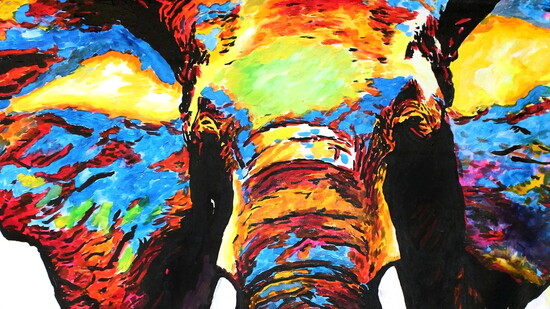
Bramblitt's connection to this year's White Cane Day Walk will be visible throughout the evening. His painting Old Soul, a vibrant elephant rendered in intense reds, blues, yellows and black, will appear on the official 2026 Walk T-shirt. Envision Arts is one of the organization's programs creating opportunities for artists who are blind or have low vision to explore their creativity, develop their work and connect with a broader artistic community.
Bramblitt chose an elephant because of what the animal represents to him. "They're strong and they're powerful," he says. "They're quiet, but there's so much raw energy." That symbolism fits an event centered on a tool that Bramblitt believes is often misunderstood.
"The white cane is hope," he says. "It's that you can actually be independent. When I got the white cane, hope came back into my life."
That message has also drawn support from business and philanthropic leaders throughout the Dallas community. Preston Hollow resident Don Clampitt, owner of Clampitt Paper, is supporting the Walk alongside his daughter Meredith. Clampitt says the company is proud to support Envision's work and help bring greater attention to a mission centered on "inclusion, independence and the wonderful people Envision serves."
Eric Kraft, Market President of Broadway Bank, brings a longer historical perspective. Kraft was involved in bringing Dallas Lighthouse for the Blind and Envision together and now serves as a director on Envision's board. He encourages the broader community to engage with the organization, "demystify blindness and understand capability."
Attorney and CPA Brian Smoot remembers growing up in Preston Hollow at a time when opportunities for people who were blind were far more limited. He sees Envision's emphasis on employment, technology and independence as part of a dramatic change in what is possible.
For Preston Hollow resident Kelley Burks, involvement with Envision changed her own perspective. "Being involved with Envision has given me a greater appreciation for the importance of creating opportunities, support and inclusion for everyone," she says.
Preston Hollow resident Sally Smith Mashburn and the Dr. Bob and Jean Smith Foundation also support Envision, drawn in part by the fact that the organization's impact is taking place directly within the Dallas community.
This year, Envision has set a goal of raising $100,000 through the White Cane Day Walk. For every $100 raised, a white cane will be provided to someone who needs one. Participants can register for the Walk, build fundraising teams or donate directly in support of Envision's work throughout North Texas.
For Bramblitt, the invitation is simpler. Come out. Meet people. Ask questions. Challenge assumptions. And walk.
Because when Bramblitt is asked what independence means, his answer does not involve doing everything alone. "Independence means being able to do things for yourself," he says, "but also being able to ask for help when you need it, because that's not a weakness. It's a strength."
Envision Dallas White Cane Day Walk. Saturday, October 17, 2026. Dallas Zoo. 2026 fundraising goal: $100,000. Register, create a team or donate at whitecanedaywalk.com
"If I can use my sense of touch and navigate a street and not get hit by a car, surely I could navigate something much simpler like a canvas."
"The white cane is hope, It's that you can actually be independent. When I got the white cane, hope came back into my life."