One morning, the only bookkeeper at a freight and logistics company in the Dallas area stopped answering her phone. There was no warning and no handoff. A weekly payment run of roughly 560,000 dollars across about 230 invoices stopped cold. So did everything else she quietly owned.
Now try this in your own business. Make a list of every financial task that happens each week. Paying suppliers and subcontractors. Sorting each expense into the right category. Invoicing customers. Recording the payments that come in. Then write a name beside each line.
If the same name appears on every one, you are a single ordinary emergency away from all of it stopping at once.
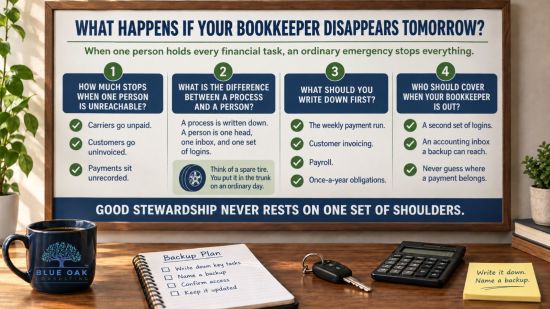
How Much Actually Stops When One Person Is Unreachable?
More than anyone expects, because the work was never mapped. Within two days, the carriers who had not been paid started calling. Customers who should have been invoiced were not. Payments that had already landed in the bank sat unrecorded. That meant the receivables report, the list of who owes you money, no longer showed who really owed what. That last one matters most. Once incoming payments stop being recorded, your view of cash flow goes dark. You are guessing about the one number a business cannot afford to guess about. The company was not broken. It simply could not see itself, and a business that cannot see its own cash is one surprise away from a real problem.
What Is the Difference Between a Process and a Person?
A process is written down, so it can be handed to somebody else on a bad morning. A person is knowledge living in one head, one inbox, and one set of logins. Think of a spare tire. Nobody shops for one on the shoulder of the highway. You put it in the trunk on an ordinary day, so a flat becomes a short stop instead of a ruined trip. Most small businesses believe they have a process when what they actually have is a loyal, capable employee who absorbed the work over years and never had reason to write it down. That is not a failure of trust or a reflection on her. It is a structural gap, and it shows up in far more trades and industrial companies than owners would like to admit. The test is simple. If she were out for three weeks starting tomorrow, could somebody else pick it up from what is written down?
What Should You Write Down First?
The recurring tasks, because those are the ones with deadlines attached. Give each one a single page that covers when it happens, what it touches, and what breaks if it is skipped. Start with these:
The weekly payment run. When it goes out, what it covers, and who approves it.
Customer invoicing. Which jobs get billed, when, and from which system.
Payroll. The run that goes out every two weeks, no matter what else is happening.
Once-a-year obligations. The insurance renewal and anything else that arrives once and gets forgotten.
Nobody needs a manual. You need enough that a competent stand-in is not starting from nothing. An afternoon of writing buys you weeks of coverage. It is one of the simplest ways to stop reacting and start planning ahead, and it usually surfaces two or three steps nobody realized were happening at all.
Who Should Cover When Your Bookkeeper Is Out?
Someone you name before you need them. That can be a second person inside the company or an outside bookkeeper you already work with. Two practical moves make the handoff possible. Keep a second set of logins somewhere secure, so access does not depend on one person's phone. Route the accounting inbox so a backup can reach it, since most supporting documents arrive by email. Then give the stand-in one hard rule. Never guess which invoice a customer's payment belongs to. If it is unclear, ask. A guess made in good faith can take months to untangle, and it will throw off your receivables the entire time.
A Final Thought
Building a backup is not a statement of doubt about the person doing the work. It is closer to the opposite. Leaving one employee holding the whole financial function puts a weight on her that no one should carry alone. She cannot be sick, or grieving, or simply away without the company suffering for it. Sharing the load is a kindness to her and a duty to everyone whose paycheck depends on the work. Good stewardship never rests on one set of shoulders.
Chris Thomas is the founder of Blue Oak Consulting, a fractional CFO firm serving small businesses across North Texas. Visit www.blueoakconsulting.net to learn more.