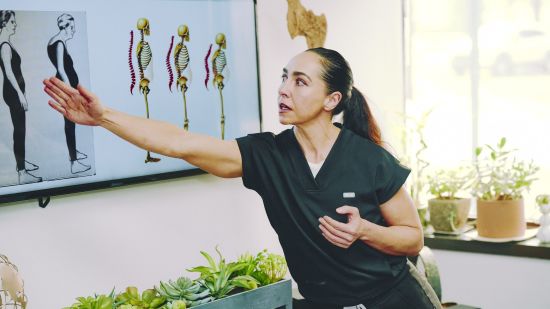
Expert insights from Dr. Claudia Tamas of Natural Medicine and Rehabilitation
Hearing that you have osteopenia can trigger an immediate wave of fear. Many people assume it means osteoporosis is inevitable or that a fracture is waiting around the corner.
Dr. Claudia Tamas of Natural Medicine and Rehabilitation wants patients to replace that fear with a plan.
“I do not want people to worry,” she says. “I want them to take action.”
Osteopenia describes bone mineral density that is lower than normal but has not reached the threshold used to diagnose osteoporosis. It matters, but it does not tell the full story of a person’s bone strength or future fracture risk.
A DEXA scan is a starting point, not the whole picture
A dual-energy X-ray absorptiometry scan, commonly called a DEXA scan, uses low-dose X-rays to estimate bone mineral density. As per current guidelines, this test is recommended to postmenopausal women and some men with risk factors for fracture. The result is often reported as a T-score that compares their bone density with that of a 30-year-old healthy young adult.
A T-score between -1.0 and -2.5 is generally classified as osteopenia. A score of -2.5 or lower meets the criteria for osteoporosis.
The test is valuable, but Dr. Tamas explains that bone density is only one part of the bone assessment. A DEXA scan is a two-dimensional measurement of a three-dimensional structure. It measures mineral density but does not fully capture the quality or internal architecture of the bone.
“The DEXA scan represents one part of the assessment,” she says. “It is an incomplete assessment.”
That helps explain why two people with similar DEXA scores may have very different fracture risks. A trabecular bone score (TBS) adds crucial insight by analyzing the texture and microarchitecture of the lumbar spine, giving clinicians a clearer picture of bone quality — something DEXA alone cannot capture.
Ask why the bone loss is happening
After receiving a low bone-density result, the next step is to review it with a qualified provider and place the number in context.
At Natural Medicine and Rehabilitation, Dr. Tamas looks beyond the scan to understand what may be driving the change. That assessment can include bone-turnover markers, hormonal health, thyroid function, blood sugar control, gastrointestinal health, nutrient absorption, medications, alcohol or tobacco use, nutrition, stress, sleep and other lifestyle factors.
Bone-turnover markers can help indicate whether a patient is actively losing bone at an accelerated rate or whether the loss may have occurred earlier and has since stabilized. Those are different situations and may call for different plans.
“When a patient is losing bone at an accelerated rate, that’s a critical piece of information,” Dr. Tamas says. “It tells us that a very different type of intervention is required compared with someone whose bone-turnover markers are stable — and we need to act on that immediately.”
The goal is to identify the factors affecting that individual patient rather than treating every low DEXA score the same way. Medication may be appropriate in some cases, she says, but treatment should still account for the metabolic, nutritional and lifestyle factors that may be contributing to bone loss.
Do not confuse caution with inactivity
One of the most persistent myths is that people with osteopenia or osteoporosis should avoid lifting weights.
Bones are living tissue. They respond to mechanical stress, which is why resistance and weight-lifting exercise play a critical role in maintaining bone and muscle strength. “The key is using the right amount of load based on your personal strength and adaptation baseline. When we match the load to your physiology, your bones respond in a safe, positive way.”
At Natural Medicine and Rehabilitation, Dr. Tamas uses the ONERO program, a supervised high-intensity resistance and impact-training approach based on research involving postmenopausal women with low to very low bone mass.
“This has to be done in a clinical setting under supervision with clinicians who understand the pathology behind the condition,” she says.
Patients are assessed individually and progress gradually. Depending on their history, mobility and fracture risk, exercises may include movements such as squats, deadlifts and lunges. This is not a green light to begin heavy lifting alone after reading an article. It is a reason to seek qualified guidance rather than avoiding strength training altogether.
Dr. Tamas says many women in the program become capable of lifting far more than they initially imagined. The point is not to turn every patient into a competitive weightlifter. It is to build enough strength to protect daily function, improve stability and support long-term independence.
Bone health requires more than calcium
Calcium matters, but taking a calcium supplement is not a complete bone-health strategy.
Dr. Tamas begins with a close look at what a patient is actually eating. Patients may complete a five-day nutrition tracker so her team can evaluate protein intake, food variety and overall nutrient quality.
Protein is especially important because bone contains a collagen framework and because muscle and bone health are closely connected. When muscles become stronger through exercise, the body also sends signals that support bone-building activity.
“Bones and muscles rise and fall together,” Dr. Tamas says. “When one declines, the other follows — and when we build one up, we strengthen both.”
She also encourages patients to get a broad range of nutrients through food, including a large variety of fibrous vegetables, and then uses supplements selectively based on individual needs. Calcium, magnesium and vitamin K may be part of that conversation, but dose, timing, diet, medical history and other nutrients all matter.
Hormonal changes — particularly the natural decline in estrogen during menopause — play a central role too. Estrogen helps regulate bone remodeling, and when levels fall, bone breakdown accelerates. Dr. Tamas emphasizes that recognizing and addressing hormonal decline is essential for protecting long-term skeletal strength, especially for women transitioning through midlife.
Sleep and stress deserve attention as well. Dr. Tamas explains that chronically elevated stress hormones can affect calcium metabolism and contribute to a less favorable environment for bone health. That is another reason the plan should address the whole patient rather than one scan result.
The first wins may not appear on a scan
Bone-density changes take time. Patients often notice other improvements first.
They stand taller. They feel stronger. Everyday tasks become easier. Their balance and confidence improve. Most important, many stop being afraid to move.
“Strength is a wonderful thing,” Dr. Tamas says. “Once you start feeling it in your body, it becomes genuinely addictive.”
Posture is one of the first areas she evaluates. As the muscles that support the spine become stronger, some patients begin standing more upright. Friends and family may notice the change before the patient does.
That visible change can carry a psychological benefit too. A person who once moved cautiously and looked down may begin walking into a room with more confidence.
When strength changes more than one life
One of Dr. Tamas’ most memorable patients traveled from another state to participate in the program. The patient had developed a significantly forward-bent posture and had spent years walking while looking toward the floor.
After several months of training focused in part on the muscles along the spine, the patient entered the clinic standing more upright and looking ahead.
“He could actually look at us,” she recalls. “We could see him smile.”
The change meant more than improved posture. Standing taller created more room for lung expansion while breathing and helped the patient feel more energetic and engaged.
Another patient became strong enough through the program to help care for her husband after he suffered a stroke. Because she could assist with lifting and moving him, he was able to return home from the hospital rather than immediately entering a rehabilitation facility.
The strength she built did not just change her own future. It changed his.
Start early, but do not assume it is too late
Asked what she wishes every woman over 50 knew about protecting her bones, Dr. Tamas does not hesitate: strength training matters.
Ideally, that work begins much earlier. Much of a person’s peak bone mass is built by early adulthood, making adolescence and the 20s an important window for nutrition, activity and resistance exercise.
Still, an osteopenia or an osteoporosis result is not proof that the opportunity has passed. It is a signal to assess the bigger picture and begin making deliberate changes now.
The safest plan depends on the individual. Someone with a history of fractures, pain, balance problems or significant bone loss will need a different starting point than an otherwise healthy person with mild osteopenia.
Build a bigger vision for bone health
Many patients arrive at Natural Medicine and Rehabilitation focused on improving one number on a DEXA report. Dr. Tamas wants them to leave with a larger goal: remaining strong, mobile and independent for as long as possible.
“We cannot take the bones out of the person,” she says. “We treat the bones, and then the entire person gets better.”
An osteopenia result should not be ignored, but it should not define someone’s future either. It should begin a thoughtful conversation about fracture risk, strength, nutrition, metabolism, lifestyle and the steps that can support healthier aging.
Additional Bone Health Resources
An osteopenia diagnosis is only one part of the bigger picture. Explore our complete guide to bone health in Bridgewater for more expert information about osteoporosis, fracture risk, strength training, nutrition, menopause and healthy aging.
MEDICAL DISCLAIMER
This article is for educational purposes only and is not a substitute for individualized medical advice, diagnosis or treatment.