The call came shortly after 10 p.m. On the other end of the line, a man sounded shaken. His father had fallen, landed in the hospital, and been discharged with no broken bones but a clear need for help.
“He told me, ‘I can’t leave my dad alone tonight, but I have to go to work in the morning,’” Dr. Michelle Rankine remembers.
An hour later, she had a caregiver at his door.
“He needed relief. He needed someone to step in like family,” she says. “Being able to solve that problem for him, that’s what we do.”
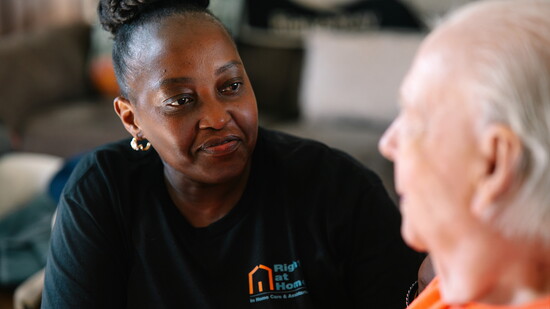
Dr. Rankine, owner of Right at Home-Lewisville, has built her agency around the idea that home care fills the spaces life doesn’t always prepare us for. At its core, she says, caregiving is less about tasks and more about presence. Caregivers step in when family members are spread thin between raising children, holding full-time jobs, and supporting aging parents.
Caregivers from Right at Home often help with daily tasks like cooking, cleaning, taking those they care for to doctor visits, and more. Her caregivers accompany clients to medical appointments, help interpret medical instructions, communicate with physicians, and keep daily care reports. It’s a layer of support most people don’t realize they need until they do.
“People think home care and home health are the same, but we’re so different,” she says. “Home health is ordered by a doctor and provides clinical services like nursing visits, physical therapy, and occupational therapy. Those visits are brief, usually a few hours a week.”
“Home care, by contrast, steps into the everyday,” she explains. “We help with bathing, dressing, meal prep, safety, transportation, housekeeping, companionship, and the simple reassurance of having someone nearby. We help people live more independently at home, and we’re there when family can’t be.”
Most importantly, home care is relationship-driven. Many seniors don’t just need assistance, they need connection.
“Loneliness and isolation aren’t talked about enough,” she says. “Caregivers uplift spirits.”
Currently, the agency employs more than 250 caregivers across Collin, Denton, and Tarrant counties. Dr. Rankine says although she loves the agency and her staff, she didn’t plan to work in home care.
She holds a PhD in education, and for years believed her path was in teaching, but 15 years ago, life shifted.
Her brother was in a devastating car accident, leaving him in a wheelchair. The family spent months helping him relearn everyday life, and Dr. Rankine naturally stepped into the role of caregiver. A few months later, he began to move his legs. Eventually, he walked again.
“I saw a miracle happen,” she says. “Not many people see that in their lifetime.”
“Most of our caregivers have cared for someone in their own lives,” Dr. Rankine added. “A spouse. A grandmother. Someone they loved deeply. That purpose drives them.”
Many families don’t plan for a sudden fall, a new medical diagnosis, or the moment a parent can no longer safely stay home alone. Dr. Rankine sees these turning points every day.
“People think they’ll be proactive,” she says. “But most of the time, we enter at a moment of crisis.”
The agency is also embracing technology. Right at Home uses an audio-based AI device (not a camera) that tracks patterns such as coughing, nighttime wandering, or repeated questions. Families can access reports even when they’re not present.
“Sometimes our caregivers are the ones who can give the full picture.” Dr. Rankine says. “Caregiving impacts everyone, and how we show up makes the difference.”
Find more information at www.rightathome.net/collin-denton, call 214‑383‑0555, or email info@rahdfw.com.
Caregiving is less about tasks and more about presence. Caregivers step in when family members are spread thin between raising children, holding full-time jobs, and supporting aging parents.