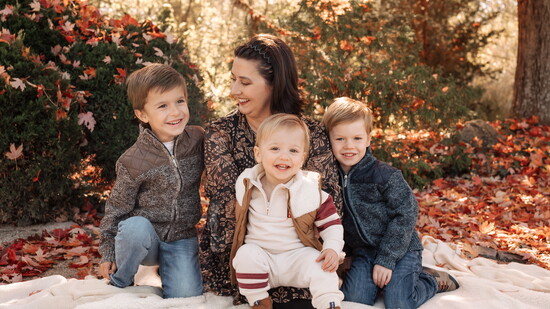
In the quiet and routine moments of life, we often find ourselves caught up in the small things, from the laundry to carpools, to daily schedules. For Brie Bauer, a nurse and mother of two, life was exactly that. However, as she has now learned, life can change in a second. "I was going through life like everyone else, you know, just the same old things we complain about that aren’t a big deal in the grand scheme of things," Brie reflects. "Then all of a sudden it just changes in a second. That happens to everyone."
At 27 weeks pregnant with her third son, Brie felt a familiar spell of pregnancy fatigue. Assuming it was a routine bug caught from her toddlers, she almost dismissed it. However, a persistent stiffness and her own medical intuition led her to visit urgent care just to be sure. Within hours, Brie was in the fight of her life. A silent Strep A infection had triggered sepsis, sending her body into distress. To save her life and the life of her son, Beau, doctors performed an emergency C-section. Beau arrived at just 2.6 pounds. He was a tiny fighter who, as Brie notes, likely saved her life by signaling his own distress.
While Beau stabilized, Brie’s journey took a harrowing turn. Her body tried to protect itself, but the cost of survival was high: the loss of all four limbs. Yet, as she woke from a ten-day coma, her first thoughts were not of what she had lost, but of those she loved. There was relief in knowing her mind was still sharp and her family was waiting for her. "I’m blessed with a new life, a new way of life, and a new view of life," she says. "And not a lot of people get that."
Brie’s time in the hospital was a grueling marathon that stretched from the initial crisis in February through her eventual release from inpatient rehab in June. Even after she emerged from her coma, her recovery remained a delicate, touch and go process marked by unexpected setbacks and nearly thirty surgeries. Yet, through the months spent at both AdventHealth and the University of Kansas Health System, Brie was sustained by what she describes as incredible care. She speaks with deep gratitude of the providers, nurses and therapists who became her lifelines, from the ICU nurse manager who moved mountains to get her the care she needed to the therapist whose simple, daily greeting of "Hey girl" became a vital sensory anchor. This compassionate support, combined with her own relentless spirit, turned a months-long hospital stay into a foundation for the new life she is building today.
Brie’s survival was not just a matter of clinical intervention, but of her own willingness to speak up when her internal warning signals did not align with the charts. Her story highlights that while medical professionals bring years of essential training to the table, the patient is the only lifelong expert on their own body. "As a patient and as a provider, you’ve got to be aggressive and you’ve got to be annoying to get things done," Brie says, reflecting on the moments she had to push for her own care. "If you don’t feel right, if you just simply say that, that should spark providers to do something else."
This level of self-advocacy is not about challenging the expertise of a medical team; it is about acting as a necessary partner in a high-stakes environment where details can move quickly. Brie recognized that even the best systems have limitations, noting that the doctors and nurses are doing their best, but they are in charge of hundreds of patients. By trusting her intuition and her survival instinct, she bridged the gap between being a passive recipient of care and an active participant in her recovery. "I knew something was wrong," she recalls of the moment she called her own rapid response. "I looked at the nurse and said, ‘I’m calling it. If you don’t call it in five minutes, I’m calling them right now.’" Her journey serves as a reminder that advocating for yourself is a collaborative, lifesaving act that ensures the person behind the symptoms is never lost in the process.
The transition from being a nurse, which is a career defined by doing, to a patient needing constant care was a profound identity shift. Brie reflects that you build your identity through being a parent, and while she lost the physical part of that role, she is finding a new way now. For a long time, the physical limitations were a source of grief. The inability to pick up a crying baby or drive her older sons, Brooks and Barrett, to school felt like a barrier to motherhood. But Brie discovered that the doing is only a fraction of the role.
"You don’t have to have a more physical approach to it," Brie explains. "The hugging, the picking up, the drawing the tears. You don’t have to do that in order to be a mother or to be a parent." She realized that being a mother is truly about being the emotional north star. "I tell myself I have to be present. If I’m in bed depressed, I’m not present there. If they don’t see me, then they won’t know me." Today, she and her toddler, Beau, are learning together. Recently, she achieved a milestone that felt like a mountain when she picked up Beau by herself for the first time. "I picked him up for the very first time by myself just the other day. That's all I want, is to be able to do that."
Brie is candid about the fact that hope is not always a constant. During her darkest days in the hospital, she relied on borrowed hope from her family. A fellow survivor once shared a mantra that sustained her: "I’ll hold on to hope for you until you are able to recognize it." By her side throughout has been her husband, Reid. Though they eloped years ago without traditional vows, he has lived out the promise of sickness and health to a heroic degree. While he handles the morning routines and the heavy lifting, Brie provides the happy thoughts at bedtime and the educational guidance that keeps their household thriving.
Brie’s journey has given her a new calling. As the founder of Brie’s Hope (Brieshope.org), she is turning her trauma into a blueprint for others. Her mission is focused on educating pregnant women about the dangers of sepsis and providing grants to families navigating the life-altering costs of limb loss. Using a stylus wrapped to her arm, she manages her foundation and connects with a global community of survivors.
"Adapt is such a simple word, but that’s how I am still here," Brie says. "It’s just adapting and not letting that trauma win." She is no longer the nurse she used to be, but she is a healer in a different sense. By sharing her story, she is teaching her sons and all of us that while we cannot always control what life hands us, we can always choose how we hold it. To support sepsis survivors and limb-loss advocacy, you can visit brieshope.org or follow her journey on Instagram at @briebauer.