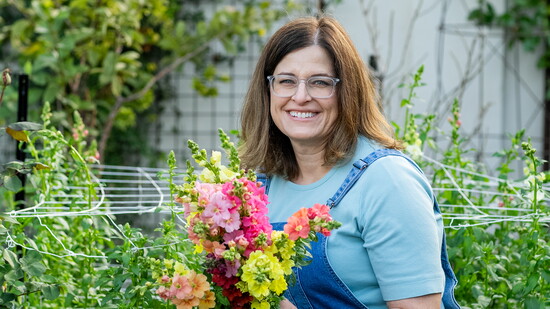
For Angela Judd, gardening has always been rooted in memory, connection, and a deep sense of place. Some of her earliest recollections involve time spent alongside her grandparents, hands in the soil, learning by doing long before she realized those moments would shape her future. “Some of my earliest memories are spending time with my grandparents in their gardens,” she shares, recalling flower planting with her grandmother in Idaho and wandering through her grandparents’ expansive garden in Indiana. Those early experiences planted more than seeds; they instilled a lifelong appreciation for growing things with care and intention.
When Angela and her husband moved to Arizona in 2008, she finally had a yard of her own and the space to begin experimenting. What started as curiosity quickly turned into commitment. After attending a square-foot gardening class, she gathered supplies, built raised beds, mixed her soil, and planted her first garden. “That was the beginning of my own gardening journey,” she says. Like many desert gardeners, the early years were filled with challenges, frustration, and trial and error.
Timing proved to be one of the most difficult lessons. Following a generic planting calendar led to crops that sprouted beautifully, only to be overtaken by heat before harvest. “It was frustrating,” Angela admits. Watering also required a learning curve, until installing a simple drip system on a timer transformed her garden’s consistency and success. Composting became another turning point, improving soil health and plant growth in noticeable ways.
Those early struggles taught Angela something deeper than technique. “I learned the hard way when to plant, mostly by making mistakes and observing what worked and what didn’t,” she says. Pests were another obstacle, and like many beginners, she initially relied on pesticides without understanding their broader impact. Over time, she began to recognize the interconnectedness of nature and the garden itself, the role of biodiversity, beneficial insects, and planting variety. Moving her garden from a low-light side yard to an area with more sun brought dramatic improvement and reinforced just how essential sunlight truly is.
Becoming a Master Gardener marked a pivotal shift in both confidence and clarity. The training connected Angela with experts who could finally answer long-standing questions and helped her realize that many struggles weren’t personal failures but realities of desert gardening. “The fundamentals really mattered,” she says. Writing a monthly article for the Master Gardener publication Roots and Shoots revealed another passion: teaching through writing. Distilling complex information into simple, approachable guidance became second nature, and soon after, Growing in the Garden was born.
What began as a way to share lessons organically grew alongside her family. Angela never intended to build a business or pursue gardening full-time, but as her children grew older, so did her platform. In 2020, everything expanded at once: writing a book, growing the garden to its current size, filming weekly YouTube videos, and collaborating with Arizona Worm Farm to create a desert-specific Mel’s Mix blend. “The vision itself has stayed consistent,” she explains. “Teaching people how to garden successfully in the desert by focusing on the fundamentals of soil, timing, watering, and sunlight.”
Because Angela gardens in the same climate as her audience, her teaching is deeply intuitive. When something goes wrong in her own garden, chances are others are experiencing the same issue. “Teaching becomes an extension of what I’m learning in my own garden,” she says. That shared experience has helped Growing in the Garden feel relatable, supportive, and practical.
Angela is also passionate about shifting perceptions around desert gardening. While many see Arizona as an impossible place to grow food, she views the challenge as a strength. “I’ve come to see those challenges as something to be proud of,” she says, pointing to the resilience and generosity of local gardeners. Initiatives like “Arizona Gardeners Are Hot” and “Arizona Gardener of the Month” highlight the creativity and knowledge thriving across the state.
Sustainability and water conservation are central to her practices. Rainwater harvesting, drip irrigation, composting, deep mulching, and avoiding pesticides all work together to create a resilient ecosystem. “Together, these practices create a resilient garden ecosystem that uses resources wisely,” Angela explains. Continued education, including recent green stormwater training, ensures she’s always learning and sharing what matters most.
The most rewarding part of her journey has been the connection. From nervous first classes to confident conversations, Angela has embraced not knowing everything. “When someone tells me they’ve learned something and are now having success, it confirms that I’m doing exactly what I’m meant to do,” she says. Looking ahead, her hope remains simple and powerful: to encourage others to start, keep trying, and share what they learn because in gardening, growth is always better together.
“Teaching becomes an extension of what I’m learning in my own garden.”
“Success still comes back to the fundamentals: soil, sunlight, timing, and watering.”
“I learned the hard way when to plant, mostly by making mistakes and observing what worked and what didn’t.”