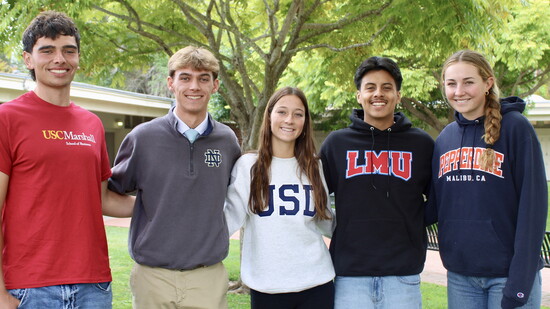
Ethan Morales was the only student in his graduating 8th-grade class. He was quiet and creative and had never set foot in a traditional high school. He didn't know a single person who would be at Bishop García Diego. When he walked onto campus for his tour, students who weren't even assigned to him fell into step beside him. His mother, Gigi, still remembers what he said when he got home. "Mom, this is my school. This is where I want to be." She pauses. "He's shy. So I was shocked."
That moment is the one Gigi returns to when other parents ask her about Bishop. She's been a fixture at Cardinal football games for nearly a decade, selling tickets long after her two older sons graduated. She knows what it looks like when a school actually means it. What Gigi was looking for wasn't just a school. It was a village.
"I needed support. More than just a school. I needed someone to mentor me, guide me, and give me constructive criticism. I needed a team. And that's what I found in Bishop."
Ethan arrived as a freshman with a dream that had been met elsewhere with polite uncertainty. He wanted to be an engineer. He wanted to go to Texas Christian University in Fort Worth. When he'd told people this before, the response was vague, encouraging in a way that quietly says, "That's really reaching." Bishop's response was different. "When he told them what he wanted to do, they said, 'Okay — and here's exactly what you need to do to get there,'" Gigi says. "He felt relieved. Like, they have the answers I've been needing. And they don't think it's impossible."
Ethan graduated from Bishop in 2020 and from TCU in 2024. He is now an electrical engineer in Texas. At one of his first internship interviews, evaluators were asked to write down what stood out about the candidate. His mother still knows what they wrote: a smile, a tie on correctly, a good handshake. "That was Ms. Carr," Gigi says.
Ms. Carr, Dean of Students, checked in with both boys nearly every week. Called Gigi directly when something needed to be addressed. Dress-coded them, to their considerable annoyance. "And now," Gigi says, laughing, "they are so thankful. Because it really has made a difference."
Her younger son, Eaven, now a sophomore at TCU studying pre-law, had his own turning point in his senior year. A concussion threatened to derail his college applications. Bishop's college counselor, Ms. Coppa, sat with him and worked through his materials line by line. Within three weeks of arriving on campus, he confidently changed his major. He already had the information he needed. Gigi's youngest, Masen, is in 8th grade and counting down. Someday, Ethan and Eaven want to create the Morales Brothers Bishop Scholarship. "That's what it's all about," Gigi says. "Building a legacy. For your family. And for the future."
The Maho family came to Bishop under different pressure — their triplet boys entered at the same time. Cost was the first question. Roughly 70 percent of enrolled families receive some form of financial assistance, a fact that reframes the decision for families who assume the door is closed before they've knocked. "We met with the school, and they helped us create a financial plan that was workable," they recall. What decided it wasn't a spreadsheet. It was a shadow day. "The students, the campus, and the entire environment were made very welcoming," the family says. "They could see themselves as Bishop students." By football preseason that fall, the question of belonging had already been answered.
Brad and Megan Hubbs knew the Catholic school framework well. When it came time for their daughter, Haley, Bishop felt like the natural next step. By sophomore year, she had hit her stride with student council, varsity tennis, and a circle of friends she'd carry past graduation. Her senior season, the girls' tennis team won CIF. "I was just really so happy for all the girls who had that trophy," Brad says. "They worked hard. It was a great moment in time." What he credits most isn't the championship. It's the teachers who saw Haley clearly and challenged her to meet herself. "The school was right for Haley," he says. "Period."
Tom Johnson, who has had three children graduate from Bishop and serves on its Board of Trustees, puts it simply. "The teachers find out who needs more attention and who doesn't. Who's more independent, and who might need a little more one-on-one time." Nobody skates through unseen.
The faith component is one that prospective families, particularly those outside the Catholic tradition, often approach with caution. Those who've lived it describe it the same way: present, meaningful, and never exclusionary. The Maho boys didn't come in with a strong religious foundation. What they found wasn't pressure, it was an invitation. "The boys felt very welcome at Bishop, and the religious studies classes offered all the students a meaningful opportunity to explore their faith."
But perhaps the moment that captures it most fully repeats itself every year, and no curriculum can manufacture it. The senior retreat. Students leave campus, share vulnerable parts of themselves, and return changed.
Brad witnessed the return. "The kids all came back, and they were in a big circle. They shared their experiences and their appreciation for their parents and their families." He pauses. "For parents who have never experienced this, until you go through it, you'll never understand it. Every single one of those kids was in tears. It was a really, really wonderful thing to see."
Gigi Morales, still in the stands, still selling tickets, still watching the Cardinal family expand around the son who hasn't even started yet, says it the way only someone on the other side of it can. "It's not a fall-through-the-cracks kind of school. Even if you want to fall through the cracks — that's not gonna happen." She laughs quietly. That village she was looking for? This was it.
There is a bell tower at Bishop García Diego that students pass every day. Red brick underfoot, eucalyptus overhead — the particular quiet of a campus that sits close to nature and close to something else. A sense, described by nearly every family who comes through, that this place is paying attention.
What these families found at Bishop wasn't a perfect institution. It was something more useful: a community scaled to the size of a human being. Small enough that a quiet kid from a school of one doesn't disappear into a crowd. Small enough that a Dean of Students knows your name, calls your mother, and dress-codes you until you're grateful for it. Big enough to field championship sports teams, offer rigorous AP coursework, and send graduates to universities across the country. And somehow, in that balance, exactly the right size to make sure no one slips through unnoticed.
That's not a marketing promise. It's what happened.
The question every parent carries through the door, "Will this place actually see my kid?" has an answer here. This place sees them.