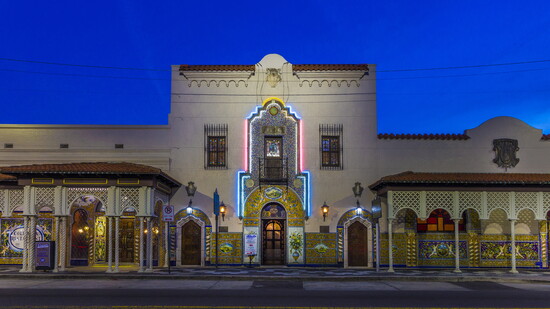
On any given day, the Columbia Restaurant is filled with moments that matter.
A couple celebrates 60 years of marriage in the same dining room where they once posed for a wedding portrait. Across the room, a grandfather introduces his grandchildren to the same Cuban sandwich his grandparents ordered. The sound of flamenco dancing drifts through hand-painted archways as servers weave between tables carrying paella, the famous “1905” Salad, and dishes that have become part of Tampa’s identity. For first-time visitors, it’s a memorable meal. For generations of Floridians, it’s something much more.
It’s easy to assume a place this famous was always meant to be a landmark. It wasn’t. When the family set out to confirm the Columbia was Florida’s oldest restaurant, researchers at USF found one catch. “Good news is you are the oldest restaurant in Florida,” said Casey Gonzmart, Jr., fifth-generation co-owner and operator of the 1905 Family Of Restaurants. “The bad news is you missed your anniversary.”
The Columbia opened in 1905, but its story began two years earlier. On December 17, 1903—the same day the Wright brothers achieved powered flight—Casey’s great-great-grandfather, Cuban immigrant Casimiro Hernandez, Sr., opened the Columbia Saloon across the street, serving beer brewed at the Florida Brewery, where he worked as general manager. When the saloon burned down a year later, Hernandez rebuilt. What emerged in 1905 was built for the cigar workers and immigrant families, not the visitors who’d eventually find it. “It was useful to the neighborhood before it was famous,” Casey said.
Walking through the Columbia today feels less like visiting a restaurant and more like wandering through Tampa’s history—15 dining rooms, each carrying the fingerprints of a different generation in tile, archways, and decades of collected art. The Columbia expanded the same way it began: one building at a time. Hernandez bought the building next door, then the one after that, cutting keyhole doorways so each new space flowed naturally into the next. “It looks like some rich guy from Spain just dropped this building down,” Casey said. “That’s not the case. It was taking over the next building, and the next one.” The tile work is still tended by hand by a longtime craftsman, and now, his daughter.
The growth makes the family’s history sound safer than it was. In 1935, deep in the Depression, barely out of Prohibition—Casimiro’s son, Casmiro, Jr., took out a $5,000 loan, roughly the price of a house, to build Tampa’s first air-conditioned dining room. “Everyone thought he was crazy,” Casey said. “Himself included.” It worked, and the willingness to bet carried the family through two world wars, a gutted Ybor City, and COVID—five generations now. “Every room here,” Casey said, “is a bet on the future.”
As the building grew, the flavors of the old neighborhood remained on the menu. Nowhere is that more evident than the Cuban sandwich: pork for the Cubans, ham for the Spanish, salami for the Sicilians, Swiss cheese, pickles, and mustard by way of German and Jewish tradition, pressed into Cuban bread. “It’s a melting pot of a sandwich,” Casey said. “It represents what Ybor was.”
The “1905” Salad is prepared tableside with iceberg, Swiss, Spanish olives, tomato, baked ham, Romano cheese, Lee & Perrin’s Worcestershire sauce, and its signature garlic dressing. The same way it has been for generations. The paella arrives in imported pans, loaded with seafood, chicken, and pork over saffron rice. And the Ropa Vieja - Spanish for “old clothes,” a reference to the shredded beef - is built from fresh beef, tomato, onion, and garlic, much as it once was from whatever a Cuban household had on hand.
Behind every dish is a kitchen where tradition is still made by hand. Seven kettles line the back wall, turning out every soup and sauce from scratch, and every vegetable is chopped by hand. It’s a standard Casey learned firsthand: he got his start there at 12, handed a 50-pound bag of onions and told to get to work. He remembered feeling like the smartest kid alive by the time he’d worked through it—until a line cook named Miguel pointed at the cooler and said, “Más cebollas.” More onions.
That kind of care is what keeps people coming back. A 90-year-old guest whose grandparents once brought him here now returns with his own grandchildren. “What other place can carry on the memories and traditions you’ve created with your family?” Casey said.
Just two miles away, that same commitment shows up at Ulele, a Columbia-family restaurant on the old Water Works site. Ulele was once a water station that sent water to the Columbia Saloon.
Today, Casey leads the Columbia alongside his uncle Richard, fourth-generation president and CEO, and cousin Andrea, fifth-generation co-owner and operator. But for all the history surrounding the restaurant, he’s quick to point out that none of it is carried alone. “My wife, Jenny, is the reason I can do this work,” he said. “She married into a business that’s been running for 121 years and never really turns off. She holds our family steady through all of it. Our two children are the sixth generation. I stand on the shoulders of the four generations before me, but I’m not carrying this alone, and I never have.”
Before the first guest arrives, before the flamenco dancers begin or the kettles go on, Casey walks through the empty dining rooms by himself.
“I’m walking in rooms of the people whose shoulders I stand on every day,” he said. “It’s an extremely humbling thing.”
“I’m walking in the rooms of the people whose shoulders I stand on every day. It’s an extremely humbling thing."