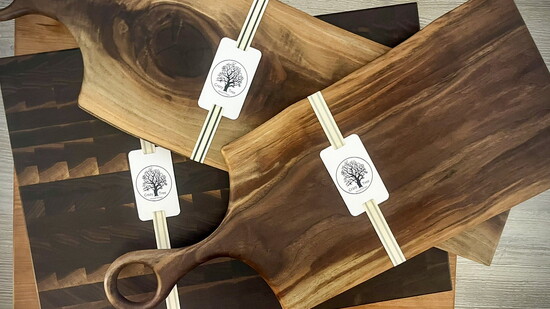
There is a moment in Carl Ecker's woodworking process that he enjoys more than any other. The board comes to him roughly cut, unremarkable. Then it goes through the planer. That’s when the wood reveals itself. The grain surfaces. The character shows up. What was once just a piece of walnut becomes something no one else will ever own.
“When you put it through the planer, you get to see the wood and the board as you’re making it,” Carl says. “That’s the best part.”
It’s a philosophy that has carried him from a Covid-era hobby to a five-year partnership with Five Swans, the upscale Wayzata boutique known for its kitchen and gift collection. And it’s exactly what Kim Zitzloff, the store’s owner, saw the first time he walked through her door.
“Carl came in and showed his boards, and we needed his boards,” Kim says. “He’s local. We love local. And the finished work is impeccable.” She didn’t hesitate. “We’ll take them all.”
Carl’s story starts with his dad. “We were always building stuff out of wood,” he says. But it wasn’t until 2020, working from home with time on his hands, that the hobby became something more. He started carving spoons. Then cutting boards. Then his family pushed him to find a home for these one-of-a-kind pieces.
“Food was the entry point,” Carl says. “I love cooking, and I knew I wanted a bigger cutting board on my counter. It makes cooking more enjoyable.” That instinct, to make the kitchen feel a little more special, still drives every piece he builds.
Carl works mostly in walnut, with some cherry and maple, and every charcuterie board starts the same way: hunting for live-edge slabs with real character.
“Maybe the branch comes out of the trunk, and it creates a really pretty figure in the wood,” he says. “I set those aside for Five Swans.”
His cutting boards take more patience, strips glued, sanded from 80 grit to 400, then finished with a custom juice groove. A single charcuterie board takes two to three hours. His largest board yet stretches four feet.
But the boards were never meant to be flashy. “I keep them very simple and want to show the wood,” Carl says. “I’m not trying to change what the tree looks like. I’m trying to let the wood speak for the design.”
He guarantees every piece for life. If a board ever warps, he’ll flatten it and send it back. “I’m not going to let anything that isn’t perfect go out there.”
For Kim, that care is exactly why the partnership works. “There’s no two alike,” she says. “They’re so unique, there’s no two boards that look or feel exactly the same.”
Customers shop for the boards as much as anyone shops for the store’s other kitchen pieces. Increasingly, they’ve become household gifts, though most people buy them to keep.
“They’re an art piece,” Kim says. “You can display it in your kitchen.” With the holidays approaching, she sees them as more than serving pieces. “When people are gathering and putting the boards on their dinner table, it’s also a conversation piece.”
Carl feels the same pull toward the table. “I want people to feel like the board is part of the experience,” he says. “For me, when I make a nice meal, it’s not just about eating. It’s about the cooking, sitting around the table, and admiring the presentation.”
Five Swans is celebrating 60 years in business this year, and they’re marking this occasion by gifting away a piece from their store each month. Carl’s boards will be among these pieces in October.
But ask him what he loves most about the partnership, and it isn’t the sales. “It’s the highlight of my week when I get to go in there and drop things off,” Carl says. “They have trust in me that I’m going to bring them quality stuff. I still think we’re a hidden gem, even after 60 years.”
When you put it through the planer, you get to see the wood and the board as you’re making it. That’s the best part.
Maybe the branch comes out of the trunk, and it creates a really pretty figure in the wood. I set those aside for Five Swans.