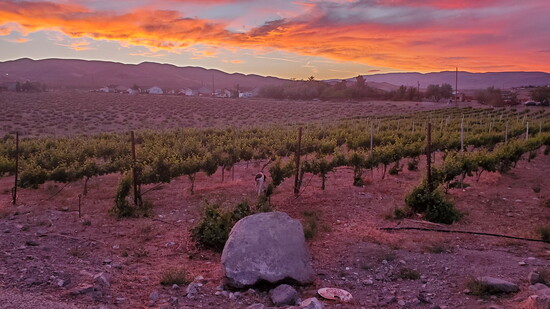
When most people picture wine country, Nevada probably isn't the first place that comes to mind.
Our state is known for sagebrush, high desert, and endless stretches of open land, not necessarily rolling vineyards. Yet across Northern Nevada, researchers, growers, and winemakers are proving that wine grapes don't just survive here. They have potential to thrive.
"Wine grapes are an incredibly sustainable crop," says Kate MacDonald, owner and winemaker of Nevada Sunset Winery, Reno’s only full production winery. Unlike many traditional agricultural crops, she notes, grapevines require relatively little water and actually benefit from Nevada's dry climate. "The rare rainfall throughout the growing season makes an arid desert climate ideal because we don't have to deal with mildew."
That same climate has inspired decades of research at the University of Nevada, Reno.
According to Jill Moe, program manager for the University of Nevada, Reno's Desert Farming Initiative, the university planted its first experimental vineyard in the late 1990s to determine which grape varieties could withstand Northern Nevada's high desert climate. After more than 25 years of research, the work continues through the Desert Farming Initiative and its partnership with the Nevada Grape Growers & Winemakers, which is studying how grapes perform across different microclimates throughout the state.
"There is no one-size-fits-all varietal here in Northern Nevada," MacDonald says. While UNR's current research focuses on riesling, growers across the state continue experimenting with a variety of grapes as they learn how elevation, soil, and local weather patterns influence each vineyard.
The greatest challenge isn't growing the vines. "It's often achieving the chemistry and flavor profile needed for quality wines," says MacDonald.
Nevada's growing season is short, with the constant possibility of late spring freezes or early autumn cold snaps. Grapes may appear ripe weeks before they've developed the balance of sugar and acidity needed for exceptional wine, making harvest timing one of the most important decisions growers face.
Moe says spring freezes remain one of the industry's biggest environmental hurdles. At the same time, UNR's research has shown that careful irrigation management can significantly improve grape production in Nevada's high desert conditions.
In fact, the very conditions many people assume would make grape growing impossible are often advantages.
According to MacDonald, Nevada's low humidity helps reduce mildew pressure, while frequent winds improve air circulation around the vines. Grapevines are also remarkably drought-tolerant, requiring only a fraction of the water used by many traditional crops. Earlier university research found premium wine grapes could be grown using substantially less irrigation than crops such as alfalfa, making them an increasingly attractive option in the state's arid climate.
And the results are already changing minds.
MacDonald jokingly refers to her Nevada-grown wines as "eyebrow wines."
"I like to pour a taste and then wait for the guest's expression," she says. "People come in with pretty low expectations, and then you see their eyebrows go up."
Those reactions have become increasingly common inside Nevada Sunset Winery, Reno's only full-production winery, where MacDonald crafts wines from both California fruit and grapes grown across Northern Nevada, including Reno and Silver Springs.
Behind the scenes, research continues to help shape the industry's future. According to Moe, the Desert Farming Initiative's current project, supported by the Nevada Department of Agriculture, will continue through 2027 and is expected to provide growers with new guidance on vineyard site selection, production, and management across Nevada.
For MacDonald, that future is filled with possibility.
"I have only scratched the surface," she says. "Now I have undertaken an entirely new region, a new state, new relationships to be built, and new wine challenges to conquer."
As Northern Nevada's wine community continues to grow, so does the opportunity to experience something uniquely local.
Whether it's visiting a vineyard, stopping into a tasting room, or simply choosing a bottle made with Nevada-grown grapes, every glass tells the story of the people helping shape the state's next agricultural chapter.