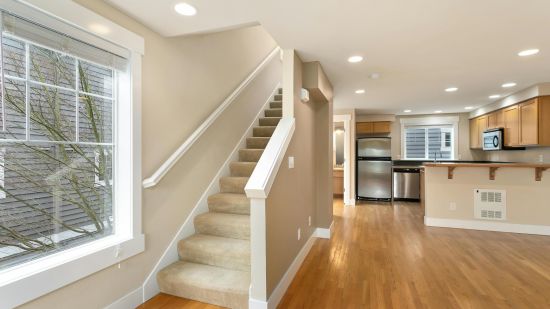
If your upstairs feels significantly hotter than your downstairs, the problem is usually caused by some combination of attic heat, poor airflow, ductwork issues or an HVAC system that is not properly balanced.
It is one of the most common comfort complaints in two-story homes. It also does not automatically mean your air conditioner needs to be replaced.
Homes near the Jersey Shore can present their own challenges. Upper floors absorb heat from the roof and attic throughout the day, while summer humidity can make bedrooms feel even warmer and more uncomfortable.
Homeowners searching for help can start with our guide to trusted HVAC companies serving Greater Long Branch.
Why Does the Upstairs Get Hotter Than the Downstairs?
Warm air naturally rises, but that is only part of the story.
The second floor also sits directly below the roof and attic, which absorb heat throughout the day. On a hot summer afternoon, an attic can become dramatically hotter than the living space below it.
If an air handler and ductwork are located in that attic, the cooling system must work inside one of the hottest parts of the home.
“In many Monmouth County homes we work in, especially two-story homes throughout Long Branch, West Long Branch, Oceanport and surrounding Shore communities, the second floor is either running off an air handler in the attic or the entire house is on a single zone that was never designed to move enough cool air upstairs,” said Casey Timorason, head of growth at Service Professionals, Inc.
“That attic can reach well over 120 degrees on a July afternoon, so the equipment and ductwork are fighting the heat all day. We ran more than 450 AC service calls this past April and May, and ‘my upstairs won’t cool’ was one of the most common complaints we heard.”
Can Poor Airflow Make the Second Floor Hotter?
Air conditioning is not just about producing cold air. The system must deliver the right amount of conditioned air to each part of the home.
If the upstairs ductwork is undersized, leaking, obstructed or poorly balanced, the second floor may not receive enough cool air. A lack of return airflow can also prevent the system from pulling warm air out of upstairs bedrooms and hallways.
This can leave the second floor feeling hot, humid or stuffy even while the downstairs remains comfortable.
According to Timorason, the problem is often related to airflow or maintenance rather than a completely failed system.
“Nine times out of 10, it is an undersized or leaky duct run, insufficient return air or a system that is low on refrigerant,” he said. “Homeowners tend to notice it most in the late afternoon and around bedtime, when the upstairs cannot catch up with the thermostat.”
Could the Attic Be Heating the Upstairs?
Poor attic insulation or ventilation can allow heat to transfer into the second floor.
Bedrooms with strong afternoon sunlight may feel especially uncomfortable. The temperature can remain elevated into the evening, even after the outdoor temperature begins to fall.
An HVAC technician can evaluate the cooling system and airflow, but homeowners may also need to consider attic insulation, ventilation and air sealing as part of the larger comfort problem.
Does Shore Humidity Make the Problem Worse?
High humidity can make an upstairs room feel warmer even when the thermostat appears to show a reasonable temperature.
An oversized AC system may cool the home too quickly without running long enough to remove sufficient moisture from the air. An aging, poorly maintained or improperly balanced system may also struggle to control both temperature and humidity.
This is one reason the size and condition of the equipment should be evaluated along with the ductwork and airflow.
Should I Close the Downstairs Vents?
Closing downstairs vents may seem like an easy way to force more cool air upstairs, but it can create additional problems.
Closing too many vents can increase pressure inside the duct system. This may reduce efficiency, increase duct leakage or place additional strain on the equipment.
A professional system-balancing evaluation is a safer way to determine whether airflow can be redirected without creating new issues.
What Can Homeowners Check First?
Before assuming the system needs an expensive repair or replacement, homeowners can check a few basics:
• Replace or clean a dirty air filter.
• Make sure upstairs supply and return vents are open and unobstructed.
• Check that furniture, rugs or curtains are not blocking vents.
• Close blinds or shades during the hottest part of the afternoon.
• Run ceiling fans counterclockwise during the summer.
• Confirm that the thermostat is working properly.
These steps will not fix every comfort issue, but they can rule out some common and inexpensive causes.
Do I Need a New AC System?
Not necessarily.
“The biggest mistake we see is a homeowner assuming that a hot upstairs means the entire system is shot and they are facing a $10,000 or $15,000 replacement,” Timorason said. “Before anyone starts talking about new equipment, we check the basics: the air filter, thermostat, supply and return vents, refrigerant charge and condensate drain.”
A clogged filter, low refrigerant charge or blocked airflow can affect a large portion of the home. Those problems may cost significantly less to correct than replacing the entire system.
Service Professionals’ internal service data also shows that many uneven-cooling complaints involve relatively young equipment.
“Of the hot-upstairs and no-cooling calls we ran this spring where we recorded the system’s age, nearly six in 10 involved units less than 10 years old. More than eight in 10 were under 15 years old,” Timorason said.
“Those are not necessarily worn-out systems. They are often systems with a fixable problem.”
When Should an AC System Be Replaced?
Age matters when evaluating whether to repair or replace an HVAC system.
“When replacement really is the right answer, age is usually a major factor,” Timorason said. “A 15- or 20-year-old unit is a different conversation. A comfort issue on a system that is only eight or 10 years old should be inspected, repaired or rebalanced before replacement is considered.”
The condition of the equipment, its repair history, efficiency and ability to cool the home should all be considered.
A reputable HVAC company should explain the available options before recommending a major investment.
How Can a Professional Fix Uneven Cooling?
Depending on the cause, possible solutions may include:
• Cleaning or replacing the air filter
• Correcting refrigerant levels
• Sealing leaking ductwork
• Improving upstairs return airflow
• Rebalancing the duct system
• Repairing damaged equipment
• Improving attic insulation or ventilation
• Adding HVAC zoning
• Replacing aging or improperly sized equipment
The right solution depends on the home.
Larger Monmouth County homes, older two-story houses, additions and finished attic spaces may each present different airflow and cooling challenges.
The Goal Is Even, Reliable Comfort
A hot upstairs affects more than the thermostat. It can disrupt sleep, make home offices uncomfortable and leave bedrooms unusable during the hottest parts of the summer.
The goal should be to identify the cause rather than immediately replacing equipment or turning the thermostat down until the first floor feels like a walk-in refrigerator.
For more information about local heating and cooling services, visit our guide to trusted HVAC companies serving Long Branch, West Long Branch, Oceanport, Deal and Oakhurst.
Service Professionals provides heating, cooling, plumbing and electrical services throughout New Jersey, including Monmouth County. Its team can evaluate uneven temperatures, airflow concerns and equipment performance to help homeowners understand whether the system needs maintenance, repair, rebalancing or replacement.
If your upstairs remains significantly warmer than the rest of your home, a professional inspection can identify whether airflow, insulation, ductwork or your cooling system is to blame.
For more HVAC maintenance tips and trusted local contractors, visit our complete HVAC guide.