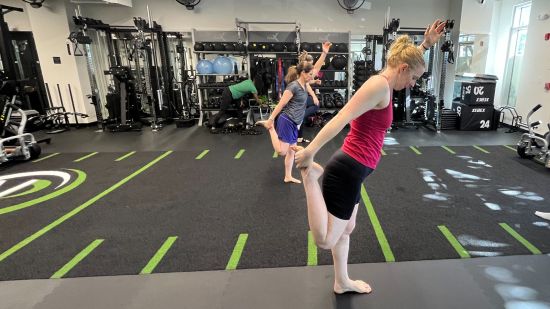
Why We Train Barefoot: Building Strength From the Ground Up
Walk into Nesfield Performance in Bethesda, Maryland, and you’ll notice something different right away: we train barefoot.
It isn’t a gimmick, and it isn’t simply about taking your shoes off. Barefoot training is part of how our personal training studio helps people move better, build foot strength, improve body awareness, and create a stronger foundation for everything they do.
Your feet are your connection to the ground. They influence how you balance, how you absorb force, and how movement travels through your ankles, knees, hips, and the rest of your body.
Yet most of us spend nearly the entire day with our feet inside shoes.
At Nesfield Performance, we believe your feet deserve to be trained too.
Foot Strength Starts With Your Foundation
The human foot is a remarkably complex structure made up of bones, joints, muscles, tendons, ligaments, and sensory receptors working together.
The small muscles located within the foot — known as the intrinsic foot muscles — help support the arch, control the toes, stabilize the foot, and contribute to balance and movement.
Research supports the importance of training these muscles for foot strength. A systematic review and meta-analysis found that intrinsic foot muscle training can positively affect the medial longitudinal arch and improve dynamic postural balance.
Think of the foot as the foundation of a house. We spend a great deal of time strengthening the larger structures above it — the legs, hips, and core — but the quality of that foundation matters too.
That is one reason we start at the ground.
The Benefits of Barefoot Training: Why Take the Shoes Off?
Shoes serve an important purpose. They protect our feet and can provide support when we need it.
But during appropriate strength and movement training, removing them allows us to challenge the feet differently.
1. You Get More Information From the Ground
Your feet aren’t just structures that hold you up. They are also sensory organs.
The bottom of the foot provides your nervous system with information about pressure, position, and the surface beneath you. When you’re barefoot, there is nothing between your foot and the floor filtering that information.
That sensory feedback can help you become more aware of where your weight is, how you’re distributing pressure, and how you’re controlling your body.
That matters whether you’re performing a squat in the gym, navigating uneven ground outside, or simply trying to maintain your balance as you age.
2. Your Foot Muscles Have to Participate
We wouldn’t expect our legs to become stronger without challenging them.
Your feet are no different.
Training without shoes can increase the demand placed on the muscles responsible for controlling and stabilizing the foot. Research on barefoot and minimalist training suggests that progressive training can produce adaptations in foot musculature and may improve aspects of stability and neuromuscular function.
A 2026 study comparing barefoot and shod lower-body training also found that both groups improved toe flexor strength, with barefoot training showing continued improvement in standing toe flexor strength over the eight-week intervention. Importantly, the researchers did not find significant differences between barefoot and shod training for most outcomes — an important reminder that barefoot training is a tool, not magic.
Our goal isn’t simply to remove your shoes.
Our goal is to teach your feet to participate in movement.
3. Barefoot Training Gives Your Coach More Information
One of the biggest benefits from a coaching perspective is that shoes can hide what the foot is doing.
When you’re barefoot, we can better observe:
How you distribute pressure through your foot
Whether your toes can spread and engage
How your arch responds under load
How your ankle moves
What happens at the foot when you squat, lunge, or balance
How changes at the foot affect movement farther up the body
That information helps our coaches determine what you need — not just what exercise you should perform.
Balance Training Starts With Your Connection to the Ground
Balance isn’t only about standing on one leg.
It’s a complex interaction between your nervous system, vision, vestibular system, muscles, joints, and the sensory information coming from your feet.
Research examining intrinsic foot muscle training has found improvements in dynamic postural balance, supporting the idea that foot function deserves a place within a comprehensive balance training program.
This becomes increasingly important as we think beyond today’s workout.
At Nesfield Performance, we train for longevity.
Strength matters. Mobility matters. Cardiovascular fitness matters. But so does your ability to confidently control your body and respond to the environment around you.
The Foot Is Connected to the Rest of the Body
We don’t look at the foot in isolation.
The body operates as a system.
If you change how someone interacts with the ground, you may also change what happens farther up the chain. That’s why our coaches pay attention to the relationship between the foot, ankle, knee, hip, and trunk during movement.
Sometimes improving a movement starts somewhere very different from where a person feels the limitation.
This philosophy is also why we don’t immediately jump into loading exercises. We want to understand how you move first.
Barefoot Doesn’t Mean “Better” for Everything
Training barefoot isn’t appropriate for every person, every exercise, or every situation.
There are times when footwear is necessary or beneficial. Certain medical conditions, injuries, training environments, and exercises may require additional protection or support.
And if you’ve spent decades wearing supportive shoes, suddenly doing everything barefoot isn’t necessarily the answer either.
Like any form of training, exposure should be intentional and progressive.
Our coaches meet people where they are and determine what makes sense based on their movement, training history, and individual needs.
What Do Your Feet Say About Your Health? Watch Tiffany on FOX 5 DC
I recently joined FOX 5 DC’s Good Day DC to discuss what our feet can tell us about our health and to demonstrate why paying attention to foot function matters. Watch the segment: “What Your Feet Say About Your Health”.
The segment highlights something we emphasize every day at Nesfield Performance: your feet provide information.
Rather than ignoring them until something hurts, we want people to understand how their feet move, feel, and interact with the rest of their body.
Personal Training in Bethesda: Start From the Ground Up
You don’t have to be an athlete to benefit from stronger, more capable feet.
You need your feet to walk. To climb stairs. To lift. To balance. To play with your children or grandchildren. To travel. To stay active. And ultimately, to continue doing the things you enjoy as you get older.
That’s why barefoot training is part of the Nesfield Performance experience.
We’re not interested in simply helping you exercise harder. We want to help you understand your body, improve how it functions, and build the strength and movement capacity you need for life.
Sometimes that starts with something as simple as taking off your shoes.
Nesfield Performance | Bethesda, Maryland | Perform Better in Life.