When your knee aches after a morning walk through the neighborhood, or your lower back tightens up after a round of golf, the natural instinct is to look right where it hurts. Ice the knee. Stretch the back. Book a massage for the shoulder.
After almost 20 years of coaching, I've learned to start somewhere else: the feet. More often than most people expect, the place that hurts is not the place where the problem started. It's simply where the body finally ran out of ways to compensate.
What Happens in the Feet Doesn't Stay in the Feet
Each foot holds 26 bones, 33 joints, and more than 100 muscles, tendons, and ligaments. Together they have two big jobs: absorbing the force of every step and turning that force into a stable, springy push-off. When they do those jobs well, everything above them gets to do its own job.
When they don't, the rest of the body picks up the slack. An arch that collapses with every step lets the shin rotate inward, which pulls the knee out of line and asks the hip to work overtime. A stiff, rigid foot can't absorb shock, so that force travels up into the knees, hips, and spine. Neither person feels it in their feet first. They feel it in the knee, the hip, or the lower back.
There is a sensory side to this, too. The soles of your feet are packed with nerve receptors that constantly tell your brain where you are in space. That information drives balance, posture, and how quickly your muscles react when you misstep on an uneven sidewalk. When that signal is dulled, from years of thick-soled shoes or simply from less movement as we age, balance and reaction time tend to slip along with it.
“Your feet are your body’s foundation to movement.”
DR. EMILY SPLICHAL, DPM, FUNCTIONAL PODIATRIST AND FOUNDER OF NABOSO
Why We Train Barefoot at Nesfield Performance
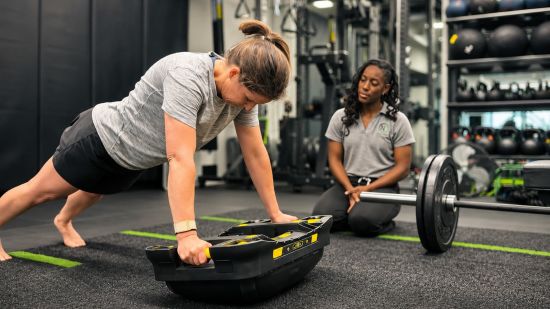
Walk into our Bethesda studio and one of the first things you'll notice is that most of our clients train with their shoes off. It isn't a trend. It's one of the most practical things we do to build strength from the ground up.
Modern shoes are wonderful for protection, but heavy cushioning and support do much of the foot's work for it. Over time, the small stabilizing muscles inside the foot get less use, and the nerve signals from the ground get quieter. Training barefoot on a safe surface reverses that. It wakes up those intrinsic foot muscles, sharpens the connection between the feet and the brain, and lets us see exactly how a client's foot moves, which we can't do through a sneaker.
It also changes how the rest of the body works. Exercises like the short foot, where you gently draw the ball of the foot toward the heel to lift the arch without curling the toes, teach the foot to stabilize itself. That stability travels upward. Dr. Splichal, whose barefoot science work shaped much of how we coach, has described the feet and core as deeply integrated, noting that
“the stronger the feet are ultimately the stronger the core and glutes are.”
DR. EMILY SPLICHAL, AUTHOR OF BAREFOOT STRONG
I shared a few of these ideas on FOX 5’s Good Day DC this summer: watch “What your feet say about your health.”
I completed Dr. Splichal's Neurosensory Specialist certification in 2022, and her approach has been part of our programming ever since. We progress every client gradually, and anyone with a medical condition that affects sensation in the feet should check with their physician first. But for most adults, a little time out of shoes each week pays off well beyond the feet.
FROM OUR CLIENTS:
“I love training barefoot because I have so much better control of my balance. I can feel my core working from the inside out, and I feel more grounded. It’s so much more satisfying.”
Kandace Needle, Nesfield Performance client
A Simple Foot Check You Can Do at Home
You don't need special equipment to get a sense of how your feet are doing. Try these in bare feet:
Big toe press: Stand tall and try to press your big toe into the floor while lifting the other four toes, then switch. If you can't separate them, your foot muscles likely need some attention.
Single-leg balance: Stand on one foot for 30 seconds near a counter for safety. If that's easy, try it with your eyes closed. A big drop-off with eyes closed points to the sensory side of balance.
Arch watch: Do a slow half squat and watch your arches. If they flatten and your knees drift inward, your foot may be setting up the knee and hip problems described above.
Shoe check: Look at the soles of your most-worn shoes. Heavy wear on one edge tells a story about how your foot is loading every step.
These checks aren't a diagnosis. If pain is persistent or doesn't improve with rest and exercise, see a qualified professional who will look at the whole picture, starting with your feet.
Learn From the Expert: Dr. Emily Splichal in Bethesda This December
This December, the Nesfield Performance Foundation is welcoming Dr. Emily Splichal, DPM, to our Bethesda studio. Dr. Splichal is a podiatrist and human movement specialist, the founder and CEO of Naboso, author of Barefoot Strong, and creator of the Barefoot Training Specialist certification used by coaches and clinicians around the world. She is flying in from Arizona for two events.
Free Community Talk: 4 Pillars to Healthy Feet & Movement Longevity
Sunday, December 6, 10:30 to 11:30 AM. Dr. Splichal will explain why our feet are the foundation for how we move and share practical ways to move better, prevent injuries, and stay active for years to come. Whether you're a runner, a weekend golfer, living with achy feet, or simply want to keep moving well as you age, you'll leave with something useful. The talk is free, but space is limited. Reserve your spot on Eventbrite.
For Professionals: Foot Posture Specialist Course
Saturday, December 5, 9 AM to 5 PM. Trainers, physical therapists, and other movement professionals can join Dr. Splichal for a full day on foot and ankle biomechanics, assessment, and wedge and posting strategies, earning the certification plus continuing education credits (NASM, AFAA, ACE, BOC, and PT state boards). Register at Naboso and select the in-person event.
Start From the Ground Up
Your feet carry you through every walk, workout, and errand, and they deserve as much attention as the knee or back that's complaining. If you're dealing with pain that keeps coming back, or you simply want to stay strong and steady for the long run, we'd love to help.
Nesfield Performance is located at 7832 Wisconsin Avenue in Bethesda, serving Chevy Chase and the surrounding DC suburbs. Book a free consultation at nesfieldperformance.com or call 240-652-2808.
About the Author: Tiffany Nesfield, CSCS, is the founder of Nesfield Performance in Bethesda and the Nesfield Performance Foundation. A former Division I track and field athlete, she has almost 20 years of coaching experience and has spent 14 years serving the Bethesda and Chevy Chase community.