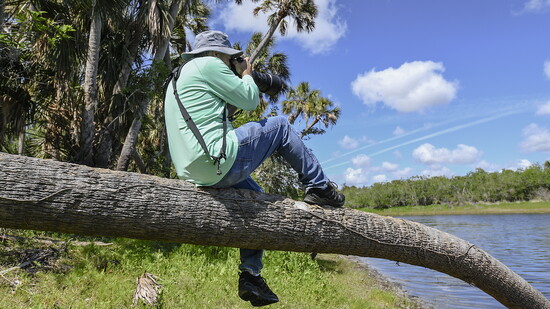
Myakka River State Park contains 58 square miles of outdoor adventure and serenity. Otters, turtles, and fish swim in the Myakka River while alligators gather in large numbers to rest on the shore, and deer, bobcats, raccoons, and more than 100 species of birds grace the subtropical forests and dry prairies. The park’s 38.9 miles of hiking trails are looped and connect with backcountry roads, enabling visitors to adapt the length of their hike to their liking or ability. An estimated 300,000 people explore the park annually, and many are inspired by what they discover in its wild Florida landscape.
Brian Glantz, local nature photographer, frequents the trails for the unique photo opportunities they present. “It’s rare to come across a place where you can get a plethora of wildlife as well as spectacular landscapes—it offers a little bit of everything,” he explained. Glantz first observed Myakka River State Park’s natural beauty through other photographers on social media and has since found community among those he encounters on the trails.
“I’ll often go up to other people with a camera—or they’ll come up to me—and we’ll have a conversation about what models, settings, or lenses we’re using, what we’re shooting, or what we’re hoping to shoot,” said Glantz. “There was a time a group of us were trying to get a shot of a barred owl and it kept landing on tree branches and flying away,” he remembered. “We would all try to get our pictures as quietly as possible while respecting each other’s space, then get in our cars and follow it to the next location.” He recalled that the shared experience of getting the sought-after shot made it even more memorable. Glantz, who teaches digital photography at Suncoast Technical College, frequently tells his students that working with other photographers is never a competition. “It’s actually an incredible way to learn the art,” he said, “whether you’ve been taking pictures for five months or 50 years.”
Glantz also enjoys moments of solitude at the park. He often tracks the call of raptors and the crackling of animals—large and small—traveling through the leafy forest and takes in the sound of the breeze as it rustles against foliage and palm fronds. He notes that one of a nature photographer’s greatest assets is being still. “It’s amazing what you can see by being patient and observant,” he said. “A bobcat may be camouflaged by the plants around it, a heron could be hidden in plain sight, or you might even walk by a beautiful flower without giving it a second look,” said Glantz.
On how far he is willing to hike to get a particular shot, Glantz said he is willing to go “50 feet or 5 miles,” depending on what he’s prepared for that day. Preparation and planning are key, especially when hiking in the Florida heat. The Florida State Parks website notes that ideal hiking seasons are late fall, winter, and early spring. Hiking in the summer presents a heightened risk of dehydration and heat exhaustion. The State Parks site also suggests hikers “always carry water, a map, and compass or GPS” and wear appropriate sturdy footwear. Other concerns include insects and flooded or overgrown trails.
Glantz is no stranger to prioritizing safety on his hikes, as his favorite subjects are also one of the park’s most volatile creatures: alligators. The park is home to hundreds of wild alligators, which can become aggressive during their May and June mating season. “It’s important to respect their space,” said Glantz. “I use my super telephoto lens to get close-ups from a safe distance,” he shared. “The detail of the scales, the eyes, the teeth, is amazing. It’s like going back in time and looking at a dinosaur.” Just as he began admiring other photographers’ work from Myakka River State Park on social media, Glantz finds that people respond strongly to the alligator photos he posts online. “Some find them stunning, others … daunting,” he said. “I’m just glad I have the opportunity to hop in the car and get these kinds of shots. That’s the beauty of living in Southwest Florida.”
In addition to one-of-a-kind photo opportunities and hiking trails, Myakka River State Park offers spaces for bicycling, birding, camping, fishing, geo-seeking, horseback riding and paddling. Visitors can also see the park from a different perspective on the Canopy Walkway, the first public treetop trail in North America. According to Florida State Parks, it “is suspended 25 feet above the ground and extends 100 feet through the hammock canopy.” It consists of two observation towers, the tallest reaching 74 feet, from which one “can look down on eagles, hawks, vultures, and the tops of live oak and sabal palm trees.”
“If you love nature, you’ll love Myakka River State Park,” said Glantz. “I have so much respect for the wildlife, and I try to convey its dignity and importance through my photographs. That’s what I hope people take away from my pictures.”