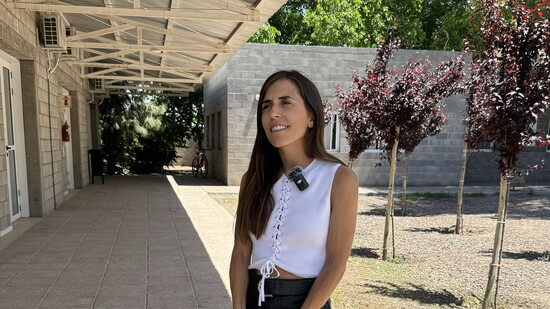
We came to Santa Julia to understand the wine.
That is, after all, why most people travel to Mendoza—for the views of the Andes and the wines that have shaped Argentina’s global reputation.
We walked the vineyards and talked irrigation and organic farming. We heard the story of a civil engineer who arrived to demonstrate an irrigation system and ended up falling in love with vines.
But one of the most defining moments of our visit happened behind the winery, where we met Julia. There, in the cultural center, she spoke with a quiet sense of ownership about building upon something her grandmother had started decades earlier.
Beyond the tasting rooms sits a place that reveals a different side of the winery. Classrooms allow employees to complete their education. A sewing workshop provides women with skills and income. A daycare brings together the children of managers and vineyard workers, their parents working just steps away.
Here, support for families is not a separate program. It is part of how the work is done.
To understand why, you begin with Emma.
Emma Zuccardi worked at the winery until she was 94, always focused on the people around her. Many vineyard families had limited access to education or left school early to support their households. Emma believed the way to change that reality was not through charity, but opportunity.
“She always said we shouldn’t just give people money,” Julia explained. “We should give them tools to improve their quality of life. Education was the first step.”
The cultural centers grew from that philosophy, allowing employees to complete their studies during working hours. Emma also saw that many spouses of vineyard workers, most often women, had few opportunities to develop a profession of their own. Sewing workshops began as training programs and gradually evolved into independent work and additional income for families.
The same thinking shaped the daycare. For families working far from town centers, childcare can be one of the biggest barriers to stability. The solution was simple: bring it closer to where people work.
“In many places, women have to choose between motherhood and their professional lives,” Julia said. “Here they don’t have to make that choice.”
The values behind these programs reach further back in the family’s story.
Julia’s grandfather, Alberto Zuccardi, arrived in Mendoza as a civil engineer developing irrigation systems in a desert climate where water is scarce. To demonstrate the system he was selling, he purchased a small piece of land. That demonstration vineyard became the foundation of the winery.
“He always said that because we depend on nature, we are responsible for giving back what we take from it,” Julia said.
That philosophy guided the family long before organic certification became common. Today, farming practices reflect that same principle.
When Julia speaks about sustainability, she broadens the definition.
“When people talk about sustainability, they often think only about the environment,” she explained. “But for us it has always meant both—land and people.”
Julia did not originally plan to work in the wine industry. She began working at the winery during summer holidays as a tour guide. Over time, the experience shaped her path.
“We were always free to choose what we wanted to do,” she said. “No one forced us to work here.”
That sense of choice continues to shape the family’s involvement today.
Innovation remains part of the culture, but not every idea succeeds.
“When you try new things, sometimes they don’t work,” Julia said. “But we like to challenge ourselves and keep learning.”
When asked what she hopes the winery will be known for in the future, her answer is simple.
“I hope we will be remembered as a winery that grew while staying true to its values,” she said. “A winery that respected the land and cared for its people.”
Behind the winery, classrooms fill during the workweek. Sewing machines hum. Children spend their day close to where their parents work.
In the end, the story is not only about what is produced from the land, but about the people who grow alongside it.
Idaho Women Shaping Wine
Leadership Rooted in Growth
As women shape wine regions around the world, Idaho’s industry is being influenced by a new generation of leaders building something of their own.
Meredith Smith, winemaker at Ste. Chapelle and Sawtooth Winery, sees that momentum firsthand.
“From winemaking to vineyard management to marketing and leadership, women are playing a major role across the industry,” Smith says.
For Smith, Idaho’s youth as a wine region is an advantage.
“Idaho is still a young industry, but it has incredible growth potential,” she says. “We’re already seeing national recognition, which speaks to both the talent here and the quality of the fruit.”
“Learning from other regions has shaped how I approach winemaking,” she adds. “It’s about asking why, staying connected, and continuing to raise the bar.”