From craft beer to clean food, these Denver women are shaping the businesses and spaces we love. Meet the founders turning bold ideas into thriving ventures. Their stories reveal what it really takes to build something lasting from the ground up.
The Art of Slowing Down: Ariana Barnstable's Lazy Cowgirl
Ariana Barnstable built an art practice that prioritizes peace. That's exactly what happened when she started painting boots for a costume designer one summer in Steamboat Springs, and the Lazy Cowgirl, part self-portrait and part collective daydream, rode onto the canvas and never left.
"She is a reflection of the envisioned life I would like to live," Barnstable says, "a version of a woman who values her peace." Born from the wide-open spirit of the West, the Lazy Cowgirl has since traveled everywhere Barnstable goes, showing up in gallery installations from Mollie Aspen to The Ramble, always living, as she puts it, her best life in beautiful settings.
For Barnstable, "lazy" isn't a flaw to correct but a philosophy to reclaim, an invitation to marinate in slow moments in a culture that treats rest as taboo. That same instinct for intentional living shapes her work off the canvas, too. As artist-in-residence at EDIT in Denver's RiNo district, she's built a hub for women artists, hosting dinners, market pop-ups, and rooftop parties that turn a solitary practice into a shared one.
Her advice to young artists moving to Denver? Believe in yourself past the point of reason—the city tends to show up for those who ask.
Steph Lindsey: Urban Sanctuary + Black Unicorn Collective
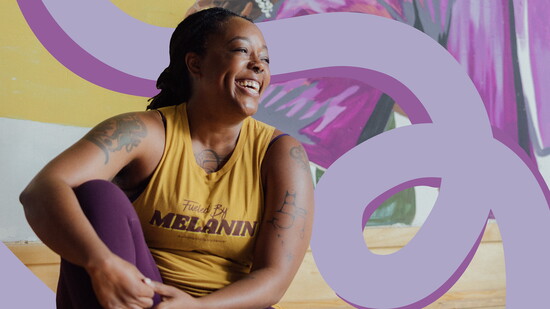
For this Urban Sanctuary teacher, the path to founding her own wellness company began as a whisper. By early 2020, after nearly 14 years as an art educator and photography professor, she was ready to teach yoga more seriously and set her sights on a studio built to center Black, Indigenous, and Global Majority practitioners. She found it at Urban Sanctuary, in Denver's Historic Five Points neighborhood, right as the pandemic sent the world home, teaching her first classes over Zoom, fear of being seen and all.
Urban Sanctuary is the only Black woman-owned yoga and wellness studio in the state. Founded in 2016 by Ali Duncan (currently on sabbatical in Southeast Asia), the studio gives teachers of the Global Majority space to bring therapeutic modalities like Yoga Asana, Reiki, and Meditation to communities long excluded from them, anchored in pillars of Authenticity, Community Care & Social Justice, Cultural Wisdom, Accessibility, and Transformation. The studio treats wellbeing as inseparable from justice, framing its work as liberation rather than indulgence. New visitors can try a month of unlimited classes for $77, or a week for $13, and the studio's nonprofit arm accepts donations supporting therapy work in Black and Indigenous communities of color.
That leap eventually carried Steph fully into yoga in 2025, focusing on building up Black Unicorn Collective, a space, she says, "born to honor the brilliance, resilience, and labor of Black women before me and around me." Drawing on Audre Lorde's teaching that self-care is self-preservation and political warfare, she frames wellness not as indulgence but as lineage, an inheritance reclaimed through meditation, movement, stillness, and storytelling.
Her creative process runs on instinct rather than routine. A self-described "mercurial air sign," she does her best thinking between 11:30 p.m. and 3:30 a.m., and gravitates toward collaborators willing to try, fail, and treat the failure as research. Off the mat, recharging looks like solitude: journaling, cooking, or an unglamorous dance party while watering her plants, always with music playing. Her curiosities run wide too. TED Talks, Vedic philosophy, African cosmology, and space, each feeding the same hunger for connection between ancient wisdom and daily life.
Find Steph's virtual offerings and upcoming retreats at TheBlackUnicornCollective.com, or catch her teaching Tuesdays, Thursdays, and Saturdays at Urban Sanctuary.
Melinda Tarbell: Two Decades of Style, One Vintage Find at a Time
After 20 years styling major campaigns for brands like PACT, New Balance, HOKA, and Volkswagen, to name a few, Melinda Tarbell has built a second career that mirrors her first: FOUND Vintage, a sustainable clothing project where every vintage piece in her curated pop-up shop is hand-selected by her alone.
The idea had been percolating for a decade before Melinda finally launched it. The push came after relocating from Los Angeles to Colorado, in the middle of grief following her father's death. "I heard the whisper of my dad's advice, 'You can't make a mistake,'" she says. "So I shifted my mindset from maybe someday to how about now."
The two worlds, she says, feed each other. Styling is her passion and keeps her eye attuned to current trends as she works with global brands to advertise their products; FOUND gives her a playground for her own creative direction. Sourcing trips built around brand photoshoots double as scouting missions, which is part of why the shop reads less like a straightforward rack and more like a traveled map, full of pieces gathered on the road.
That instinct for curation shows up in how FOUND presents its finds: in themed capsule collections rather than a flat shop grid. One recent example is the FOUND Vintage "Old School Edit." The concept was born from a single 1990s Tommy Hilfiger button-up shirt that sparked the visual direction for the early Fall campaign. When curating the FOUND collections, Melinda is drawn towards natural fabrics and quality construction. At FOUND Vintage, you will always find a range of price points so sustainable dressing stays accessible to her customers.
The hardest part of the job may be restraint. "There are pieces I find when sourcing that I fall in love with," she admits, sometimes hoping an item won't fit so she isn't tempted to keep it. However, watching a client light up in a vintage piece of clothing with real history is worth the sacrifice, she says. Proof that these FOUND Vintage treasures deserve a new chapter.
Finding Andrea More: Megan Falley on Grief, Poetry, and What Doesn't Suck
After her 2018 collection, Drive Here and Devastate Me, Megan Falley was working mostly in prose and memoir, certain that was where she would stay. Then Andrea Gibson, her partner of nearly a decade and the beloved poet behind the blog Things That Don't Suck, died after a long cancer journey. The first thing Falley wrote afterward was a poem.
She calls these bursts "poetry emergencies," moments when a feeling or image strikes so hard she has to grab a pen before it disappears. It is a fitting description for grief itself, at once fleeting and permanent, small in form but bottomless in what it holds.
Falley has continued Andrea's blog since their death, describing the work as a kind of continuation rather than a memorial. She writes through Andrea's lens now, processing her own life through the question of what doesn't suck. It feels, she says, like keeping someone alive. She could not keep the breath in Andrea's lungs, but she can keep their words moving through the world.
Much of that world was built here, in Boulder and the foothills around it. Coot Lake, the Boulder Reservoir, Chautauqua Park, and the Sanitas Valley Trail all carry pieces of the life she shared with Andrea and their three dogs: Squash, Idgie, and Winnebago.
Their relationship is now the subject of a documentary streaming on Apple TV+, and Falley hopes viewers take away something beyond illness. The joy in their story was not separate from the cancer, she says. It was sharpened by it. Andrea's final years held laughter, devotion, and an almost athletic commitment to being alive.
"I also hope people, especially women, understand what a waste it is to spend our lives hating our bodies for how they look," Falley says. "A living body is not an aesthetic problem to solve. It is the place where every joy we will ever experience gets to happen. And, if we're lucky, every grief, too."
For Falley, that same refusal to treat pain as something separate from life extends to grief itself.
"Grief is a very welcome feeling for me," she says. "It feels so close to love, and so close to connection. It keeps me in relationship with Andrea rather than outside of it, so I never wish it away. I fear the end of grief. I hope to be in my eighties, crying over Andrea, while an onlooker mistakes it for fresh hurt, and I open my mouth to tell them an old story.
"That doesn't mean I won't be dancing, unraveling in laughter, or running into the ocean a minute after crying. My grief and my utter elation at being alive exist side by side, quite comfortably, really. Taking turns. Even holding hands."
AndreaGibson.Substack.com/p/The-Only-Thing-We-Have-Control-Over
Chantel Columna’s Novel Strand
The idea for Novel Strand Brewing Company started over a few pints and a game of shuffleboard. Chantel met her now-husband and business partner Tamir, along with co-founder Ayana, at Rensselaer Polytechnic Institute in Troy, New York. Between rounds at their favorite local bar, the three joked about one day opening a brewery together while dabbling in homebrewing on the side.
A 2014 trip to Denver turned the vision into a plan. Chantel and Tamir fell for the city and Colorado's outdoor life, and by fall 2015 they had moved west to chase it. Novel Strand Brewing Company officially formed in July 2016, and after collaborating with established breweries to build a following before they even had a taproom, the doors opened in the summer of 2018 in Denver's Historic Baker Neighborhood.
The name came from Tamir's background in biochemistry, landing on something that captured the brewery's spirit: changes in DNA aren't good or bad, just different. That philosophy became the brand.
Chantel's role has always been running the business rather than making the beer, and ask her what she's most proud of, and she points to the community she built around it. She started the brewery's book club, now in its fifth year and grown to five groups across different genres, along with a run club now in its second year. Both have become gathering points for the neighborhood.
Coming from construction and civil engineering, Chantel was used to being one of the only women in the room, and craft beer wasn't so different. Early on, suppliers sometimes assumed Tamir was the sole owner or directed decisions to him by default. Tamir made a point of keeping her in every conversation, and Chantel never let the assumptions slow her down. Nearly a decade in, the brewery has grown from beer alone into a full bar and espresso program, proof of how far that persistence has taken them.
Four Generations Strong: The Women Keeping Pacific Mercantile Alive
At Sakura Square in Denver, Pacific Mercantile has weathered 83 years of change, including internment camps, shifting neighborhoods, and now a new wave of redevelopment. Through it all, the store has stayed in the hands of one family, and today it's being carried forward by a mother and daughter writing the next chapter together.
Jolie Noguchi stepped into the role of matriarch after her own mother passed away, inheriting not just a business but a responsibility to preserve decades of values and hard-won resilience. She credits her brothers and extended family for helping her find her footing during that transition, and says the work ethic her mother instilled is what keeps her showing up every day.
Now Jolie is watching that legacy pass again, this time to her daughter Alyssa, who left a career in fashion merchandising to return to the store full-time after her grandmother's death. Alyssa says she'd always felt connected to Pacific Mercantile, having worked there on and off her whole life, but it was watching her mother struggle to manage everything alone that pushed her to commit fully. She describes the decision as one her mother never pressured her into, letting her arrive at it on her own terms.
Working side by side hasn't been without friction. Alyssa pushes her mother to embrace new technology, something Jolie admits she resists, while Jolie encourages her more reserved daughter to step into the outgoing, people-first role the business demands. Still, both agree on the fundamentals: treating employees like family, greeting each day with warmth, and using the store's platform to educate customers about its history.
As Sakura Square heads toward redevelopment, both women are focused on the balance between honoring the past and building for the future. They hope to preserve the store's round front window, a symbol of unity and the cycle of life, along with the close-knit, family feel that has defined Pacific Mercantile for generations. Their goal is for the store to remain a hub not just for the Japanese American community, but for Denver as a whole, for decades to come.